
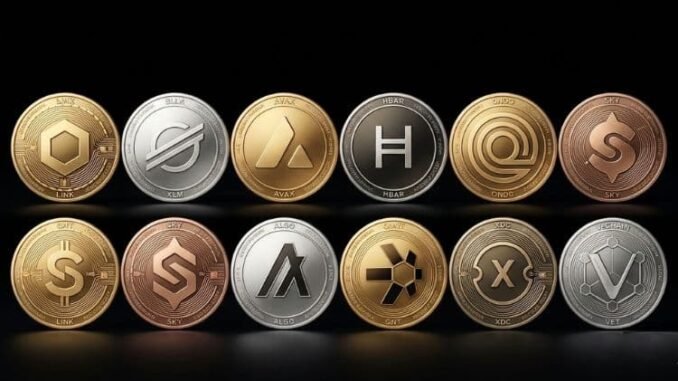

The real-world asset (RWA) tokenization sector has become one of the most closely watched areas in the digital asset industry. Over the past two years, the conversation around blockchain utility has gradually shifted away from speculation and toward practical financial infrastructure.
As a result, cryptocurrencies connected to tokenized assets, institutional settlement systems, and blockchain-based financial rails are attracting increasing attention in 2026.
The idea behind RWA networks is relatively simple. These blockchain networks aim to connect traditional financial assets such as bonds, payments, commodities, invoices, treasury products, and settlement systems to decentralized infrastructure. Instead of focusing solely on crypto-related utility, these projects aim to bridge digital networks and real economic activity.
Why Are Real-World Asset Tokens Gaining Traction in 2026?
The RWA tokens are receiving increased attention in 2026 because of the growing adoption of rails that bring traditional finance on-chain. Coins that give exposure to this emerging narrative have benefited from the hype, as market users increasingly seek ways to invest in the tokenization sector in its early stages.
Notably, the RWA sector has continued to expand in 2026. The value of the total tokenized assets distributed on blockchains has exceeded $33.8 billion, as real-world assets appear to have found a new abode.

Meanwhile, this traction is largely due to traditional financial institutions becoming more comfortable with blockchain infrastructure. Major asset managers, payment firms, and banking institutions are increasingly experimenting with tokenized financial products, stablecoin settlements, and blockchain-based liquidity systems.
Another major factor is regulation. Several jurisdictions introduced clearer frameworks for tokenized securities and blockchain settlement systems over the past year. One of the most recent breakthroughs is the expected innovation exemption guideline that the US SEC will issue, which will support securities tokenization on blockchains. Such clarity has encouraged more traditional firms to test blockchain infrastructure without the uncertainty that previously slowed adoption.
The increasing attention to the RWA sector is now being reflected in tokens tied to this sector. As the investor interest grows, we have highlighted the top 10 RWA tokens by market cap in today’s market.
Top 10 RWA Crypto Tokens by Market Cap in 2026
| Rank | Token | Current Price | Market Cap | Main Focus |
|---|---|---|---|---|
| 1 | Chainlink (LINK) | $9.80 | $7.15 billion | Oracle infrastructure and tokenized asset connectivity |
| 2 | Stellar (XLM) | $0.1480 | $4.96 billion | Cross-border payments and financial settlement |
| 3 | Avalanche (AVAX) | $9.53 | $4.17 billion | Institutional blockchain infrastructure |
| 4 | Hedera (HBAR) | $0.090 | $3.9 billion | Enterprise-grade distributed ledger systems |
| 5 | Ondo (ONDO) | $0.409 | $1.95 billion | Tokenized treasury and financial products |
| 6 | Sky (SKY) | $0.0707 | $1.643 billion | Decentralized financial infrastructure |
| 7 | Algorand (ALGO) | $0.115 | $1 billion | Tokenization and payment rails |
| 8 | Quant (QNT) | $73.8 | $891 million | Blockchain interoperability |
| 9 | XDC Network (XDC) | $0.0345 | $710 million | Trade finance and enterprise settlement |
| 10 | VeChain (VET) | $0.0067 | $579 million | Supply chain and logistics tracking |
Chainlink (LINK)
Chainlink is the largest RWA-focused crypto project by market capitalization. The network plays a major role in connecting blockchain systems to off-chain financial data, a role that has become increasingly important as tokenized assets expand across multiple chains.
Its Oracle infrastructure is now widely used in tokenized finance applications. Its cross-chain interoperability protocol (CCIP) has also gained massive adoption, with SWIFT, Coinbase, and SBI Digital among major users.
LINK trades at $9.80, with a market cap of $7.15 billion. Although it is down 19% year-to-date, analysts expect it to finish the year stronger. The asset could realistically reach $15 before the end of 2026.
Stellar (XLM)
Stellar positions itself as a blockchain focused on payments and low-cost international settlement. Yet its high-speed, institutional-grade security and scalability have led to widespread adoption in the tokenization industry.
Currently, Stellar has over $2.4 billion in distributed and represented RWAs tokenized on its network, up an impressive 11% over the past 30 days. It also has a 30-day transfer volume of $275.5 million, with the US Treasuries being the most tokenized asset class on its platform.
Its native token, XLM, trades at $0.148, down 26% since January 1, and has a market cap of $4.96 billion. Realistically, the coin could reach $0.220 before the end of 2026, an increase of over 50% from the current price.
Avalanche (AVAX)
Avalanche has increasingly attracted institutional attention because of its customizable subnet architecture. Financial firms experimenting with tokenized products have shown interest in Avalanche due to its scalability and relatively fast transaction processing.
Data show that over $1.8 billion in RWAs are live on Avalanche, the ninth largest among all networks. $1.2 billion RWAs are distributed on Avalanche, while $678 million is represented.
Price-wise, AVAX trades at $9.53 with a market cap of $4.17 billion. In a conservative scenario, the token could reach $12 this year.
Hedera (HBAR)
Hedera has carved out a niche through enterprise partnerships and a corporate governance structure. The network has consistently emphasized business adoption, compliance-friendly infrastructure, and enterprise-grade settlement systems.
In February, Hedera ranked top in RWA blockchain development activity, reflecting its major role in facilitating the integration of physical assets into blockchain infrastructure. Its low-cost, high-speed setup is tailored to institutions to tokenize real-world assets on-chain.
At press time, HBAR trades at $0.09 and has a market cap of $3.9 billion. Should momentum escalate, the token could hit $0.204 before the end of 2026.
Ondo Finance (ONDO)
Ondo has become one of the fastest-rising RWA projects due to its focus on tokenized treasury products and blockchain-based financial instruments. The platform has gained visibility as its tokenized yield-bearing products continue attracting institutional attention.
Ondo has issued over $3.85 billion in tokenized assets, the majority of which are US Treasuries. The platform offers US dollar yields and short-term US government bonds, which are two of its biggest products.
ONDO changes hands at $0.409, up 14% YTD. With its strong adoption, the coin could trade at $0.63 by the end of this year on a conservative scenario.

Sky (SKY)
Sky has built a decentralized financial infrastructure tied to tokenized systems and digital settlement layers. Its ecosystem ranks among the largest decentralized finance systems that incorporate traditional finance to generate yield for holders.
SKY trades at $0.070, up 22% since the start of the year. Projection places the token near $0.09 in 2026.
Algorand (ALGO)
Algorand remains active in tokenization initiatives and blockchain payment infrastructure. The project has maintained a strong reputation for transaction efficiency and low network costs.
Currently, over $99 million in real estate has been tokenized on Algorand, with the total tokenized asset exceeding $400 million. Its Algorand Standard Asset (ASA) framework makes onboarding easy, allowing users to tokenize directly on the network’s layer.
ALGO, its native token, trades at $0.115 with a market cap of $1 billion. Projections suggest a slight increase to $0.12 for the coin before the end of 2026.
Quant (QNT)
Quant focuses primarily on interoperability between blockchain systems and traditional financial infrastructure. As institutions increasingly use multiple blockchain networks simultaneously, interoperability solutions have become more important.
The platform uses its Overledger OS to make interoperability easy, securely connecting RWA protocols. Notably, the European Central Bank selected Quant as a pioneer partner last year for its digital Euro project.
QNT trades at $73.8, up 6% this year. If adoption escalates, the coin could reach $115 on a conservative basis.
XDC Network (XDC)
The XDC Network targets the trade finance and enterprise settlement markets using its Delegated Proof-of-Stake (XDPoS) consensus. The project has positioned itself around document verification, cross-border business payments, and tokenized financial workflows.
RWAs over $17 million have been distributed on the XDC network, with its stablecoin market cap exceeding $72.7 million.
At press time, XDC trades at $0.0348 with a market cap of $710 million. The coin could reach $0.0735 realistically before the end of 2026.
VeChain (VET)
VeChain is a blockchain-as-a-service (BaaS) network, heavily focused on supply chain verification and logistics tracking. While it does not directly tokenize assets, it specializes in tracking and verifying RWAs using the Internet of Things (IoT).
VET trades at $0.0067 with a valuation of $579 million. Projection places the coin at a realistic target of $0.0072 by the end of 2026.
How Do RWA Tokens Work?
RWA tokens function by representing real-world financial or economic value on blockchain networks. In some cases, these tokens represent ownership rights tied to physical assets such as real estate, commodities, or invoices. In other situations, they help facilitate payment systems, settlement layers, or financial data infrastructure.
Many RWA networks also act as the technological foundation for tokenized products issued by financial firms. Instead of relying entirely on traditional banking rails, institutions can use blockchain systems to move value more efficiently and transparently.
Some projects also focus on tokenized treasury products, while others specialize in data infrastructure, interoperability, or institutional settlement systems. Despite their differences, most RWA tokens share the broader objective of connecting blockchain technology with traditional financial activity.
Benefits of Investing in RWA Crypto Coins
One reason many market participants are paying closer attention to RWA crypto coins is that the sector has practical financial use cases. Several projects are already working with payment companies, asset managers, or enterprise software providers, with prominent market participants projecting that the sector will be worth trillions of dollars in the future.
Another advantage is diversification within the broader crypto sector. While meme coins and highly speculative tokens often depend heavily on social momentum, RWA-focused projects may benefit from institutional adoption trends and expanding tokenization markets.
The sector could also benefit from the broader shift toward digital financial infrastructure. As tokenized assets become more common globally, blockchain networks capable of supporting such systems may continue to gain relevance.
Risks to Consider Before Investing in RWA Tokens
Despite the optimism surrounding tokenized assets, the RWA sector still faces important challenges. Regulation remains one of the biggest uncertainties. Although some regions have introduced clearer rules, global regulatory standards remain inconsistent.
Another issue involves scalability and adoption speed. Many tokenization initiatives are still relatively early-stage, and it remains unclear how quickly traditional financial systems will fully integrate blockchain infrastructure.
Competition also remains intense. Multiple blockchain networks are attempting to position themselves as the preferred infrastructure for tokenized finance, payments, and institutional settlement. As such, not every project will succeed in the long term.
Security risks, smart contract vulnerabilities, and broader crypto market volatility also continue affecting the sector. Even fundamentally strong projects can experience significant declines during periods of macroeconomic uncertainty.
How to Buy RWA Crypto Coins
Most leading RWA cryptocurrencies are available on major centralized crypto exchanges. Users typically begin by creating an account, completing identity verification, and funding it with fiat currency or stablecoins.
After purchasing tokens, some users choose to store their assets on exchanges, while others transfer them to self-custody wallets for additional security. Hardware wallets remain one of the most common storage solutions for long-term holders.
Before purchasing any RWA crypto asset, it is important to research the project’s utility, institutional partnerships, tokenomics, and long-term roadmap. While the sector is attracting attention in 2026, individual projects can still perform very differently depending on adoption levels and broader market conditions.
For more on Crypto news today and the latest crypto price prediction updates, visit our dedicated coverage hub
DisClamier: This content is informational and should not be considered financial advice. The views expressed in this article may include the author’s personal opinions and do not reflect The Crypto Basic opinion. Readers are encouraged to do thorough research before making any investment decisions. The Crypto Basic is not responsible for any financial losses.



Be the first to comment