

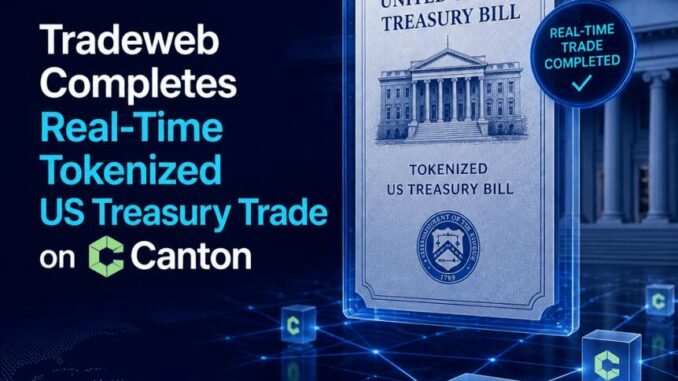

Tradeweb has carried out an onchain trade that pairs tokenized US Treasuries with tokenized cash, using Franklin Templeton as the seller of a tokenized Treasury security and Virtu Financial as the buyer. The execution reportedly took place over the Canton Network, with the companies saying settlement was completed in real time.
The deal is positioned as an industry milestone because it settles a tokenized Treasury against USDCx, a USDC-backed stablecoin issued on Canton. While the parties did not disclose the trade size, the firms framed the transaction as a practical step toward broader tokenized Treasury market infrastructure—particularly as major back-office plumbing, including DTCC’s planned tokenization services, moves closer to launch later this year.
Key takeaways
- Tradeweb executed a real-time onchain purchase-and-sale of a tokenized US Treasury settled against USDCx on the Canton Network.
- Franklin Templeton transferred the tokenized Treasury to Virtu Financial in exchange for tokenized cash, with Canton Network handling settlement synchronization.
- The trade is described as the first real-time purchase and sale of a tokenized US Treasury against USDCx, according to a Tradeweb spokesperson.
- The timing matters ahead of DTCC’s planned Tokenization Services rollout later this year.
- The transaction underscores how tokenized government bonds are moving from pilots toward production-style workflows.
A tokenized Treasury trade, settled in real time
According to the companies involved, Tradeweb served as the execution venue and source of price discovery for the transaction. Canton Network, meanwhile, coordinated settlement between the tokenized Treasury security and the tokenized cash leg of the trade.
Tradeweb and its counterparties said the trade settled in real time, though the exact notional amount was not released. Execution and settlement roles are often separated in traditional market structure; this type of workflow highlights how tokenization can compress those steps—at least within a controlled network environment—by linking asset and payment rails directly to the same settlement layer.

In a statement provided to Cointelegraph, a Tradeweb spokesperson said the transaction marked what they described as the industry’s first real-time purchase and sale of a tokenized US Treasury settled against USDCx, a USDC-backed stablecoin issued on Canton. Participants included Blockdaemon, Digital Asset, Societe Generale, Franklin Templeton, Tradeweb, and Virtu Financial.
Why the USDCx pairing is meaningful
The stablecoin used for settlement is not a minor detail. In tokenized Treasury markets, the “cash leg” is where many of the operational and compliance questions tend to concentrate: liquidity management, settlement finality, and how the payment instrument fits existing controls.
By explicitly citing settlement against USDCx on Canton, the firms are signaling that tokenized Treasuries can be paired with a stablecoin payment instrument on-chain—without requiring the buyer and seller to rely solely on separate off-chain cash processing. That matters for investors and trading desks because it can reduce settlement friction and shorten the path between trade execution and cash/asset finality, which are often decisive factors in institutional adoption.
At the same time, it remains important to watch how broadly these rails can scale beyond a limited set of participants. Real-time settlement claims are most meaningful when replicated across more counterparties, varied liquidity conditions, and larger volumes. The transaction size was not disclosed, leaving market participants to interpret the operational significance rather than the economic scale.
DTCC tokenization services as the next infrastructure milestone
The onchain trade also arrives ahead of a separate but related development: DTCC’s planned Tokenization Services later this year. DTCC has said the offering will enable participants to tokenize select stocks, exchange-traded funds (ETFs), and US Treasury securities while maintaining “the same investor protections and ownership rights as traditional assets,” according to DTCC’s published materials.
In practice, DTCC’s role is often associated with standardizing and simplifying settlement and custody workflows across the industry. If DTCC’s services deliver interoperable tokenization capabilities, they could help bridge the gap between isolated tokenization efforts and wider market participation. That makes Tradeweb and Canton’s transaction more than a standalone experiment—it can be read as preparation for a future where more participants can connect through shared tokenization infrastructure.
What remains uncertain is how DTCC’s approach will interact with existing tokenized Treasury ecosystems, including the specific stablecoin-based cash rails used for settlement. The Tradeweb/Canton transaction shows one functional pathway; the industry will likely be watching whether DTCC supports similar settlement models and whether cash and asset tokenization can be standardized across networks and venues.
Franklin Templeton’s wider tokenization push
This latest transaction fits into Franklin Templeton’s ongoing expansion of tokenized financial assets. Earlier this year, the asset manager partnered with Binance to let institutions use tokenized money market fund shares as trading collateral while keeping the underlying assets in regulated custody. Franklin Templeton has also partnered with Ondo Finance to bring tokenized ETFs onto blockchain networks, pointing to a broader strategy of onboarding institutional use cases through established market counterparties and custody frameworks.
The Treasury segment has been gaining attention alongside money markets and tokenized funds, in part because sovereign debt is often viewed as a foundational asset class for stable, yield-bearing tokenization strategies. While this does not automatically mean tokenized Treasuries will displace traditional Treasuries in size, each successful onchain settlement test reduces uncertainty about whether tokenized ownership can be operationally viable.
Governments and market data: tokenized sovereign debt keeps growing
Tokenized government bond efforts are not limited to the private sector. Several jurisdictions have launched blockchain-based initiatives to test issuance, settlement, and market infrastructure for sovereign debt.
Hong Kong was among the early movers, launching an inaugural digital green bond in 2023 and completing its third digital green bond issuance in November 2025, according to Hong Kong Monetary Authority announcements. Separately, the HKMA has said it will build a digital asset platform to support issuance and settlement of tokenized bonds, with plans to expand the infrastructure to other digital assets and connect with tokenization platforms across the region.
In the UK, the government appointed HSBC Orion to support its Digital Gilt Instrument pilot, designed to test blockchain-based issuance, settlement, and secondary trading of government bonds.
Meanwhile, on-chain Treasuries have reached significant scale in tokenized form. Data from RWA.xyz cited in the announcement places the tokenized US Treasury market at $14.6 billion, spanning 84 on-chain products and representing the largest segment within the tokenized real-world assets market.
Taken together, the picture that emerges is one of gradual maturation: policy pilots are exploring the mechanics of tokenized sovereign debt, while institutional market players are running increasingly production-like trades that validate execution and settlement workflows. The Tradeweb–Franklin Templeton–Virtu Financial transaction adds a concrete “cash + asset” settlement example—one that is particularly relevant for traders and custodians who need clarity on how stablecoin-based settlement can function alongside tokenized Treasuries.
Next, investors and market participants should watch for how DTCC’s forthcoming Tokenization Services change the connectivity and standardization of tokenized Treasuries settlement, and whether real-time USDCx-based settlement models prove replicable across more counterparties and larger volumes.



Be the first to comment