



Canadian financial institutions are investing heavily in digital identity verification, but Toronto-based TrueDoc believes many are overlooking another vulnerable part of the application process: the documents used to support financial decisions.
TrueDoc is building a document-forensics platform designed to identify signs of manipulation in bank statements, paystubs, tax records, invoices, identity documents, PDFs and screenshots.
The bootstrapped company began development in Toronto in October 2025 and received its first payment in May. It has since grown to 40 paying customers and 1,500 free users, with 32 of its paying customers joining in July alone.

Founder and CEO Andrii Patiutka says generative AI has made creating convincing fraudulent documents faster and more accessible.
“A realistic paystub, bank statement, invoice or identity document once required design skills, specialized software and a considerable amount of time,” Patiutka said. “Today, a professional-looking document can be created or altered in minutes and reproduced at scale.”
Patiutka, a Ukrainian founder with a background in infrastructure and cybersecurity, was also motivated by meeting people in Ukraine and Canada who had been affected by fraud.
“Hearing their experiences showed me that fraud is not simply a technical problem,” he said. “It can take away someone’s savings, damage trust and leave people feeling unsafe long after the financial loss itself.”
TrueDoc is intended to complement identity-verification, KYC, lending and fraud-prevention systems rather than replace them. While identity technology may establish who an applicant is, TrueDoc examines whether the documents submitted by that applicant can be trusted.
The platform analyzes several layers of forensic evidence, including PDF structure, metadata, mathematical inconsistencies, visual alterations, screenshot indicators and conflicts between embedded text and what appears on the rendered page.
Consider a paystub on which someone changes the visible net-pay amount from $1,850 to $4,850. An optical character recognition system could correctly extract the altered amount, employee name and employer without identifying anything unusual.
TrueDoc could instead find that the original amount remains in the PDF’s embedded text layer, that the new figure does not reconcile with deductions or year-to-date totals, or that its spacing and rendering differ from the surrounding text.
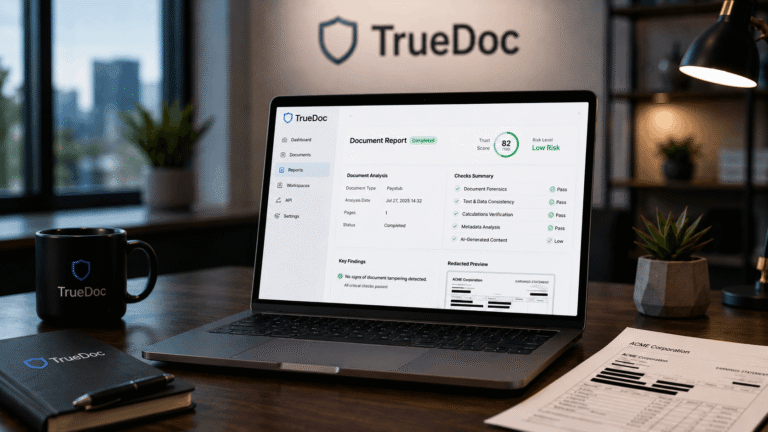
The platform evaluates those signals together and produces an explainable report identifying why the document may require further review.
“A single metadata anomaly or formatting difference is not treated as proof of fraud,” Patiutka explained. “Legitimate documents are often converted, compressed or processed through multiple systems. The concern becomes stronger when several independent inconsistencies point in the same direction.”
Customers currently access TrueDoc through a hosted web platform. After uploading a document, users generally receive a trust assessment, risk level and list of forensic findings within 120 seconds.
The company says original documents are deleted after analysis rather than permanently stored. TrueDoc retains a redacted forensic report and the findings required to understand the result, reducing the amount of sensitive financial and identity information held by the platform.
Business customers can also access shared workspaces with team roles, review histories and audit information. TrueDoc is developing an API, batch-processing tools and webhook capabilities for organizations that want to incorporate document analysis directly into onboarding, underwriting, claims or compliance workflows.
TrueDoc’s first Canadian institutional user is a Manitoba credit union. The company has also attracted customers in the United States, United Kingdom, Australia, the Netherlands, Sweden, Brazil, Hungary, India, Malaysia and New Zealand.
Having bootstrapped its development and early operations, TrueDoc is now beginning conversations with investors. Funding could help accelerate enterprise integrations, security and compliance work, independent validation and business development.
The company’s next priorities include completing its API and batch-processing capabilities, supporting additional document types and working with more Canadian credit unions, lenders, insurers and tenant-screening providers.
“As AI makes document fraud faster, cheaper and easier to scale, we believe verification must become both more forensic and more privacy-conscious,” Patiutka said.


Be the first to comment