

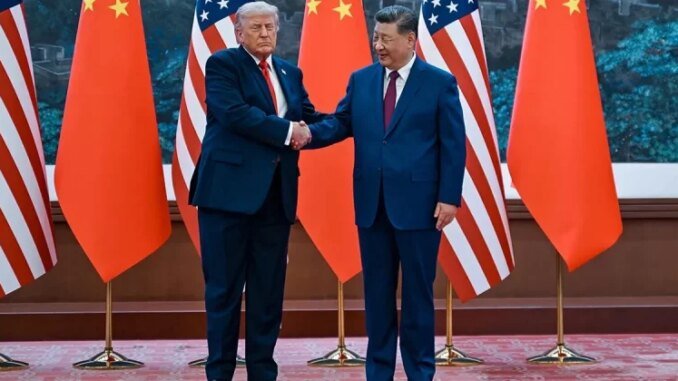

President Trump says his talks with Chinese President Xi Jinping have produced a set of trade agreements, headlined by China’s commitment to buy 200 Boeing aircraft and a massive agricultural purchase package. The announcements are being framed as a step toward stabilizing the world’s most consequential economic relationship.
US officials indicated that China would purchase more than $10B in agricultural products, with expectations that annual purchases could reach as high as $17B. The Boeing deal also reportedly includes potential for follow-on orders, though operational details remain thin on the ground.
Big numbers, blurry details
The agricultural component follows a familiar playbook. US farmers, particularly soybean producers, have been caught in the crossfire of US-China trade tensions for years. A $10B-plus purchasing agreement would provide real relief to agricultural communities that have absorbed significant pain from tariffs and retaliatory measures. The $17B annual target, if it materializes, would represent a substantial floor for US agricultural exports to China.
The broader US trade strategy appears aimed at promoting exports across several key sectors: aircraft, soybeans, energy, and medical devices.

Stability over breakthroughs
Analysts watching the summit have largely converged on a single assessment. Both sides came looking for stability, not transformation.
The lack of firm commitments or detailed operational frameworks is the tell. When a deal is real, you get specifics: timelines, delivery schedules, pricing mechanisms, enforcement provisions. When a deal is aspirational, you get round numbers and phrases like “potential for follow-on orders.”
What this means for markets
For Boeing specifically, the news is constructive but not conclusive. A 200-aircraft commitment from China would help fill production slots and signal demand recovery in a critical international market.
For the agricultural sector, the implications are more immediately tangible. US farmers operate on thin margins and short time horizons. Soybeans, which have been at the center of US-China agricultural trade for years, would likely see the most direct impact.
The energy and medical device sectors mentioned in the broader trade strategy are worth watching too. China is the world’s largest energy importer and has a rapidly aging population that needs medical technology.
For crypto markets, there’s nothing directly relevant here. No discussions regarding digital assets or cryptocurrency-related policy were part of the announced agreements.



Be the first to comment