



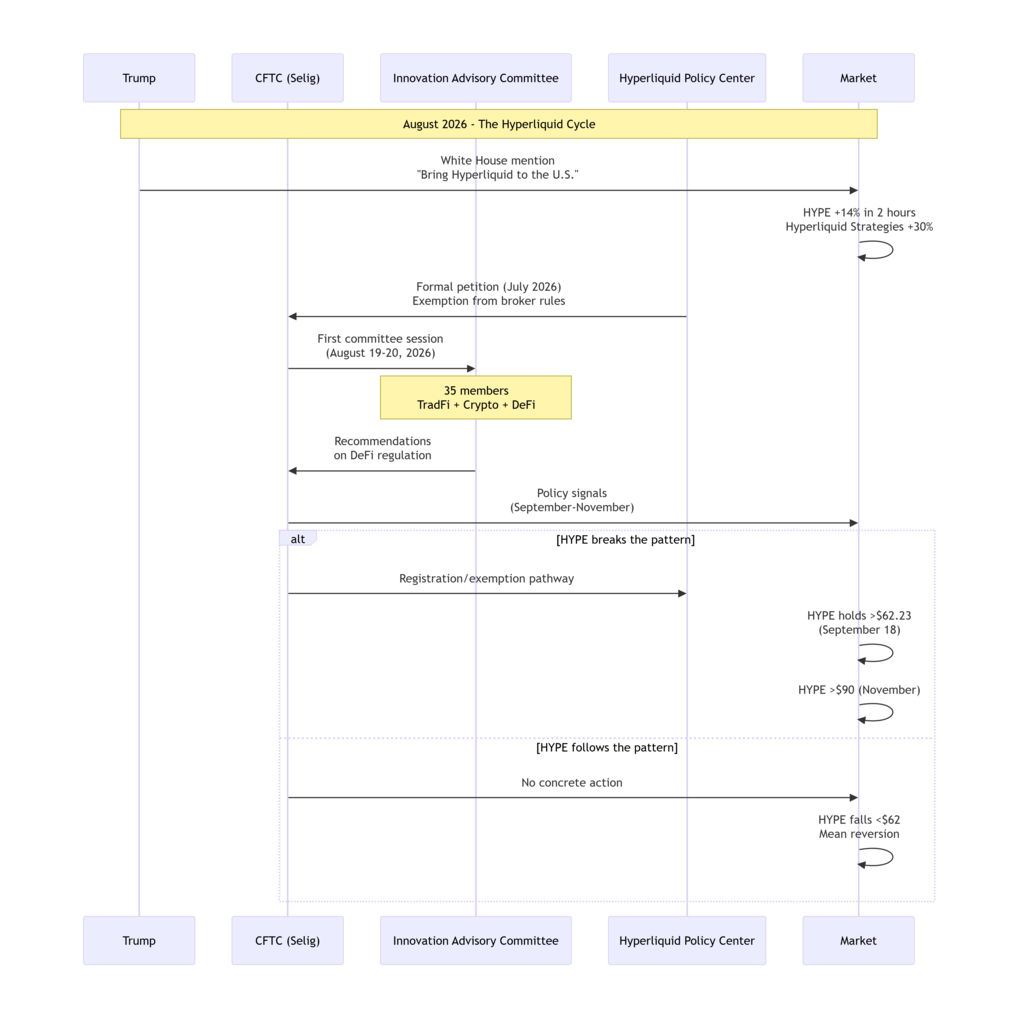
On August 19, 2026, President Donald Trump made a statement that shook digital asset markets: “I understand Mike is also working to bring Hyperliquid to the United States in a fully compliant and legal way.” The remark, made during a White House meeting with executives from Coinbase, Ripple, Nasdaq, and other firms, triggered an immediate move in Hyperliquid’s native token (HYPE), which surged from $62.23 to nearly $71 in just two hours—a 14% increase. Hyperliquid Strategies, the Nasdaq-listed company that holds HYPE in its corporate treasury, closed up 30%, its best trading day on record.
However, this presidential endorsement arrives with an uncomfortable track record. Trump has made eight previous crypto endorsements since taking office, and all of them, without exception, currently trade below their pre-endorsement price, with an average drawdown of 60%. The pattern is consistent: an initial average spike of 31% within 24 hours, a negative reversal within 30 days, and a long-term collapse. The central question of this analysis is whether Hyperliquid represents a qualitative anomaly in this cycle or whether it will become the ninth case of an unfulfilled promise.
The key difference, according to Crypto Economy analysis, is that HYPE is the first Trump endorsement accompanied by a real regulatory process already in motion. This is not merely presidential rhetoric; it is institutional machinery already operating: the Commodity Futures Trading Commission (CFTC) approved perpetual futures in the United States in May 2026, Hyperliquid and Phantom filed a formal petition in July 2026 for DeFi-tailored rules, and the CFTC’s Innovation Advisory Committee, chaired by Michael Selig, held its first session the Thursday after the presidential mention.
Fundamental Concepts and Hyperliquid’s Technical Architecture
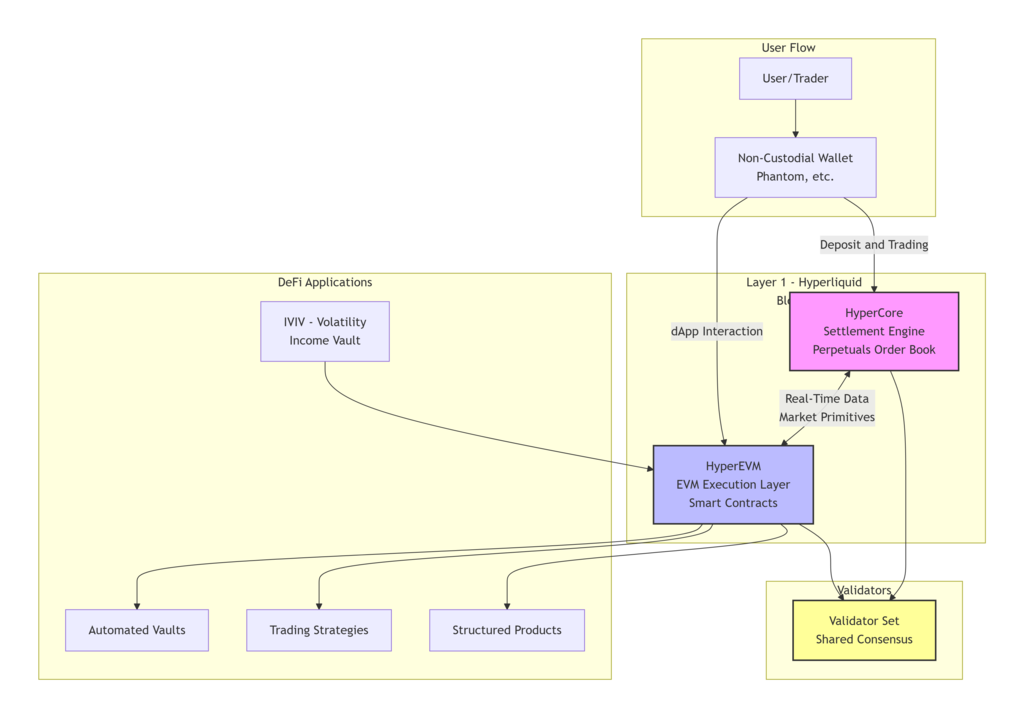
Hyperliquid is a Layer 1 blockchain designed specifically for decentralized derivatives trading, with an on-chain settlement engine called HyperCore. Unlike traditional DeFi platforms that operate on Ethereum or other general-purpose chains, Hyperliquid built its own infrastructure to optimize the performance of its perpetual order book. The architecture is complemented by HyperEVM, an execution layer compatible with the Ethereum Virtual Machine (EVM) that operates directly alongside HyperCore, sharing the same validator set and consensus.


This deep integration allows dedicated smart contracts to access real-time market data and trading functionality natively, enabling composable designs such as vaults, automated strategies, and structured products that interact directly with on-chain market primitives. In February 2026, the company launched, in partnership with the Rysk protocol, an Institutional Volatility Income Vault (IVIV), which allows users to execute options strategies such as covered calls and cash-secured puts entirely on-chain.
HYPE Tokenomics
The HYPE token has a fixed maximum supply of approximately 1 billion tokens, with no additional emissions planned. The first token generation event occurred on November 29, 2024, with approximately 310 million tokens created and put into circulation. Approximately 389 million were initially reserved for community rewards and future emissions, while 238 million are subject to a vesting schedule for core contributors that began in November 2025 and extends over several years.
A key mechanism is token burning: purchases made by the Assistance Fund are considered permanently burned, reducing the total supply from 1 billion to approximately 956 million by April 2026. This deflationary mechanism, combined with growing demand, creates a scarcity dynamic that analysts have pointed to as one of the bullish catalysts for HYPE.
Chronology of Endorsements
To assess whether HYPE can break the pattern, it is necessary to examine in detail the full history of Trump’s previous endorsements. The following table compares the characteristics and outcomes of each:
Table 1: Complete history of Trump’s crypto endorsements and their outcomes.
The most emblematic case is the March 2025 “Crypto Reserve” promise. Trump stated on Truth Social that his Executive Order on Digital Assets directed the Presidential Working Group to advance a Strategic Crypto Reserve that would include XRP, SOL, and ADA. ADA surged 75% within hours, while XRP added 31% and SOL 26%. The entire market gained more than $500 billion that afternoon. However, approximately one hour later, a follow-up executive order established that the reserve would be exclusively Bitcoin and prohibited the purchase of altcoins. ADA never returned to its previous price and today trades 73% lower.
The case of the TRUMP memecoin is even more revealing of the potential harm to retail investors. Three separate promotions generated temporary peaks, but nearly 1 million wallets lost a total of $3.81 billion.
The Hyperliquid Case: A Qualitative Exception
Hyperliquid’s endorsement presents structural differences that distinguish it from all previous ones. The first is that there is a real, verifiable regulatory process underway. The CFTC, under Chairman Michael Selig, has taken a proactive approach toward DeFi and crypto derivatives. In March 2026, Selig announced that the agency plans to clarify when DeFi software providers must register, update rules for leveraged and margined spot trading, address the status of perpetual derivatives, and consider how to regulate AI-driven trading systems.
Selig also established the joint “Project Crypto” initiative with the SEC to end jurisdictional disputes between the two agencies and coordinate oversight. This is a significant institutional shift that reduces the regulatory uncertainty that has historically held back institutional adoption of DeFi in the United States.
The Formal Petition by Hyperliquid and Phantom
In July 2026, the Hyperliquid Policy Center and Phantom, the non-custodial wallet, submitted a joint comment to the CFTC requesting that registration requirements for exchanges and brokers not apply to on-chain protocols and non-custodial wallets.
They argued that publishing software for DeFi should not, by itself, require registration as an exchange or clearing organization, and they requested a pathway for already-registered companies to transition regulated functions to on-chain infrastructure.
This petition is not a symbolic gesture. It represents a deliberate strategy by Hyperliquid to build a favorable regulatory framework before seeking formal entry into the U.S. market. The existence of this petition, combined with the presidential mention, suggests coordination between the Hyperliquid team and the Trump administration.
The CFTC Innovation Advisory Committee
The CFTC’s Innovation Advisory Committee (IAC), formally established on February 12, 2026, through Notice 9182-26, represents a paradigm shift in the relationship between regulators and the crypto industry. Unlike previous committees where regulatory agencies invited one or two crypto representatives to “make up the numbers,” the current IAC is an “all-star team” of 35 members including leaders from traditional exchanges (CME, Cboe, Nasdaq), crypto platforms (Coinbase, Kraken, Gemini, Crypto.com), DeFi protocols (Uniswap, Solana, Ripple, Chainlink), and top-tier venture capital firms (a16z crypto, Paradigm, Framework Ventures).
This committee, chaired by Selig, sends a clear signal: U.S. regulators are moving from “passive regulation” to “collaborative governance” with the industry. The first IAC session, held the Thursday after the presidential mention, is a concrete milestone that investors can monitor to assess whether Trump’s promise translates into regulatory action.
Supply Structure and Deflationary Mechanism
HYPE’s tokenomics has characteristics that distinguish it from most governance tokens in the DeFi space. With a fixed maximum supply of 1 billion and an active burn mechanism, HYPE operates under a deflationary that contrasts with the inflationary models typical of many protocols.
Table 2: HYPE tokenomics and supply projections.
The Institutional Vehicle: Hyperliquid Strategies (PURR)
A crucial element for understanding Trump’s endorsement is the existence of Hyperliquid Strategies Inc. (ticker PURR), a Nasdaq-listed company whose core business model is accumulating HYPE in its corporate treasury. This structure allows institutional investors to gain exposure to HYPE through an SEC-regulated vehicle without needing to interact directly with the blockchain.

In September 2026, Hyperliquid Strategies expanded its committed equity financing line with Chardan Capital Markets from $1 billion to $2.5 billion. As of June 30, the company had issued approximately 76.06 million PURR shares, generating $646.6 million in gross proceeds, and had accumulated approximately 29.3 million HYPE tokens. With HYPE trading near $83.30 in early September, that stake was worth approximately $2.44 billion.
The amendment to the Chardan agreement includes an investor protection clause that limits the issuance of shares below $12.02 to 42,641,847 shares once cumulative sales reach $1 billion. If PURR shares trade below that threshold, the company is forced to issue more shares for the same capital, deepening dilution for existing shareholders.
HYPE reached an all-time high of nearly $100 on September 23, 2026, driven by $36 million in whale accumulation and a Binance listing. By late September, the token was trading around $90, with a market capitalization of approximately $23 billion.
The Risk of the Historical Base Rate
Despite the qualitative differences, the risk that HYPE follows the historical pattern is real. The base rate of eight previous endorsements with an average 60% drawdown is a statistical fact that is difficult to ignore. Crypto markets have a well-documented tendency to “sell the news” after catalyst events, and a presidential mention is not a formal regulatory approval.
The original article’s warning is clear: the mention “is not a formal approval,” and the history of Trump’s broken crypto promises is overwhelming. Even with a regulatory process underway, there is a risk that the CFTC, under political or legal pressure, fails to deliver a favorable framework for Hyperliquid within the expected timeframe.
The Three Validation Milestones
BeInCrypto’s analysis establishes three concrete milestones to assess whether HYPE breaks the pattern:
-
Thursday meeting (August 20, 2026): Does “compliant and legal” become a real item on the IAC’s regulatory agenda?
-
September 18 (30-day mark): Does HYPE manage to stay above $62.23? Only one previous endorsement briefly achieved this.
-
November (90-day mark): Is there a registration or exemption pathway that separates Hyperliquid from the crypto reserve episode?
In light of available data, the second milestone appears to have been passed: HYPE not only held above $62.23 but reached all-time highs near $100 in September. This suggests that, at least in the short term, Trump’s endorsement has had a more lasting effect than in previous instances.
Hyperliquid-Specific Risks
Beyond political risk, Hyperliquid faces significant technical and market risks:
-
Concentration risk: Hyperliquid Strategies holds approximately 35.1 million HYPE tokens valued at $3.2 billion, with an unrealized gain of $1.57 billion. A significant liquidation by this vehicle could generate massive selling pressure.
-
Residual regulatory risk: Although the CFTC is advancing, the SEC could retain jurisdiction over certain aspects of HYPE as a security. Coordination through “Project Crypto” mitigates but does not eliminate this risk.
-
Technical execution risk: The integration of HyperEVM with HyperCore is innovative but not immune to vulnerabilities. An exploit in the smart contracts or the bridge could have devastating consequences.
-
Market risk: The crypto derivatives market is highly cyclical. A recession in the broader crypto market could drag HYPE down regardless of the protocol’s fundamentals.
Projections and Scenarios
Table 3: HYPE price scenarios for the end of 2026.
Trump’s presidential endorsement of Hyperliquid represents a potential inflection point in the relationship between the U.S. government and the DeFi sector. Unlike the eight previous endorsements, which were mainly symbolic statements without institutional backing, the Hyperliquid mention comes with a verifiable regulatory process: a formal petition before the CFTC, an innovation advisory committee with active industry participation, and a CFTC chairman who has publicly stated his intention to modernize rules to accommodate DeFi and perpetual derivatives.
However, the history of Trump’s broken crypto promises is overwhelming. The base rate of eight endorsements with average 60% drawdowns sets a significant burden of proof. The fundamental difference is that, for the first time, there is a real regulatory process underway that could materialize into concrete action within the next 90 days.
Available evidence suggests that HYPE has passed at least the first obstacle: holding its price above the pre-mention level for more than 30 days. The all-time high near $100 in September 2026 indicates that the market is positively pricing the probability that Hyperliquid will achieve a regulated entry into the United States.



Be the first to comment