

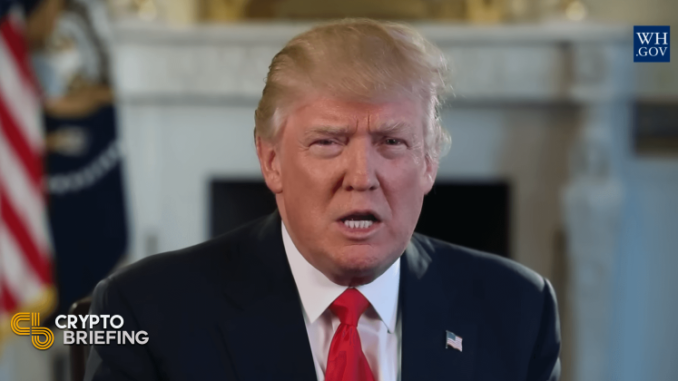

President Donald Trump on Tuesday issued an executive order directing the Federal Reserve and other federal regulators to evaluate expanding payment system access for fintech and digital asset firms as part of a wider administration effort to reduce regulatory barriers to financial services.
The order, titled “Integrating financial technology innovation into regulatory frameworks,” instructs federal agencies to review rules, guidance, and licensing processes that may impede fintech innovation or partnerships with regulated financial institutions.
Agencies including the SEC, FDIC, OCC, CFPB, CFTC, and NCUA have 90 days to identify reforms and 180 days to begin encouraging innovation through regulatory changes.
The administration said the current system imposes fragmented and burdensome oversight that advantages incumbent financial firms.

The directive applies to a wide range of fintech activities, including payment platforms, lending technology, digital banking, blockchain services, brokerage operations, investment management, and digital asset businesses.
Trump also asked the Fed to conduct a review of legal and regulatory frameworks governing access to Fed payment accounts and services for uninsured depository institutions and non-bank financial firms, including those engaged in digital asset activity.
The Fed has 120 days to submit recommendations to the White House addressing legal authority, barriers to access, risk considerations, and consistency among regional Reserve Banks.
If the central bank determines existing law permits broader access, the order requests transparent application procedures and 90-day timelines for completed applications.
Under the Federal Reserve Act, regional Reserve Banks hold the power to approve or deny applications for access to payment rails. Institutions seeking such access, commonly referred to as master accounts, have traditionally been licensed depository institutions. That requirement has pushed some crypto firms to pursue federal charter licenses in order to qualify.
The Fed is expected to clarify whether each of its 12 regional banks can independently decide on granting or denying payment account access.
Master accounts would allow crypto companies to connect directly to core US payment systems, bypassing the intermediary banks they currently rely on for dollar-denominated settlement. For institutional clients, that could mean faster deposits and withdrawals, reducing both cost and friction in moving funds between digital asset platforms and traditional finance.
Kraken’s precedent and industry pushback
The debate over extending Fed access to crypto firms intensified earlier this year after the Kansas City Fed approved a limited-purpose account for Payward, the parent company of crypto exchange Kraken, in March.
The arrangement gives Kraken a “skinny” master account with access to high-value dollar settlement rails, though with restrictions.
That decision, however, drew sharp criticism from established banking groups. The Bank Policy Institute, a trade association representing many of the largest US banks, said it was “deeply concerned” that the Kansas City Fed acted before a standardized policy framework for limited-purpose accounts had been finalized.
The institute has argued that case-by-case approvals without clear rules risk undermining financial stability and creating uneven regulation.
Legislative efforts gain momentum
Congressional activity has mirrored the executive branch’s push. Last month, California Representatives Sam Liccardo, a Democrat, and Young Kim, a Republican, introduced the Payments Access and Consumer Efficiency Act, known as PACE.
The bipartisan bill would establish clear statutory pathways for qualifying non-bank payment providers to access Fed services. Though still in its early stages, the legislation has drawn endorsements from crypto industry groups that have long lobbied for formal rules.
Industry advocates argue that without explicit statutory guidance, the approval process for master accounts will remain unpredictable, discouraging investment. Traditional banks counter that extending Fed payment access to lightly regulated entities introduces systemic risk and could erode the supervisory framework that underpins financial stability.


Be the first to comment