



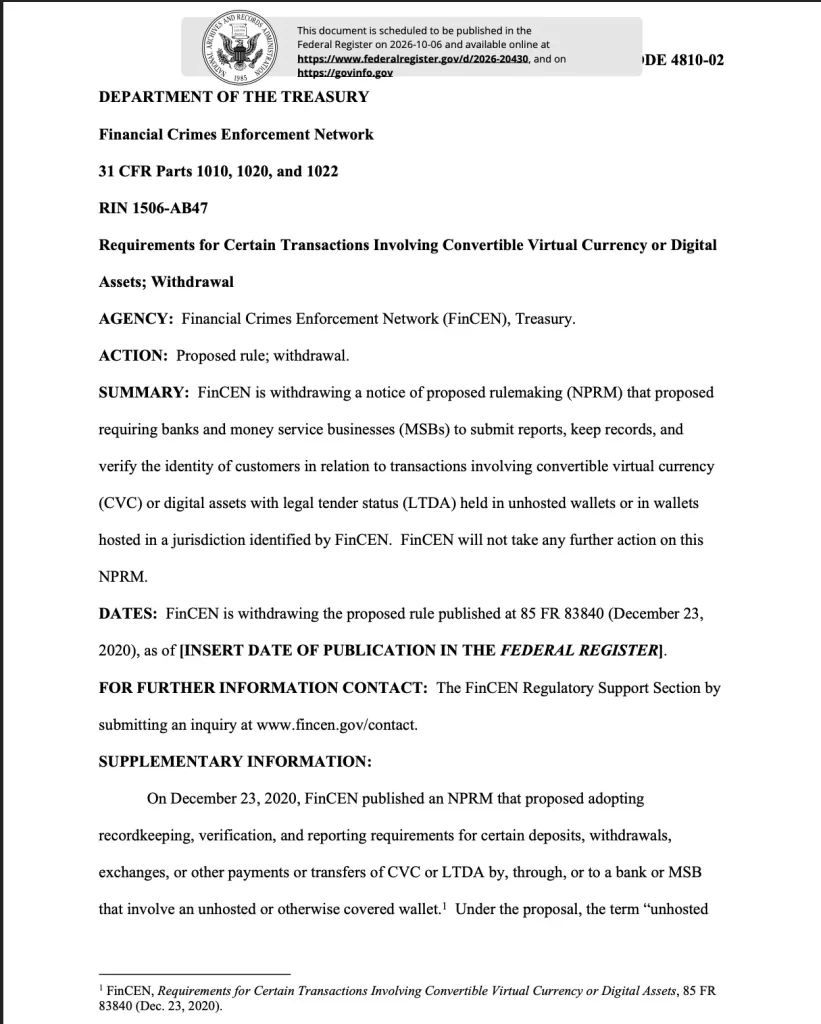
The U.S. Treasury has withdrawn two long-pending proposals covering self-custody crypto wallets and crypto mixing services. The decision ends years of uncertainty that had faced strong opposition from parts of the crypto industry.
This also marks a major change in how U.S. regulators plan to approach digital asset rules under the Trump administration.
Treasury Withdraws Two Crypto Proposals
On October 5, 2026, the Treasury’s Financial Crimes Enforcement Network (FinCEN) announced the withdrawal, saying it would take no further action on the proposals.
The first proposal was introduced in December 2020. It would have required banks and money services businesses to keep records for certain transactions involving unhosted wallets above $3,000 and report transactions above $10,000.

The proposal also required financial institutions to collect and verify information about customers and counterparties involved in certain transactions with private wallets.
Treasury also withdrew a separate proposal covering convertible virtual currency (CVC) mixing services, introduced in 2023 under Section 311 of the USA PATRIOT Act.
That proposal sought to classify transactions involving CVC mixers as a class of primary money laundering concern. It would have required financial institutions to collect and report information linked to transactions involving these privacy-focused services.
Industry Welcomes Treasury Decision
The move has received support from crypto industry groups that had opposed the proposals.
The Digital Chamber said the withdrawal removes regulatory pressure around self-custodial wallets.
FinCEN said the decision fits the administration’s effort to make digital asset regulations “fit-for-purpose.”
The Treasury’s decision now leaves the crypto industry without the two proposed reporting frameworks, while existing AML and financial rules remain in place.
What Happens to Self-Custody Next?
Under the withdrawn proposals, regulated financial institutions would have faced additional requirements when customers moved crypto to private wallets.
With the proposals withdrawn, the reference material states that there is no new federal requirement forcing banks or exchanges to identify the owner of a self-hosted wallet simply because a customer sends funds there.
Was this writing helpful?
Story Ends Here
Trust with CoinPedia:
CoinPedia has been delivering accurate and timely cryptocurrency and blockchain updates since 2017. All content is created by our expert panel of analysts and journalists, following strict Editorial Guidelines based on E-E-A-T (Experience, Expertise, Authoritativeness, Trustworthiness). Every article is fact-checked against reputable sources to ensure accuracy, transparency, and reliability. Our review policy guarantees unbiased evaluations when recommending exchanges, platforms, or tools. We strive to provide timely updates about everything crypto & blockchain, right from startups to industry majors.
Investment Disclaimer:
All opinions and insights shared represent the author’s own views on current market conditions. Please do your own research before making investment decisions. Neither the writer nor the publication assumes responsibility for your financial choices.
Sponsored and Advertisements:
Sponsored content and affiliate links may appear on our site. Advertisements are marked clearly, and our editorial content remains entirely independent from our ad partners.
Read the Next News





Be the first to comment