



Security tools have a familiar paradox: the more important they are, the more likely they are to be put away.
Many hardware wallets spend most of their time in a drawer or safe after setup. When assets need to move, users bring the device back out, connect it to a client, and review the transaction. That instinct is understandable, but it also shows the distance that can remain between hardware security and daily use.
UKey’s product direction, as it stands, looks like an attempt to shorten that distance.
Core 26 uses a color touchscreen and metal body to make dedicated hardware feel more approachable. Seed Ring turns seed-phrase backup into a wearable ring. Then there is Zero Ring: it already appears in UKey’s website footer, but its product details have not been announced. Its presence raises another possibility. If backup can be worn, could transaction signing also take on a lighter, more everyday hardware form?

UKey Core 26: A Security Device That Does Not Need to Perform
The Space Black edition of UKey Core 26 has a quiet kind of confidence.
Its 3.5-inch color touchscreen takes up most of the front. The corners are softened but precise; a dark metal frame follows the glass panel and gives the device a clean outline. The circular fingerprint area at the bottom does not demand attention, yet helps Core 26 feel like a precision tool built to travel. On the back, the UKey mark, camera, and flash are each given their place, with the same restrained visual language.
The packaging continues that approach. A matte-black box carries little more than the gold UKey Core wordmark and an outline of the device. Inside, Core 26, an NFC backup card, and its accessories are arranged with clarity. Nothing needs to be over-explained for the purpose of each item to come through.
It does not rely on an exaggerated shape to signal a futuristic identity. Its appeal is that UKey has brought the usual severity of a security device into a more considered physical form.
Hot-Wallet Access, Hardware-Signed Control
That design language also reflects what Core 26 is for. In UKey’s setup, the UKey Wallet app handles everyday access — preparing and relaying a transaction request — while Core 26 keeps control on the device: users review the address, amount, and transaction details on the independent screen, then confirm and sign on the device itself. The result is a two-layer flow: software convenience for access, hardware authority for signing.
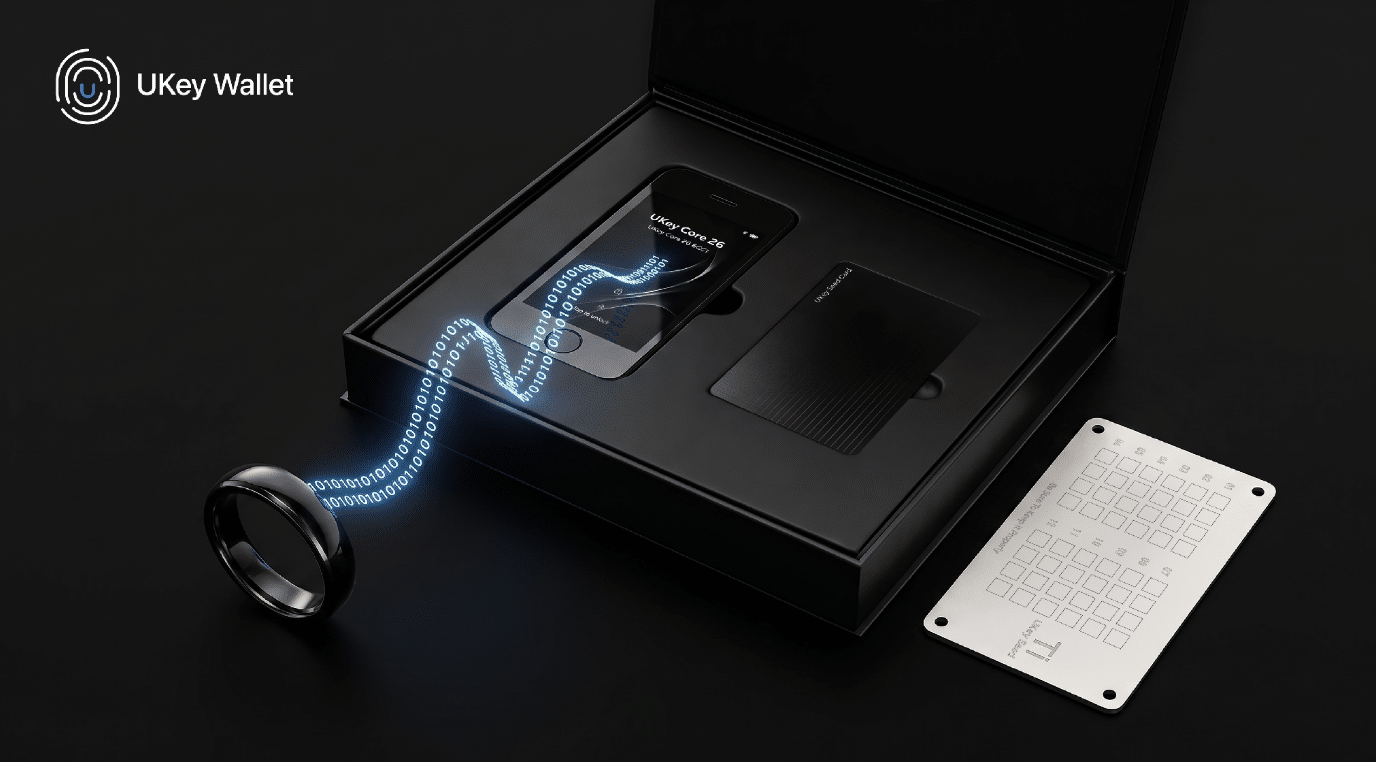

For a hardware wallet, a screen is a security interface before it is a visual feature. When the screen is clear and the interaction model feels familiar, users are more likely to examine a transaction rather than treat the device as a black box that simply needs a quick confirmation.
This is where Core 26 begins to feel more at home in daily life. It remains dedicated hardware for private-key protection and device-side signing, without asking users to first enter an awkward ‘professional mode.’
UKey Seed Ring: Recovery Carried in a Black Ceramic Ring
UKey Seed Ring 26 does not put its technology on display.
Its rounded form is made from high-strength black ceramic. Light catches the curved surface with a subtle sheen. At a glance, it reads more like a minimal everyday accessory than an electronic device with an obvious purpose.
The product materials also include a 925 silver chain, allowing the ring to be worn as a pendant. A black suede presentation box carries the same sense of understatement into storage. Worn on a hand or kept beneath a collar, it does not have to explain itself to anyone nearby.
Its functional boundary is clear. UKey says Seed Ring uses a battery-free passive NFC design: it receives a brief burst of energy and can be read at close range only when a compatible device is nearby. It is intended for seed-phrase backup and wallet recovery. It cannot initiate transactions and does not take part in signing.
That restraint matters.
Seed Ring is not an attempt to force an entire hardware wallet into a ring. Instead, it takes one task from the self-custody process — recovery — and gives it a form better suited to being carried. No battery, no continuous operation, and no transaction authorization make its role easier to understand.
Paper seed phrases can be affected by water, fire, and the environment. Metal backup plates work well for long-term storage but are not always convenient to carry. A ring represents a different trade-off: it does not seek to replace every backup method, but gives users another recovery medium that can be worn, concealed, and kept close at hand.
Once the technology is less visible, the product can feel closer to the person using it.
Core 26, Seed Ring, and Seed Ti: Three Moments of Self-Custody
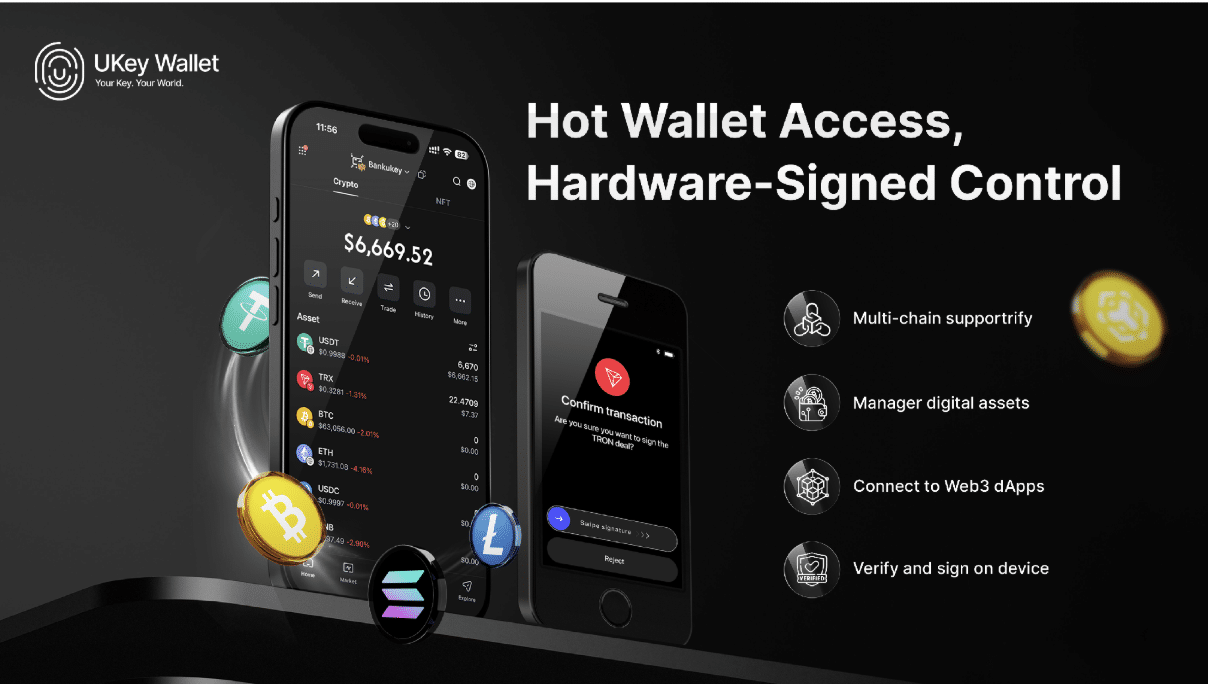
Across the current lineup, three products cover three different moments. Core 26 handles independent-screen review and device-side signing. Seed Ring carries NFC recovery and backup as a wearable. Seed Ti is a titanium recovery medium for long-term physical backup — a durable, low-tech record of the same recovery information, kept apart from the daily device.
UKey Core 26, Seed Ring, and Seed Ti: signing, carried recovery, and long-term physical backup.

Rings and Cards Are Changing Where Hardware Wallets Fit
Cards and rings are no longer only conceptual forms in the hardware-wallet market.
NFC card-style hardware wallets that work with a phone are already available. Some makers have also put private-key protection and transaction-signing capability into a ring. Tangem Ring’s public product materials, for example, place a wearable form factor, NFC connection, and transaction signing within the same usage flow.
That does not mean a ring is inherently safer than a screen-equipped hardware wallet, or that every security function should be compressed into a smaller shell. It points to something else: hardware wallets can move beyond the traditional ‘screen and buttons’ format and enter more real-life settings.
The first change is availability. A hardware wallet kept in one fixed place may suit low-frequency, high-value, or especially deliberate activity. A card in a wallet or a ring worn every day may appear in more routine authorization moments. When the device is already nearby, the friction of using hardware confirmation naturally falls.
The second change is habit. Security mechanisms matter only when they are actually used. If backup, review, and signing require extra preparation every time, users may gradually simplify the process. When those actions fit existing routines, they are easier to sustain.
Rings and cards also have a less obvious advantage: they do not look like traditional security devices. For people who travel often or use Web3 services across different settings, a lower-profile form can have value in itself.
Of course, a lighter form factor does not make the security responsibility lighter.
For signing devices without an independent screen in particular, the product needs to make clear where full transaction information appears, how the user is authenticated, how the authorization target is checked, how an unauthorized party is limited after a device is lost, and how backup and recovery are arranged. Convenience only becomes useful when those authorization boundaries are clear.
Could UKey Zero Ring Be a Signing Ring?
As of August 14, 2026, UKey Zero Card and UKey Zero Ring appear in the product sequence in the footer of UKey’s website and store.
But among UKey’s publicly available information, there is not yet a formal Zero Ring product page, technical specification, feature description, or release date. Whether it is a signing ring, which connection method it might use, and how it might store keys do not yet have official answers.
That makes ‘Seed handles backup, Zero handles signing’ an easy and logical product association — but it remains an association, not confirmed UKey product planning.
Precisely because its functions have not been announced, the most interesting questions are not unconfirmed specifications. They are practical ones: how would a ring verify its holder? Where would users review transaction details? Could an unauthorized person use it after it is lost? And how would it work alongside UKey Wallet, Core 26, and Seed Ring?
If a future Zero Ring does take on lightweight signing, UKey could form an interesting division of roles: Core 26 for independent-screen review and fuller transaction scrutiny, Seed Ring for backup and recovery, and Zero Ring for more frequent everyday authorizations.
The word ‘if’ matters. A product name appearing publicly is not the same as a product function being confirmed. What will determine Zero Ring’s value is not the ring form alone, but whether UKey can clearly explain signing, verification, lost-device handling, and recovery within such a small device.
UKey’s Everyday-Hardware Direction Is Taking Shape
From Core 26 to Seed Ring, UKey’s direction is easy to see.
Core 26 retains the independent interaction and device-side confirmation expected from a hardware wallet, while bringing its appearance and operation closer to mature consumer electronics. Seed Ring does not pursue complete wallet functionality; it puts recovery capability into a black ceramic accessory that can be worn.
Whether Zero Ring will complete the everyday-signing part of that picture still depends on a formal UKey announcement. If the answer is yes, the important proof will not simply be that ‘a ring can sign.’ It will be whether a lightweight form can coexist with a clear, dependable security flow.
That is harder than making a smaller hardware wallet — and more worth watching.
For the official positioning, features, specifications, and release plans for UKey Zero Card and UKey Zero Ring, please refer to future updates on the UKey official website.
Disclaimer: This is a paid post and should not be treated as news/advice.



Be the first to comment