


Optimism is expanding its role as the operator of Ethereum-based chains for other brands. Unichain, Uniswap Labs’ Ethereum layer-2 chain, plans to transfer its production sequencing, public node access, monitoring and incident response to Optimism under its October 9 migration announcement.
The planned testnet move on Oct. 13 and mainnet move on Oct. 29 extend the operating strategy set out by Jing Wang in Optimism’s Ink announcement: product teams build their applications and ecosystems while Optimism runs the infrastructure beneath them. Soneium’s September agreement follows the same division of labor as Ink’s earlier June plan; both chains use the OP Stack.
For users, the consequence reaches beyond who answers an outage call. A common provider can bring protocol expertise and coordinated maintenance, but it also becomes a common organizational dependency. Each chain’s deployed contracts determine whether users can get a transaction included and recover funds during a provider failure.
Unichain moves from support toward operations
Unichain already had an OP Enterprise relationship. Optimism’s enterprise introduction, in its version updated July 31, says Uniswap Labs operates Unichain with the Mission Critical add-on. Read alongside the October announcement, the change is an expansion from support into responsibility for production operations.
Uniswap Labs says the migration preserves the chain ID, contracts, balances, applications and Uniswap v2, v3 and v4 deployments. It also says Unichain remains a Stage 1 rollup with permissionless fault proofs and its existing contract-upgrade governance. The production operator changes while the chain and its upgrade authorities remain in place.
Soneium’s Sept. 30 announcement assigns the Optimism Foundation and OP Labs support for deployment, sequencer operations, node infrastructure, upgrades, monitoring and incident response. Soneium keeps its roadmap and engineering involvement, including ongoing work on the chain itself and its Tokenized IP products. The announcement does not specify a cutover date.
Ink offers an earlier version of the same strategy. In her June 23 announcement, Wang described an arrangement in which the Ink Foundation could concentrate on ecosystem growth while Optimism operated and improved the network. The plan targeted an August cutover and included mainnet and testnet sequencers, RPC, the explorer, monitoring and incident response.
A later Optimism guide published Sept. 7 describes Ink’s infrastructure as operated by the Foundation through OP Labs.
The reliability promise has an operational price
OP Enterprise is Optimism’s chain infrastructure and support service. Its tier definitions explain why the operating model matters. Under Self Managed, the customer runs the infrastructure and controls its sequencer and nodes; Optimism supplies support and monitoring. Under Fully Managed, OP Labs runs the sequencer, batcher, proposer and chain infrastructure, and handles security patching.
Those components perform different jobs. The sequencer orders transactions, the batcher submits transaction data to Ethereum, and the proposer submits claims about the resulting chain state. Moving those day-to-day roles to the protocol developer can reduce the work a partner coordinates internally. Sequencing, data submission and state proposals become provider responsibilities; Ethereum settlement and the contracts that accept proofs remain separate.
Soneium’s agreement promises a 99.9% monthly uptime target and around-the-clock on-call incident response. The Mission Critical add-on advertises a 99.95% uptime SLA, a 15-minute initial response to the most serious incidents and status updates every 30 minutes. Unichain’s earlier relationship explicitly included that add-on.
These are service commitments, not measured improvements in uptime. The 15-minute target covers an initial response; recovery can take longer.
The rationale is a direct organizational path between operating a chain, identifying a protocol problem and applying a patch. The trade-off is that distinct branded chains increasingly rely on the same organization for sequencing, maintenance and incident handling.
A provider-wide process problem could affect several customers. The announcements establish a shared operator but do not disclose whether cloud regions, signing keys or other infrastructure are shared, so correlated technical failures remain a possibility rather than an observed outcome.
Inclusion survives sequencing failure; exits differ
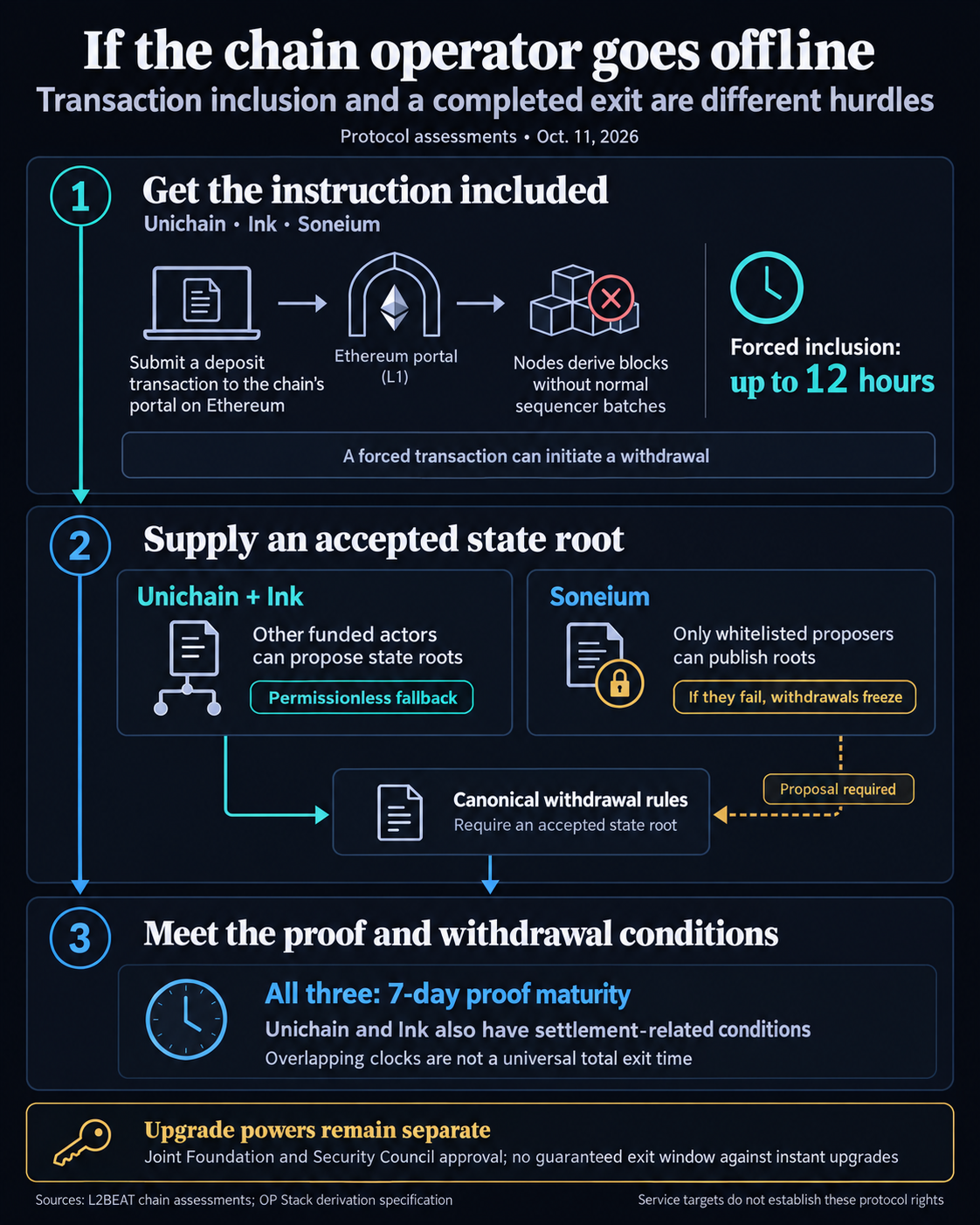
Ethereum supplies a fallback below the managed service. Current L2BEAT assessments separately list forced transaction inclusion through Ethereum for Unichain, Soneium and Ink, with up to a 12-hour delay.
The OP Stack derivation specification and forced-transaction guide describe how it works: a user submits a deposit transaction to the chain’s portal contract on Ethereum. When the sequencing window expires, nodes can derive blocks containing those transactions without normal sequencer batches. A forced transaction can initiate a withdrawal.
That preserves a route around an unavailable or censoring sequencer. Money becomes available on Ethereum only after the withdrawal’s separate proposal and proof conditions are met, with permissioned dependencies still possible along the way.
| Chain | Managed-operations disclosure | If the usual proposer fails |
|---|---|---|
| Unichain | Oct. 9 plan; testnet Oct. 13, mainnet Oct. 29 | Permissionless state-root proposals provide a fallback |
| Ink | June plan targeted August; September vendor guide describes managed operation | Permissionless state-root proposals provide a fallback |
| Soneium | Sept. 30 Fully Managed adoption; no precise completed cutover date | Whitelisted-proposer failure freezes withdrawals |
L2BEAT rates Unichain and Ink as Stage 1 and says other actors with sufficient funds can propose state roots. Their canonical exit paths permit others to do the usual proposer’s work, provided funded actors submit accepted roots and the applicable proof and withdrawal conditions are met.
Soneium has a different dependency. Its currently respected super permissioned game has no functional onchain dispute process, according to L2BEAT, and only whitelisted proposers can publish roots. If those proposers fail, withdrawals freeze. Forced inclusion can get a transaction into the derived chain; it cannot supply the missing withdrawal proposal authority.
The withdrawal assessments for Unichain, Ink and Soneium also retain a seven-day proof-maturity period for all three chains. Unichain and Ink have additional settlement-related conditions: at least three-and-a-half days for root settlement and three-and-a-half days after settlement. Proof inclusion can precede settlement, so those clocks should not be mechanically added into a universal withdrawal time. Soneium retains withdrawal delays despite its respected game lacking an onchain challenge process.
Optimism operations do not erase upgrade powers
Production operations, contract-upgrade authority and asset custody are separate questions. Uniswap says its governance arrangement persists. L2BEAT’s current assessments show joint Foundation and Security Council approval for upgrades on all three chains, with no delay on regular upgrades and no guaranteed exit window against those instant powers.
An Ethereum fallback during sequencer failure therefore does not guarantee an opportunity to leave before an unwanted contract change. Stage 1 preserves meaningful operator-independent paths, but retains powerful upgrade authorities.
Unichain’s promised native interoperability remains a future feature. Soneium’s announcement expressly excludes interoperability. Ink’s June plan describes one-day withdrawals as a proof-system rollout, while its current withdrawal assessment still retains seven-day proof maturity.
CryptoSlate’s September Upgrade 20 coverage examined the technical preparation for future interoperability. Outsourcing production operations is a separate development, with its own question of who maintains the chain and handles failures.
The next dated milestones are Unichain’s Oct. 13 testnet and Oct. 29 mainnet migrations. Their completion would extend Optimism’s strategy from selling protocol support to operating another established production chain. The reliability case will then depend on performance in service, while users’ recourse will continue to depend on the specific inclusion, proposal and upgrade rules beneath each brand.




Be the first to comment