



Uniswap took center stage while most large-cap crypto assets spent July grinding sideways waiting for the next catalyst. The protocol didn’t wait around for one.
I went back through the protocol’s own governance record to see exactly what happened, and I’ll be honest, it’s rare for me to find a token whose price move lines up this cleanly with a documented, on-chain governance outcome rather than just market noise. That’s what pulled me into digging deeper here instead of skimming past another green candle.
What Happened To Uniswap In July
UNI ran from roughly $3.83 to $4.54 between July 29 and 31, a move of about 19% in three days, before settling back near $4.07. New wallet creation and large-holder ($100K+) transaction counts both climbed sharply over the same window, alongside a jump in daily active addresses well above July’s earlier baseline.
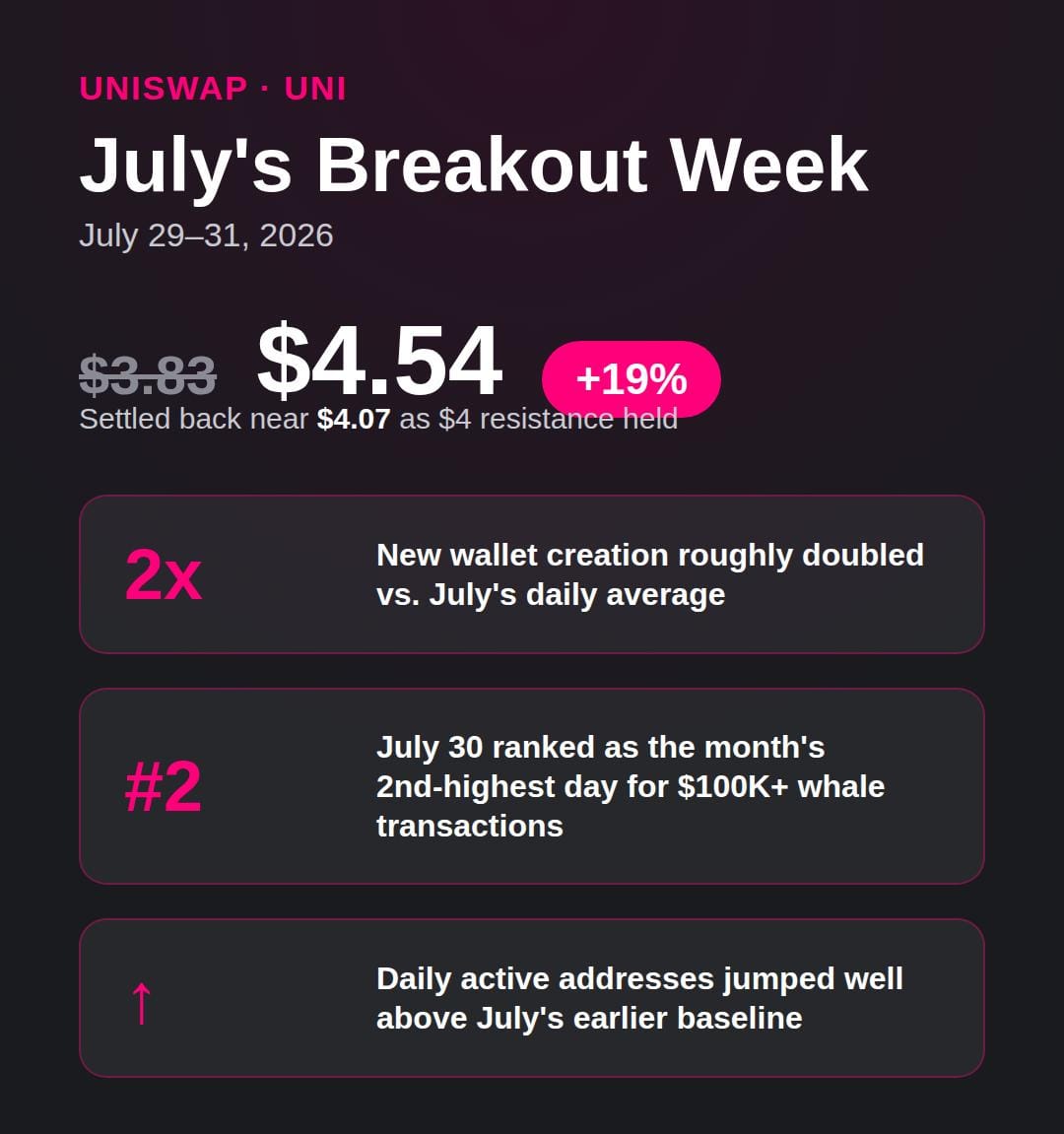

What makes this stretch worth writing about, to me, isn’t the percentage move itself, it’s that the move landed in the exact 48-hour window following a specific, verifiable governance execution, not a rumor or a speculative narrative. I’ve seen enough crypto rallies built on nothing to know the difference matters.
Inside Governance Proposal 100 And 99
On July 27, 2026, two Uniswap governance proposals executed on-chain within minutes of each other. Proposal 100, “Activate v4 Protocol Fees (Part 1/2),” passed with 46,604,583 UNI in favor against 1,274,746 opposed, clearing the 40 million quorum with room to spare and executing at 7:54 am UTC. Its companion, Proposal 99, “Protocol Fee Expansion: Robinhood Chain,” passed even more decisively, 46,881,791 for versus zero against, executing minutes earlier at 7:44 am UTC. I like that both proposals are logged with their full onchain execution transactions directly on Etherscan, so I didn’t have to take anyone’s word for the vote outcome, I could just go check it myself.
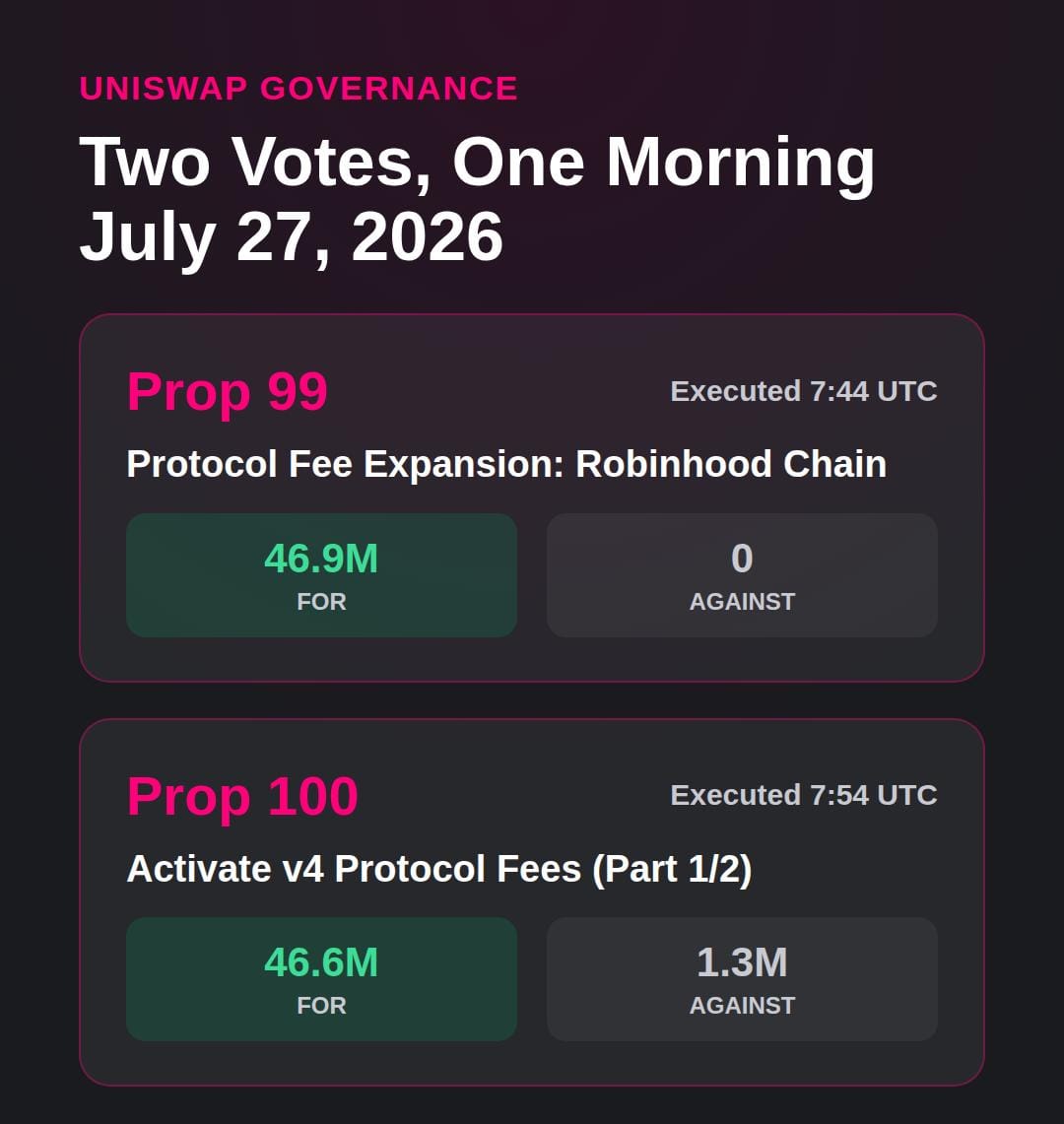
Together, the two proposals turned on protocol fees for select v4 pools across seven networks, Ethereum, Arbitrum, Base, BNB Chain, Polygon, OP Mainnet, and Robinhood Chain, extending a framework that governance first approved under the UNIfication proposal back in December 2025.
How The Burn Mechanism Actually Works
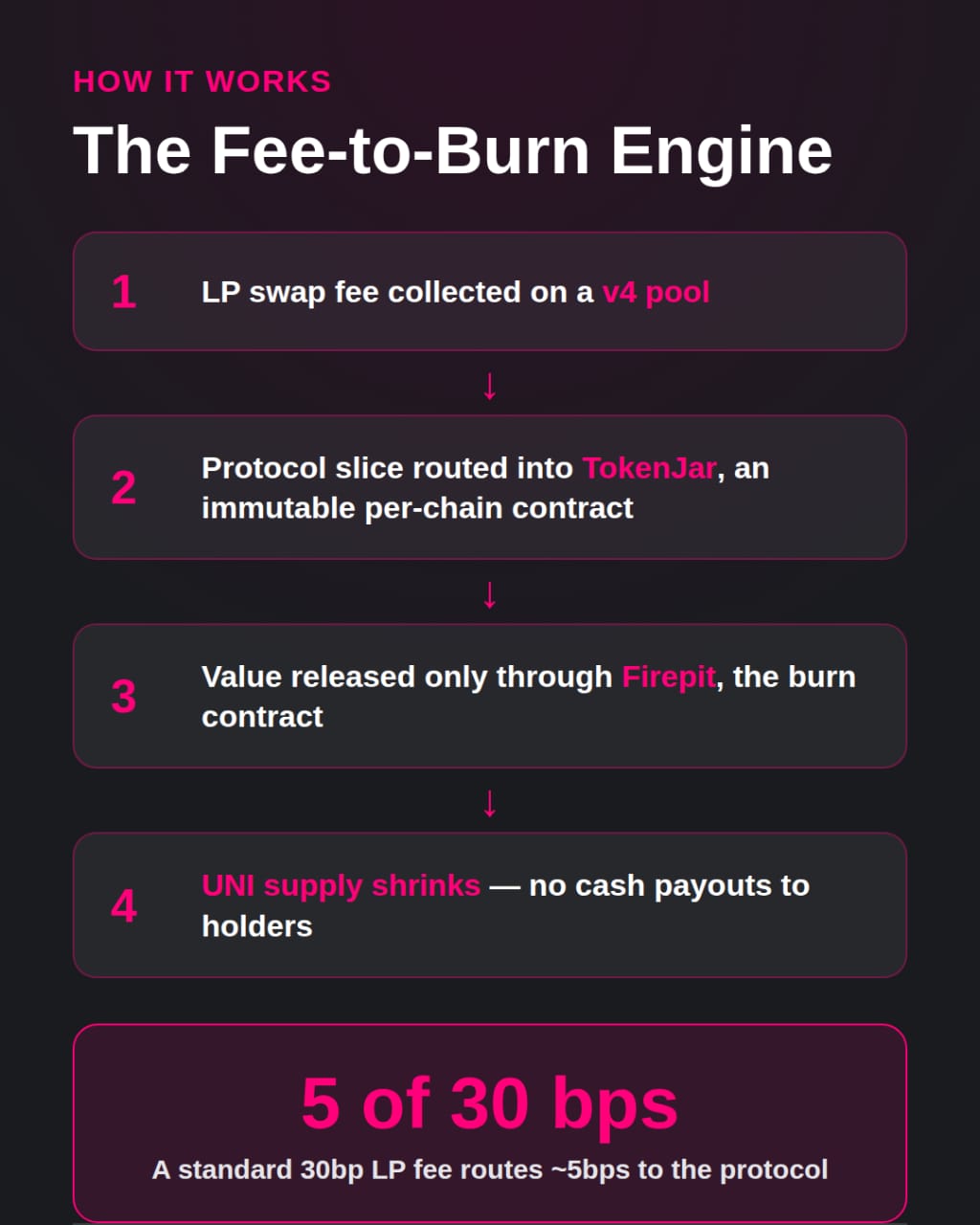
This is the part I think people skim past, but it’s genuinely the whole story once you sit with it. Fees collected under this system don’t get paid out to UNI holders directly. Instead, they flow into an immutable per-chain contract called TokenJar, and the only way to pull value back out of TokenJar is by burning UNI through a companion contract called Firepit, as laid out in Uniswap’s own protocol fee documentation.
That structure is deliberate, and honestly I think it’s a smart piece of design, it ties protocol revenue to a shrinking token supply instead of something that looks like a dividend, which sidesteps a lot of the regulatory ambiguity that kept this fee switch dormant for years. On the fee sizing itself, Proposal 100’s own published rate table shows the mechanics precisely: a pool charging a standard 30 basis-point LP fee now routes roughly 5 basis points of that to the protocol, based on a curve governance approved directly in the proposal text. What I appreciate here is that the full v4 fee-adapter contracts and deployment addresses are published openly on Uniswap’s GitHub, so I could go verify the entire mechanism myself, line by line, rather than trusting a summary.
Robinhood Chain Added Fuel To The Fire
Part of why Proposal 99 mattered so much, in my read of the timeline, comes down to timing. Robinhood Chain, an Arbitrum-based Layer 2, went live on July 1, 2026, and Uniswap was a day-one partner there, with v2, v3, v4, and UniswapX all deployed as the chain’s primary public AMM, according to Uniswap Labs’ own launch post.
By July 10, cumulative swap volume on those Robinhood Chain deployments had already crossed $6 billion, a figure confirmed directly in the text of Proposal 99 itself. When I lined the dates up, extending the fee-and-burn mechanism to that chain right as its volume was ramping meant the burn engine picked up a fast-growing, fee-generating venue at almost the same moment it flipped on, not months later, once the excitement had already faded.
What The On-Chain Activity Shows
Set against that backdrop, the address and whale activity I mentioned earlier starts to make a lot more sense to me. New addresses roughly doubled over July 30 and 31 compared with the month’s earlier daily average, active addresses on those same two days ran well above anything else logged in July, and whale-sized transactions above $100,000 hit their second-highest single-day count of the month on July 30. To me, that’s a pattern of both new participants and existing large holders reacting to the same 48-hour governance event, not two unrelated things that just happened to overlap.
What Comes Next For Uniswap
I want to be careful not to oversell this. None of it locks in anything. The pullback from $4.54 back to around $4.07 shows resistance near the $4 handle hasn’t fully broken yet, and Proposal 100 itself is explicitly labeled “Part 1/2”, five more chains, including Celo, Soneium, X Layer, Worldchain, and Zora, are still waiting on a follow-up vote before v4 fees go live there too.
Whether UNI holds its July gains into August will likely come down to whether swap volume across these newly fee-enabled pools stays strong, since the entire burn engine only works as fast as the fees actually flowing into TokenJar. Still, for a month where most of the top 30 just chopped sideways, I think Uniswap is one of the few names where the price move, the governance record, and the on-chain activity all point in the same direction and in my experience, that’s a rarer combination than it sounds.
Disclosure: This is not trading or investment advice. Always do your research before buying any cryptocurrency or investing in any services.
Follow us on Twitter @themerklehash to stay updated with the latest Crypto, NFT, AI, Cybersecurity, and Metaverse news!




Be the first to comment