




TLDR
- Two Uniswap governance proposals open for voting July 19–26
- One activates v4 protocol fees across seven chains for the first time
- A second proposal enables v2 and v3 fees on Robinhood Chain
- Both fee streams would feed the existing UNI burn mechanism
- Robinhood Chain crossed $6 billion in cumulative Uniswap swap volume within ten days of launch
Uniswap governance is set to vote on two proposals that could expand the amount of UNI burned from circulation. Voting opens July 19 and runs through July 26.
The first proposal would activate protocol fees on selected Uniswap v4 pools. This would cover Ethereum, Arbitrum, Base, BNB Chain, Polygon, Optimism, and Robinhood Chain. It is the first time v4 fees have been put to a governance vote.
We just submitted two Uniswap governance proposals for final onchain vote:
1) v2 + v3 protocol fees on robinhood chain
2) v4 protocol fees on ethereum, base, arbitrum, robinhood, bnb, polygon, optimism(third proposal with remaining v4 chains coming soon)
Both direct all new… pic.twitter.com/NUCXxegnte
— Hayden Adams 🦄 (@haydenzadams) July 17, 2026
The second proposal, submitted by Uniswap founder Hayden Adams, would turn on v2 and v3 fees on Robinhood Chain. Uniswap launched all three protocol versions on the network when it went live on July 1.
Robinhood Chain is an Ethereum Layer 2 built on Arbitrum’s tech stack. Its Uniswap deployments crossed $6 billion in cumulative swap volume by July 10, just ten days after launch.
Analyst BATMAN, known on X as @CryptosBatman, highlighted UNI’s momentum on July 13. He pointed out that UNI is the primary automated market maker for Robinhood Chain, which he said adds more revenue to the protocol. He noted the chart was showing a breakout and called a retest a solid entry area.
$UNI has been gaining traction.
This is due to the bullish sentiment created by Robinhood.
UNI is the primary automated market maker for Robinhood Chain, which adds more revenue for them.
The chart is pricing it in through a breakout.
A retest would make a solid entry area. pic.twitter.com/DV036wBm0D
— BATMAN ⚡ (@CryptosBatman) July 13, 2026

Both proposals route collected fees into Uniswap’s TokenJar system. Searchers claim accumulated fee assets by providing UNI of equal value. That UNI is then sent to a burn address. Fees collected on other chains are bridged back to Ethereum before being destroyed.
Adams said on X: “Based on current volumes, especially Robinhood, we expect the impact on UNI burn to be substantial.”
How v4 Fees Work Differently
Activating fees on v4 required new infrastructure. Unlike v2 and v3, which use fixed fee tiers, v4 pools can use hooks and dynamic fees that change block to block.
The proposal introduces a V4FeePolicy contract to calculate fees and a V4FeeAdapter to apply governance rules. Pools are sorted into “families” and fees are computed from a set of rules rather than set pool by pool.
A second v4 vote covering five more chains — Celo, Soneium, Worldchain, X Layer, and Zora — is planned separately. Uniswap’s GovernorBravo contract limits each proposal to ten onchain actions.
UNI Burn Activity Before the Vote
The UNI burn mechanism launched as part of the “UNIfication” overhaul passed in December 2025 with 99.9% support. That vote activated fees on v2 and v3 Ethereum mainnet pools and burned 100 million UNI from the treasury.
The rollout has since expanded to 11 chains. The protocol burned a record 186,000 UNI in a single day last month.
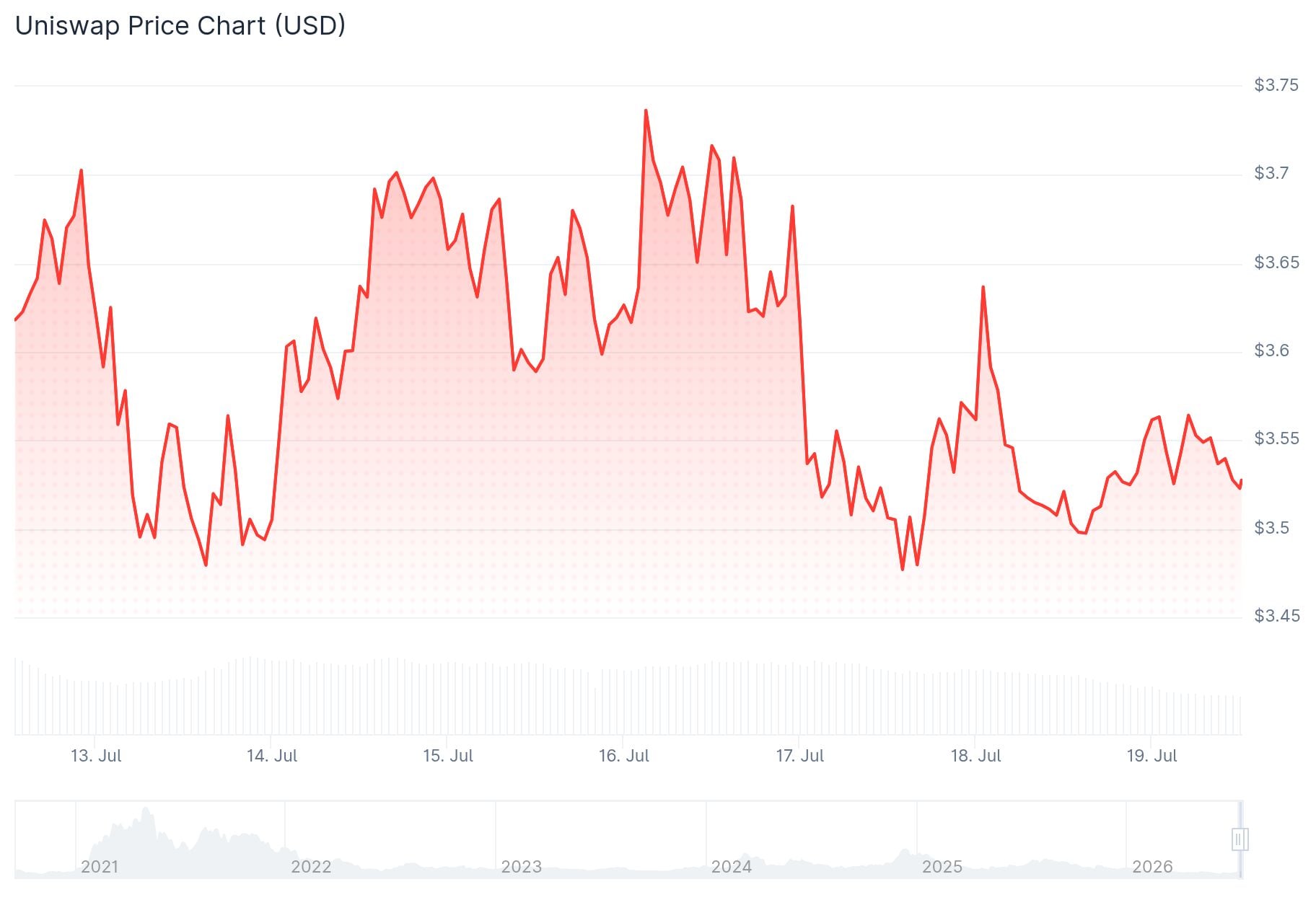
UNI is currently trading around $3.50.



Be the first to comment