


An unidentified private chain has appeared on Chainlink’s CCIP tracker, drawing attention after 124 messages were exchanged between the private environment and Ethereum.
The activity was evenly split, with 62 messages sent and 62 received. That pattern looks more like controlled testing than ordinary user traffic, especially because the chain is not publicly named on the tracker and appears to sit outside the usual set of consumer-facing public networks.

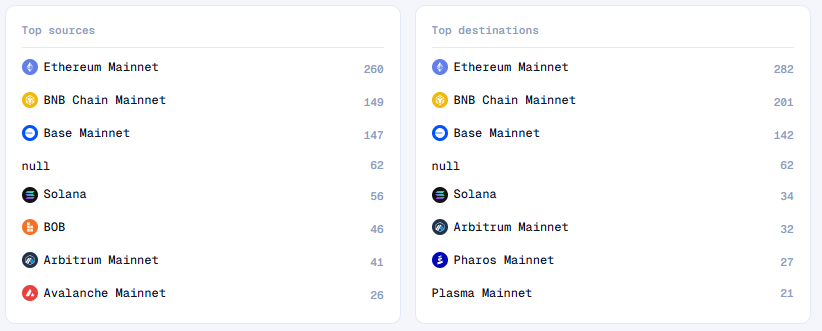
The chain identity has not been confirmed by Chainlink, DTCC, Swift, or any other institution. The visible data only shows cross-chain message activity between Ethereum and an unnamed private chain. That makes the activity notable, but not enough to assign it to a specific financial-market project.
Why The Message Pattern Stands Out
A small, balanced set of messages between Ethereum and an unidentified private chain can indicate a test lane, integration check, proof-of-concept workflow, or early production-readiness exercise. The exact 62-and-62 split suggests two-way messaging rather than a one-direction transfer burst.
For Chainlink, that matters because CCIP is built for more than token bridging. It can move messages, instructions, and transaction data across public and private blockchain environments. In institutional use cases, that can support settlement instructions, asset servicing records, collateral workflows, compliance-controlled transfers, and private-chain interactions that still need public-chain connectivity.
The activity also fits the privacy design Chainlink has been building for financial institutions. Chainlink’s privacy stack lets private chains connect to public blockchain infrastructure while limiting what outside observers can see. CCIP Private Transactions are designed to keep sensitive information such as token amounts, counterparties, and data instructions confidential while still using the public CCIP network.
DTCC And Swift Drive The Speculation
The institutional speculation comes from timing. DTCC is building its Collateral AppChain with Chainlink infrastructure, aiming to support near-real-time collateral management, valuation, margining, optimization, and settlement across financial markets. The platform is expected to go live in Q4 2026.
DTCC is also pushing tokenized market infrastructure through other rails. Its recent Stellar collaboration is designed to connect DTC’s tokenization service with Stellar and allow DTC-custodied assets to be represented on a public blockchain once the service is ready. That separate project does not identify the private CCIP chain, but it shows how quickly DTCC is moving from pilots toward production-style tokenization infrastructure.
Swift has also worked with Chainlink on blockchain connectivity for financial institutions, including projects that allow banks to connect to public and private chains through existing Swift messaging standards. That work has covered tokenized asset settlement, fund subscription and redemption workflows, and corporate actions data across traditional and blockchain systems.
Those projects explain why traders are watching any private-chain activity on CCIP closely. A private chain connected to Ethereum through CCIP could fit the technical shape of institutional infrastructure, especially for tokenized collateral, asset servicing, settlement testing, or controlled financial messaging.
The link remains unconfirmed. The unknown chain could also belong to another enterprise, private appchain, internal test environment, market infrastructure provider, or pilot unrelated to DTCC or Swift.
LINK Traders Watch Institutional CCIP Signals
The activity lands during a stronger institutional narrative for Chainlink. CryptoAdventure recently covered how Chainlink network growth has outrun LINK price action as CCIP usage, enterprise interest, and tokenized-asset infrastructure continued expanding.
Chainlink’s role is also widening beyond DeFi oracles. Mastercard and Chainlink recently moved deeper into onchain crypto buying through card rails, while CCIP remains one of the core tools connecting public chains, private chains, payment systems, and tokenized assets.
For LINK holders, the unknown private-chain activity adds another data point to the same thesis: Chainlink is trying to become the interoperability and data layer for both DeFi and regulated financial infrastructure. The token still needs stronger market follow-through, but institutional CCIP activity gives bulls a clearer adoption story than ordinary bridge volume alone.
Confirmation Is Still Needed
The main risk is over-attribution. A private chain appearing on CCIP does not automatically mean DTCC, Swift, a bank, or a major asset manager is behind it. Institutional systems often use private networks, but so do test environments, enterprise pilots, and internal developer deployments.
The confirmed activity is narrow: an unidentified private chain exchanged 124 messages with Ethereum through CCIP, with 62 messages moving each way. That is enough to show a live cross-chain path, not enough to identify the owner or purpose.
A named lane, a Chainlink disclosure, a tracker update, or an announcement from a financial institution would change the story quickly. Until then, the activity sits in the same category as other early institutional blockchain signals: visible enough to matter, but still too limited to call a confirmed DTCC, Swift, or bank deployment.



Be the first to comment