

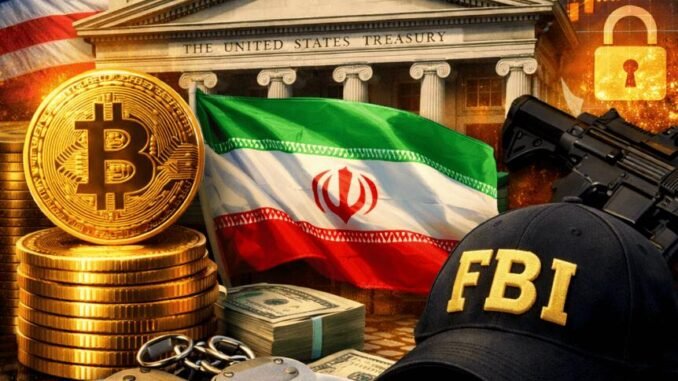

The United States has seized roughly $1 billion in Iranian cryptocurrency assets, Treasury Secretary Scott Bessent announced at the Reagan National Economic Forum. He characterized the action as a direct disruption of illicit financial activity, describing it as an outright grab of wallets that some owners may not yet realize have been emptied. The disclosure situates the seizures within a multiyear effort to constrain Iran’s access to international financial networks and to press its leadership economically.
Bessent said the seizures are part of a broader pressure campaign against Iran, known as Operation Economic Fury. Launched in March 2025, the operation combines cryptocurrency takedowns, banking account freezes, and coordinated asset confiscation with European partners. He framed the effort as a sustained, comprehensive push designed to “cut them off” financially, noting that the trajectory over the past five-and-a-half to six weeks has been remarkably effective. “Between five and a half to six weeks of an incredibly successful military campaign and Operation Economic Fury, where we have really cut them off. They are at the end of their Tether now financially,” he stated.
Key takeaways
- The United States reports roughly $1 billion in Iranian crypto assets seized through Operation Economic Fury, including wallet-level takedowns.
- The newly disclosed figure is about twice the $500 million previously announced in late April and well above the $344 million disclosed earlier in the month.
- Officials describe Iran’s financial situation as dire, with high inflation, internal funding pressures, and disruptions to state services and military payrolls.
- The seizures illustrate intensified cross-border enforcement and international cooperation, with implications for crypto compliance, sanctions screening, and banking access for sanctioned states.
- Policy conversations around crypto-enabled shipping and revenue mechanisms—such as Bitcoin-based incentives for Hormuz transit—signal broader state-influenced use cases for digital assets, pending regulatory scrutiny.
Asset seizures: scale, method, and regulatory context
According to officials, the $1 billion in Iranian crypto assets seized under Operation Economic Fury represents a significant escalation in exploiting blockchain-traceable funds linked to sanctioned activity. The strategy appears to rely on identifying wallets associated with state-backed or proxy actors, then applying enforcement measures that repurpose or redirect the assets through compliant channels. The approach also reflects the United States’ broader sanctions toolkit, which increasingly treats certain digital assets as subject to traditional financial and export-control regimes.
The Treasury’s disclosures underscore a shift in how authorities frame enforcement risk for crypto-asset holders connected to sanctioned regimes. By publicly detailing wallet-level seizures and the scale of the assets involved, policymakers and regulated institutions gain a clearer baseline for due diligence, screening, and ongoing monitoring. For exchanges, custodians, and banks with crypto-related business lines, the development raises questions about the diligence required to identify sanctioned wallets, the treatment of seized or frozen crypto, and the timing of any redress or remediation for affected customers.

The previously reported figures provide context for the current disclosure. Officials had announced roughly $500 million in Iranian crypto assets seized in late April and about $344 million in crypto assets seized earlier in the month. The latest figure, therefore, suggests a substantial acceleration in enforcement activity within a relatively short window. These milestones have implications for cross-border regulatory coordination, including parallel actions by allied regulators and law enforcement partners in Europe and beyond. For market observers, the trend highlights the growing intersection of sanctions policy with digital-asset compliance requirements and the need for rigorous KYC/AML controls across custody and exchange ecosystems.
Iran’s economic strain and the geopolitical backdrop
Secretary Bessent painted a picture of severe economic strain within Iran, describing a regime that has allegedly siphoned hundreds of millions of dollars monthly and allocated proceeds among a broad leadership cadre. He suggested inflation could exceed 200 percent, with social subsidies being deployed to mitigate cost-of-living pressures and widespread internet restrictions affecting communications. Reports cited by officials indicate that a substantial portion of Iranian troops have faced delayed or disrupted pay, further complicating the regime’s capacity to project authority and sustain external influence flows.
The statements also reflect the strategic complexity of negotiating with a fractured leadership structure following recent strikes against senior regime figures. While Bessent did not hinge policy outcomes on these internal dynamics alone, the comments underscore how enforcement actions intersect with diplomatic channels, sanctions policy, and potential leverage in any future negotiations surrounding Tehran’s regional posture and long-term security considerations.
These disclosures come at a moment when the U.S. and its allies continue to calibrate sanctions pressure against Iran, balancing the aims of disrupting illicit financial networks with broader regional stability goals. The clearly articulated message is that crypto assets are not beyond the reach of conventional sanctions enforcement, and that dynamic, rapid actions can be employed to disrupt stated objectives even when actors pivot to digital instruments. For compliance teams and risk managers at financial institutions, the implications are twofold: a heightened emphasis on tracing cross-border crypto flows and an expanded mandate to screen counterparties against sanctioned-entity lists in near real time.
Policy implications and regulatory coordination
Beyond the immediate asset seizures, observers are examining the regulatory and policy ramifications for the crypto industry. The operation demonstrates a continued hard line on sanction enforcement, potentially accelerating the development of best practices around sanctions screening, wallet clustering analysis, and the cross-jurisdictional sharing of intelligence related to illicit fund flows. Firms engaged in custody, exchange, or payment processing face heightened expectations to implement robust monitoring, rapid response protocols, and transparent reporting mechanisms when dealing with funds that may be implicated by sanctions regimes.
In parallel, the focus on state-led crypto strategies—such as potential monetization schemes tied to strategic chokepoints—highlights the need for clear regulatory guardrails around crypto-based insurance, settlement, and revenue-sharing models used by states. As reported by Cointelegraph, Iran has been weighing a Bitcoin-based insurance framework to monetize shipping through the Strait of Hormuz, a project that could generate substantial revenue if implemented at scale and supported by compliant, auditable mechanisms. The proposed platform, termed “Hormuz Safe,” would sell digital marine insurance payable in Bitcoin and settled on the blockchain, potentially enabling more than $10 billion in revenue for the country, subject to regulatory approval and international compliance constraints. A separate report cited that some ships could pass Hormuz in exchange for a Bitcoin-denominated tariff of about $1 per barrel of oil. The development underscores the convergence of sovereign financing strategies and digital asset infrastructure, inviting scrutiny from licensing authorities and international financial regulators alike.
For regulated entities, the evolving environment implies a need for heightened vigilance around sanctioned counterparties, as well as clearer guidance from regulators on the permissibility and treatment of crypto assets tied to state operations. The cross-border dimension—where U.S. actions, European cooperation, and potentially other jurisdictions intersect—will likely shape licensing decisions, oversight practices, and the rigor of AML/KYC programs across the global crypto ecosystem. In this context, ongoing updates from U.S. agencies and international partners will be critical reference points for risk managers, legal counsel, and compliance leaders assessing exposure to sanctioned activities or users with ties to Iran or other restricted regimes.
Closing perspective
The scale of the recent seizures, coupled with Iran’s stated economic and strategic pressures, signals a pronounced trend: cryptocurrency is increasingly entangled with state-level sanctions enforcement and foreign policy aims. As authorities pursue more aggressive asset recovery and cross-border cooperation, firms across the crypto value chain must strengthen their compliance programs, enhance real-time monitoring, and prepare for evolving guidance on sanctioned assets and state-backed financial activities. The coming months will likely reveal further operational details and regulatory responses that define how digital assets interface with traditional sovereignty and enforcement mechanisms.
For further context, authorities and industry observers continue to monitor related developments, including prior disclosures and coverage of Iran-related crypto actions. In particular, Cointelegraph has reported on related seizures and policy discussions, illustrating the ongoing convergence of sanctions policy, crypto regulation, and geopolitical risk management.


Be the first to comment