



A high-profile €23 million crypto case involving Lithuanian businessman Vilhelm German and
Chinese crypto-mining giant Bitmain is shaping up to be a major embarrassment for Lithuanian
law enforcement.
Sponsored
Crypto Prediction Markets
18+ · Gambling involves risk. Play responsibly.
What began as a major fraud prosecution now appears to be descending into a legal fiasco,
after a Lithuanian court dismissed prosecutors’ filings earlier this month over absurdly formed
case material.
A €23m Crypto Mining Case — and a Bizarre Twist
The case centres on Lithuanian businessman Vilhelm German and allegations that he and his
associates fraudulently obtained more than €23 million worth of cryptocurrency-mining
equipment from a company linked to Chinese mining manufacturer Bitmain.
Prosecutors allege that the group arranged to use around 5,400 crypto miners in Lithuania,
damaged some of the equipment and then claimed it could not be used in the country. They
allegedly staged its return and demanded around €700,000 in cryptocurrency from its owners.
German denies the charges, describing the case as a business dispute between Lithuanian and
Chinese companies. He also says he has no direct legal relationship with Exawatt, the entity
that signed the contract with Bitmain, and therefore had no means of taking possession of the
equipment.
But the latest development has shifted the focus away from the alleged fraud itself — and onto
the way the evidence was prepared.
Documents reviewed by DailyCoin show that the prosecution did not question the witnesses,
while it appears to rely on absurd, machine-translated statements that are impossible to
understand.
When Court Evidence Goes Off the Rails
One of the most troubling aspects of the case is the key material originally written in Chinese.
Instead of being properly translated into Lithuanian, it was rendered in a way that consistently
worked against Mr. German, deliberately, it appears, to make him look guilty. When the court
examined the translated material, it was shocked by how grossly inaccurate it was.
One passage became: “Settled soft soft butter plate salty Chen boat plate,” making parts of the
evidence impossible to understand.
Others included: “The Iraqi side should create a white overtime management aircraft” and
“System Agreement for Hash Power Calculation Service.”
There were also phrases such as “Prayer for forgiveness” and “International Red Summit.”
Even names and basic terminology got mangled in translation. German’s surname was
reportedly rendered as “Vokietija” — meaning “Germany” in Lithuanian.
Meanwhile, “Party A” and “Party B” were reportedly translated as “Vakarėlis A” and “Vakarėlis
B”, using the Lithuanian word for “party” in the sense of a social gathering.
The Court Flags Automated Translation
The court has found that a substantial portion of the evidence, originally written in Chinese, had
been translated using the automated non-certified translation tools.
The defence argues that the case had no grounds to proceed before the court — and that it was
ultimately removed from the list of pending cases by court order.
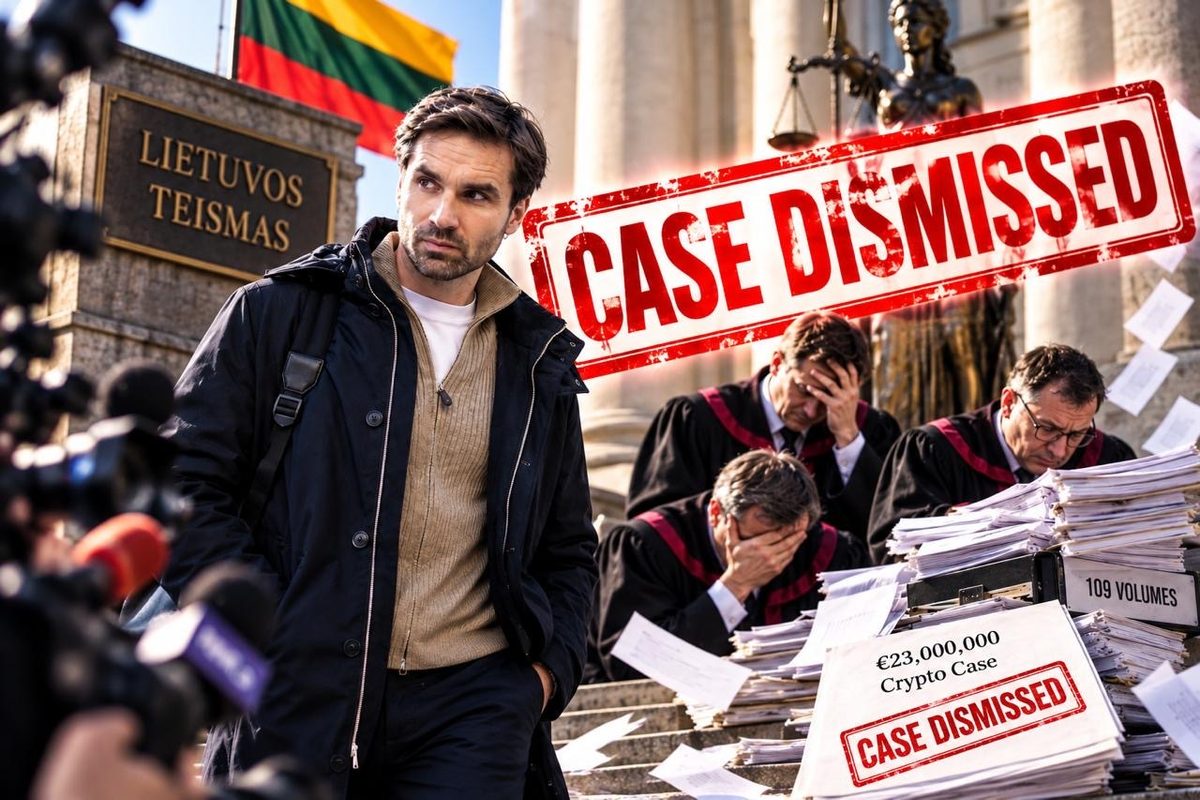
Such a decision is another major blow for prosecutors in the sprawling 109-volume case.
The issue is potentially more serious than a series of bizarre translations. In most EU countries,
machine translation is used mainly as a tool for initial work or review. Court documents
generally have to be translated by certified translators. In Lithuania, criminal case documents
cannot be translated using machine-translation tools.
Prosecutors have gone dead silent over the embarrassing blunder, while Vilhelm German
appears to have walked out of the courtroom as the winner.
A Wider Legal Saga
The crypto-mining case was separated from a wider investigation involving Foxpay, a financial-
technology company linked to German.
Earlier this year, a Lithuanian court also halted proceedings in a separate case involving
Foxpay.
During the pre-trial investigation, German was detained in 2024. He was released in early 2026
after posting €1 million bail.
Cases involving Vilhelm German have repeatedly stalled in court over insufficient evidence.
But the latest episode takes the saga to a whole new level: what was billed as a major fraud
case has instead descended into a complete prosecutors fiasco, with most of the evidence
submitted by prosecutors making no sense.
What Happens Next?
The big question now is not just what happens to the case, but whether the state will end up
paying the price.
German spent time behind bars during the investigation. He is reportedly one of the largest
Bitcoin holders in Europe, and possibly in the world, and he is not expected to let this go quietly.
If his detention is ultimately found to have lacked sufficient legal grounds, the Lithuanian
government could face a compensation claim of a scale it has rarely, if ever, seen.
The question then becomes: how much could German seek in damages?
DailyCoin will be closely monitoring the case and will report on further developments as they
unfold.



Be the first to comment