

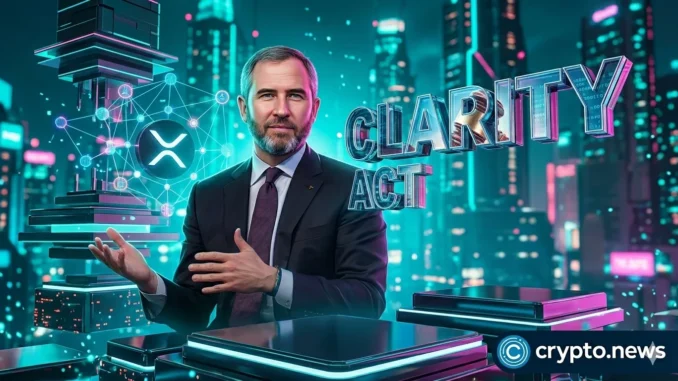


Asked on a podcast whether XRP holders could receive equity in a Ripple public offering, Brad Garlinghouse nodded and floated a “special arrangement.” It was vague, unpromised, and electrifying to a community starved for catalysts. Here is what it could actually mean, and what it almost certainly cannot.
Summary
- Garlinghouse hinted at a possible “special arrangement” for XRP holders.
- He did not announce an IPO, a holder reward, or any concrete mechanism.
- Ripple equity and XRP remain legally separate assets.
- The most realistic benefit to XRP holders is still indirect utility, not equity.
In a June 2026 interview on the “Crypto In America” podcast, Ripple chief executive Brad Garlinghouse was asked a question the XRP community has wanted answered for years: if Ripple ever goes public, could XRP holders get a piece of it?

He did not say no. He nodded, and offered a single tantalizing phrase: that perhaps there would be a “special arrangement.”
That was the entire substance of it, four words wrapped in a maybe, with no detail, no commitment, and no timeline. And yet within hours it had rippled across XRP social media as though a promise had been made, because for a token that has spent 2026 grinding sideways near a dollar while Ripple collects institutional wins, even a hint of direct reward lands like a lightning strike.
This piece takes that hint apart: what a “special arrangement” could plausibly mean, why each version of it runs into a wall, and how a holder should read an offhand remark without getting played by it.
The honest framing matters from the start, because the gap between what was said and what was heard is the whole story. Garlinghouse described a possibility, not a plan, attached to an event, a Ripple public offering, that has not been announced and that he has repeatedly suggested is not close.
The community heard a catalyst. The reality is closer to a maybe attached to a maybe.
That does not make the question worthless, because the answer reveals a great deal about how Ripple equity and the XRP token actually relate, and about why the two keep diverging. This guide covers the moment itself, the legal wall between a company and its token, the genuine ways Ripple’s incentives align with holders, the menu of things a “special arrangement” could be, the obstacles each faces, and the framework for reading the hint with clear eyes.
The four words that lit up XRP social media
To understand why a vague phrase moved sentiment, you have to understand the state of mind it landed in.
XRP holders spent 2026 watching Ripple rack up exactly the kind of institutional milestones the community long predicted: settlements with JPMorgan, stablecoin launches with major partners, a steady drumbeat of bank deals, while the token itself stayed pinned near a dollar and change, beneath every major moving average.
That combination, corporate triumph paired with token stagnation, breeds a particular hunger: the sense that the wins are real but somehow are not reaching holders, and that some missing mechanism could finally connect the two.
Into that hunger dropped Garlinghouse’s nod and his “special arrangement,” and the phrase did what catalysts do in a starved market. It gave people something to hope for.
It helps to be precise about what was actually said, because precision is the first casualty of excitement. Garlinghouse did not announce a holder allocation. He did not describe a structure, a size, or a date.
He responded to a direct question about whether holders could gain equity by acknowledging the possibility in the softest available terms.
Days earlier, at an industry conference, he had been notably cooler on the idea of going public at all, observing that many listed crypto companies have struggled in public markets and that staying private gives Ripple more operational flexibility, while stopping short of ruling an offering out.
Put those two moments together and the picture is not a company preparing to reward token holders. It is a chief executive keeping every option open in public, declining to close a door without committing to walk through it.
The market chose to focus on the open door.
Why a public offering does not normally touch the token
The reason a holder allocation would be remarkable, rather than routine, is that an initial public offering has nothing to do with a token by default.
Ripple the company and XRP the token are legally separate things, and this is the single most important fact in the entire discussion. Ripple is a private company that sells software and payment services, signs deals with banks, holds a large treasury, and has shareholders.
XRP is a cryptocurrency that trades on its own supply and demand. Owning XRP makes you neither a shareholder nor a creditor of Ripple; it gives you no claim on the company’s profits, assets, or equity.
When a company goes public, it sells shares to investors, and the people rewarded are the holders of those shares, the existing equity owners, employees with stock, and early backers. Token holders are simply not part of that transaction, because they own a different asset entirely.
This is why a token is not company equity. A token can be associated with a company, used by a network, and held by that company, but it does not automatically become a claim on the company’s cap table.
This separation is not a technicality Ripple could wave away if it wanted to; it is the structure that governs everything. It is also exactly why XRP has spent the year failing to rally on Ripple’s corporate wins: the market, correctly, prices Ripple’s success as accruing first to Ripple, and only indirectly and slowly to the token.
A public offering would be the purest expression of that disconnect, a moment when Ripple converts its corporate value into tradeable equity for equity holders, with XRP holders watching from outside the deal.
So when Garlinghouse floats a “special arrangement,” he is gesturing at something that would deliberately break the normal pattern, a way to route some benefit of an equity event to holders of a non-equity asset.
That is a genuinely unusual thing to propose, which is part of why the phrase drew so much attention, and also why it deserves hard scrutiny instead of celebration.
The case that Ripple’s incentives already align with holders
Before dismissing the hint as empty, it is worth taking seriously the strongest version of the bullish argument, because it has real merit.
Garlinghouse and many in the community make the point that Ripple’s interests and XRP holders’ interests are already aligned, even without any special mechanism, because Ripple is the largest single holder of XRP in the world.
The company keeps an enormous quantity of the token, much of it in escrow, which means Ripple profits when XRP rises in exactly the way ordinary holders do. Whatever raises the price of XRP raises the value of Ripple’s own holdings.
This alignment is not imaginary, and it should not be dismissed as spin. Ripple’s actual day-to-day work, the partnerships, the payment integrations, the institutional adoption of its ledger and its stablecoin, plausibly increases XRP’s long-term utility and demand, which is a real if indirect benefit to anyone holding the token.
A holder is, in a loose sense, riding alongside the largest XRP whale on earth, one with deep pockets and a decade-long commitment to making the asset useful. That is a meaningful thing to have on your side.
But notice the precise shape of the benefit: it is indirect, gradual, and conditional on Ripple’s broader strategy actually translating into token demand, which, as 2026 has shown, is far from automatic.
That is why Ripple’s wins do not move XRP. The company can succeed, the ledger can gain credibility, and XRP can still wait for direct demand.
Alignment of incentives is not the same as a payment. “Ripple wants XRP to go up” is a very different proposition from “Ripple will hand XRP holders a slice of its IPO.”
The first is structural and real. The second is the speculative leap the “special arrangement” comment invites.
What a “special arrangement” could actually look like
So what could Garlinghouse plausibly mean?
Since he gave no detail, the honest approach is to map the realistic possibilities and weigh each, treating them as a menu of speculation rather than a forecast.
The most direct version would be some form of allocation to holders: a mechanism by which verified XRP holders receive shares, or the right to buy shares, in a Ripple offering, perhaps proportional to holdings. This is the version the community dreams of, because it would convert XRP ownership into a claim on Ripple equity, the very link that does not currently exist.
A softer variant would be priority access instead of free equity, letting XRP holders into an offering ahead of the general public, a perk without a giveaway.
Other versions stay within the token world instead of crossing into equity. Ripple could, in principle, pair any public listing with a token-side reward, an airdrop of XRP or of a new instrument to holders, timed to the event, which would sidestep the thorniest securities problems of distributing actual shares.
It could create a loyalty or staking-style program that rewards long-term holders around the listing. Or “special arrangement” could be far more modest than any of this, a governance gesture, a symbolic recognition, or simply Ripple structuring its business so that more value flows through XRP over time.
The range is enormous precisely because the phrase was empty, stretching from a genuine equity allocation at one end to a vague promise of goodwill at the other.
The community heard the first. Sober reading has to consider that the truth, if there is one at all, could sit anywhere along that spectrum, and that the most dramatic interpretations are also the least likely.
Why each version runs into a wall
The reason to temper expectations is that almost every concrete version of a “special arrangement” collides with serious obstacles, which is likely why Garlinghouse spoke in hints instead of specifics.
Distributing actual equity to XRP holders would be a securities and compliance nightmare. XRP holders number in the tens of millions, scattered across the globe in every regulatory jurisdiction imaginable, many anonymous, many in countries where Ripple cannot easily offer securities at all.
Identifying who qualifies, verifying them, and distributing shares in compliance with the securities laws of dozens of nations would be staggeringly complex. An offering is already one of the most heavily regulated events a company undertakes, and layering a novel token-holder allocation on top invites exactly the kind of legal risk that underwriters and regulators recoil from.
Token-side rewards avoid the equity problem but introduce others. An airdrop to holders raises its own securities questions in some jurisdictions and does nothing to address the fundamental issue that the token and the company remain separate.
Priority access to an offering is more feasible but far less exciting, and even that requires a workable, compliant way to identify genuine holders.
Fairness is another wall. Any arrangement that rewards holders as of a certain date invites accusations of favoring insiders or enabling gaming, and Ripple has spent years cultivating a reputation for regulatory caution it would be loath to jeopardize.
There is also a simple precedent vacuum. No major company has paired a public offering with a direct reward to holders of a separate, associated token, because the structure is awkward, legally fraught, and of uncertain benefit to the company doing it.
The absence of precedent is not proof it cannot happen. But it is a strong signal that “special arrangement” is far easier to say into a microphone than to build into a deal.
The catalyst-stack problem: not all catalysts are equal
The “special arrangement” comment is best understood as one entry in a larger habit, the tendency of the XRP community to treat every Ripple-related signal as part of a single, accumulating stack of catalysts that will eventually send the token higher.
In that mental model, a settlement with JPMorgan, an ETF inflow, a favorable regulatory development, and a hint about an IPO reward all get tossed into the same bucket labeled “reasons XRP will moon.”
The problem is that the items in that bucket are not equal, and treating them as interchangeable is how holders end up disappointed when the price does not respond the way the headline count suggests it should.
The useful distinction is between observable catalysts and speculative ones. CLARITY Act passage, ETF inflows, exchange-reserve changes, and real settlement volume are observable: they either happen or they do not, and when they happen they can be measured and priced.
A possible reward attached to a possible public offering is a different category entirely. It is a speculative possibility layered on a corporate decision that has not been made, with no structure, no size, and no date.
That is why where real XRP demand comes from matters more than IPO speculation. ETF inflows, exchange reserves, and actual XRP usage are measurable; a possible arrangement is not.
Stacking that on top of observable catalysts as though it carries equal weight inflates the apparent bull case without adding anything solid to it.
The discipline that protects a holder is to sort the stack honestly: give real weight to things that are happening and can be tracked, and treat a hint about an unannounced arrangement tied to an unannounced offering as what it is, a low-probability, high-uncertainty maybe that belongs at the very bottom of the pile, not the top.
Why Ripple may stay private anyway
There is a further reason to keep the hint in perspective, and it sits one level up: the public offering the “special arrangement” is attached to may not happen any time soon.
Garlinghouse has been openly ambivalent about going public, noting that staying private gives Ripple operational flexibility and pointing out that many crypto companies have not fared well in public markets.
He has said plainly that an offering is not something happening very soon, even while declining to rule it out. Ripple is also not a company under pressure to list: it is well capitalized, profitable in its core business, and sitting on a large XRP treasury, which removes the usual urgency that pushes firms toward public markets to raise cash.
This is the part the excitement tends to skip. A reward to holders is conditional on an offering, and the offering itself is uncertain, which makes the reward doubly contingent.
If Ripple chooses to stay private for years, as its chief executive’s comments suggest is entirely possible, then the “special arrangement” remains permanently hypothetical, a thing that could only exist alongside an event that may never come in the form imagined.
Even in the bullish scenario where Ripple does eventually list, the company would face every obstacle described above when deciding whether to build a holder mechanism. The path of least resistance for any firm going public is the conventional one that rewards equity holders and leaves token holders out.
None of this means Ripple will never reward holders. It means the hint sits behind two locked doors, an uncertain offering and an uncertain mechanism, and a holder banking on both opening is betting on a long chain of maybes.
The deeper reason the equity-token wall exists
It is worth pausing on why the separation between Ripple equity and XRP is so firm, because the community often treats it as an inconvenience Ripple could simply choose to overcome, when in fact it is a protective firewall that serves XRP holders even as it frustrates them.
The wall is not an accident of paperwork. It is the product of years of legal struggle, and dismantling it casually could undo the very thing that makes XRP investable today.
Recall that XRP spent years under a cloud because regulators argued it was an unregistered security, a claim that turned on whether buying the token amounted to investing in Ripple’s efforts and expecting profit from them.
The token’s hard-won legal clarity rests precisely on the finding that XRP, as traded on public exchanges, is not a stake in Ripple. The distance between the company and the token is what lets XRP be treated as a commodity instead of a security.
Now consider what a direct equity link would do to that settlement. If Ripple created a mechanism that tied XRP ownership to a claim on the company’s equity or profits, it would be handing regulators a fresh argument that the token is, after all, a security, an investment in Ripple’s success with an expectation of profit from the company’s efforts.
The arrangement the community dreams of could, in the worst case, drag XRP back toward the exact classification it just escaped, with all the trading restrictions and institutional hesitancy that status carries.
This is the paradox buried in the “special arrangement” hope: the cleanest way to reward holders, by linking the token to the company, is also the way most likely to damage the token’s legal standing.
That is why the catalyst that could codify XRP’s status matters more than a speculative equity link. Legal certainty is valuable precisely because it keeps XRP out of the securities bucket.
It helps explain why Ripple, a company famous for its regulatory caution, would speak only in vague hints rather than concrete plans. A real equity link is not just operationally hard; it is legally hazardous to the asset it would be meant to reward.
This is why the indirect alignment described earlier is not a consolation prize but, in a sense, the safer form of benefit. Ripple driving XRP’s utility and value through its business activity raises the token without making it a security, because the gains come from the token’s own usefulness and demand, not from a contractual claim on the company.
A holder who understands this should be careful what they wish for. The firewall that keeps Ripple’s wins from flowing directly into the token is the same firewall that keeps XRP a commodity, and a “special arrangement” clever enough to breach one might breach the other.
The most valuable thing Ripple can do for holders may be exactly what it is already doing, building utility around the token. The least valuable, or even harmful, may be the dramatic equity link the hint seemed to dangle.
How to read the hint without getting played
The way to handle a moment like this is to separate sentiment from substance, because the two move on very different timescales.
As sentiment, the “special arrangement” comment is genuinely meaningful: it shows Ripple’s chief executive is aware of holder frustration, willing to gesture toward addressing it, and keen to keep the community engaged, all of which matter for a token whose price is heavily driven by community conviction.
A hint like this can move sentiment and short-term price action regardless of whether anything concrete ever follows, and a trader watching narrative flows should not ignore it.
But sentiment is not the same as a plan, and confusing the two is the trap.
As substance, the honest reading is that almost nothing has changed. There is still no public offering announced, no holder mechanism designed, no legal pathway cleared, and no commitment made, only a chief executive declining to close a door while standing well back from it.
For the hint to become real, a holder would need to see two concrete things follow: an actual decision by Ripple to go public, with a filing and a timeline, and then an actual, structured mechanism for involving holders that survives the securities, fairness, and practicality obstacles laid out here.
Until both exist, “special arrangement” is a phrase, not a payout.
The disciplined position is to enjoy the signal for what it reveals about Ripple’s posture toward its community, to give it appropriate, which is to say minimal, weight in any view of XRP’s actual prospects, and to keep one’s attention on the observable catalysts that truly move the token.
The community heard a promise. What Garlinghouse offered was a maybe, and the difference is everything.
Frequently asked questions
What did Garlinghouse actually say about XRP holders and a Ripple IPO?
On a June 2026 podcast, asked whether XRP holders could gain equity if Ripple went public, Brad Garlinghouse nodded and said perhaps there would be a “special arrangement.” That was the full substance: a vague acknowledgment of a possibility, with no structure, size, or timeline attached. Days earlier, at an industry conference, he had been cooler on going public at all, saying staying private gives Ripple flexibility. So the remark was a hint, not a plan or a promise.
Would a Ripple IPO normally benefit XRP holders?
No, not by default. Ripple the company and XRP the token are legally separate. A public offering sells shares and rewards equity holders, employees, and early investors, while XRP holders own a different asset with no claim on Ripple’s equity or profits. This is exactly why XRP has not rallied on Ripple’s institutional wins through 2026: the market prices those wins as accruing to the company first, and only indirectly to the token. A holder reward would be a deliberate break from the normal structure.
What could a “special arrangement” actually be?
Since Garlinghouse gave no detail, the possibilities range widely. The most dramatic would be allocating shares, or the right to buy shares, to verified XRP holders. Softer versions include priority access to an offering, a token-side airdrop timed to a listing, or a loyalty program for long-term holders. The most modest reading is a symbolic gesture or simply structuring Ripple’s business so more value flows through XRP over time. The community assumes the dramatic version, but the truth, if any, could sit anywhere on that spectrum.
Why might a holder reward be hard to deliver?
Distributing actual equity to tens of millions of anonymous, globally scattered XRP holders would be a securities and compliance nightmare across dozens of jurisdictions, layered on top of an already heavily regulated offering. Token-side airdrops raise their own legal questions and do not bridge the company-token gap. Any holder-as-of-a-date reward invites fairness and gaming concerns. There is also little precedent for pairing a public offering with a reward to holders of a separate token, which signals how awkward the structure is in practice.
Is Ripple even going public soon?
Probably not soon, by Garlinghouse’s own account. He has said an offering is not something happening very soon and has emphasized that remaining private gives Ripple operational flexibility, noting that many public crypto companies have underperformed. Ripple is well capitalized and profitable in its core business and holds a large XRP treasury, so it faces little pressure to raise cash through a listing. Because any holder reward is conditional on an offering, an uncertain offering makes the reward doubly contingent.
How should XRP holders treat this hint?
Separate sentiment from substance. As sentiment, the comment matters: it shows Ripple is aware of holder frustration and wants to keep the community engaged, which can move short-term sentiment. As substance, almost nothing has changed, since there is no announced offering, no designed mechanism, and no commitment. For the hint to become real, a holder would need an actual decision to go public and an actual, compliant holder mechanism to follow. Until both exist, it is a phrase, not a payout, and deserves minimal weight.
This article is information, not investment advice. It concerns speculative, unannounced possibilities, and corporate plans, statements, and market conditions can change. Prices and details reflect reporting available as of June 25, 2026. Verify current information with official sources before relying on anything described here.



Be the first to comment