


The Federal Reserve unanimously raised its target range by 25 basis points to 3.75%-4.00%, while officials’ projections pointed to one more increase before year-end.
Key Takeaways
- The Fed raised rates by 25 basis points.
- All 12 committee members supported the increase.
- The target range now stands at 3.75%–4.00%.
- The 2026 rate projection increased to 4.1%.
- Officials project another hike before year-end.
A unanimous vote moves the range
The Federal Open Market Committee approved the quarter-point increase by a 12 – 0 vote, according to the Federal Reserve’s September statement. The decision raised the federal funds target range from 3.50%-3.75% to 3.75%-4.00%.
The Fed said inflation remains elevated and that the increase should support a timelier return to its 2% goal. The unanimous vote indicates that policymakers agreed on the need for tighter policy despite continued uncertainty around the economic outlook.
The statement did not promise another hike or provide a timetable for subsequent action. The separate projections released alongside it provide the clearer indication of where officials currently expect rates to finish the year.
The dot plot lifts the 2026 rate projection to 4.1%
The median federal funds rate projection for the end of 2026 increased to 4.1%, from 3.8% in June, according to the Fed’s Summary of Economic Projections.
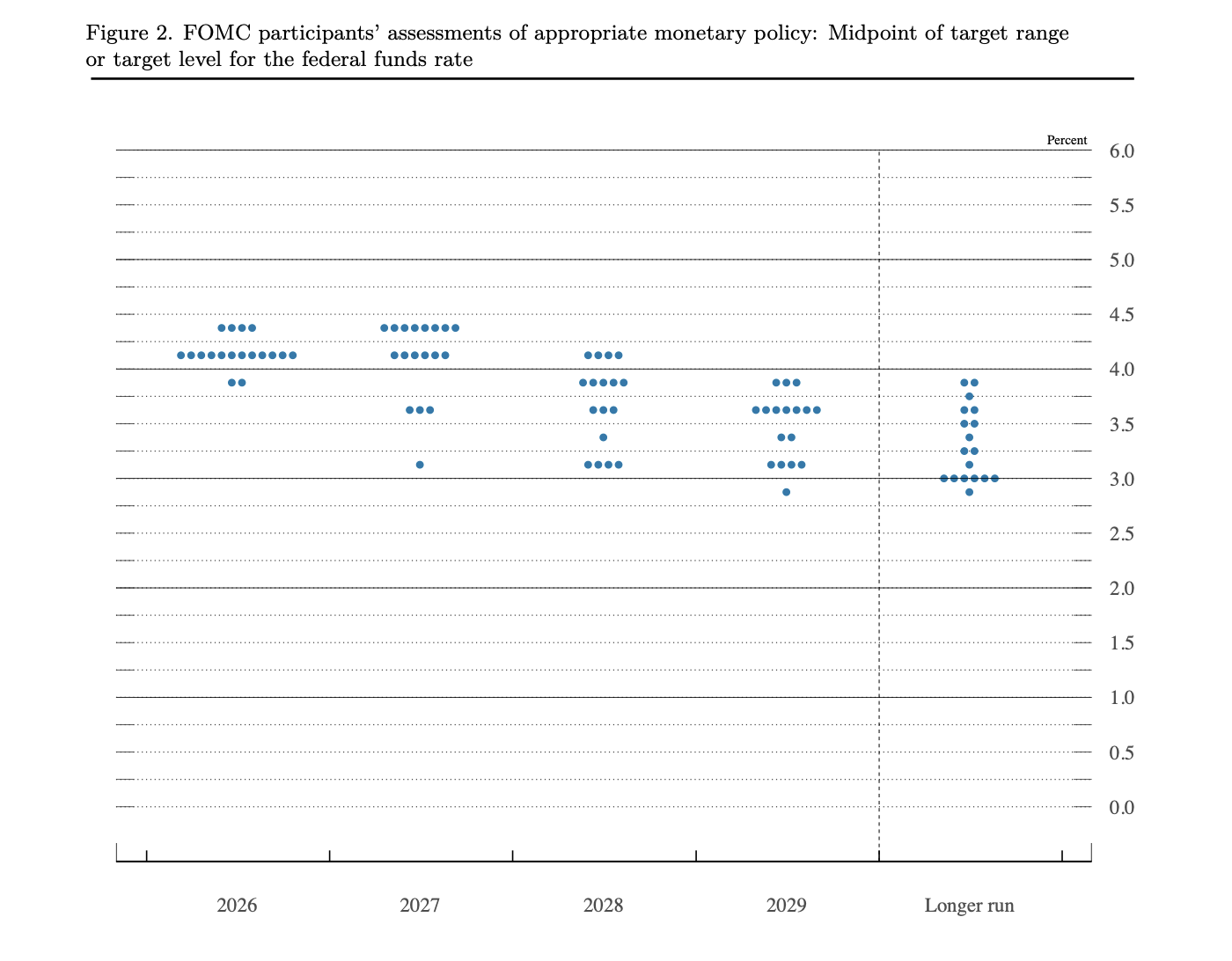
Because the projections are published to one decimal place, the move from 3.8% to 4.1% represents an increase of roughly 25 basis points in the expected policy path. It indicates that the median official now sees one more quarter-point hike before the end of the year.
The calculation begins with the midpoint of the target range. The midpoint of today’s new 3.75%-4.00% range is 3.875%. One additional 25-basis-point increase would take the range to 4.00%-4.25%, with a midpoint of 4.125%. Rounded to one decimal place, that becomes the projected 4.1%.
The dot plot should not be treated as a scheduled decision. Each participant submits an individual forecast based on the policy path they consider appropriate under their economic outlook. The Fed describes that path as “the future path of policy that each participant deems most likely” to meet the central bank’s employment and price-stability mandate.
Attention now turns to Chair Kevin Warsh’s press conference for clues on what would trigger the projected second increase and what evidence could persuade officials to leave rates unchanged instead.
The Fed sees an economy that can absorb tighter policy
The committee did not describe the economy as weak. It said activity continues to expand at a solid pace, domestic spending has remained resilient and capital investment is robust. Productivity growth was also described as strong.
Labour-market conditions provided no clear reason to delay the hike. According to the statement, job gains have kept pace with growth in the workforce, while the unemployment rate has changed little.
That assessment helps explain the unanimous decision. Raising borrowing costs becomes more difficult when employment or spending is contracting sharply because tighter conditions can deepen a slowdown. The Fed’s description instead suggests that demand and employment remain firm enough for policymakers to concentrate on inflation.
The statement acknowledged elevated uncertainty, partly because of geopolitical developments. The committee did not, however, treat that uncertainty as sufficient reason to postpone the increase.
Ample reserves do not cancel the rate increase
The Fed also said it would continue maintaining ample reserves in the banking system. That language describes how the central bank implements monetary policy; it is not a separate decision to make financial conditions easier.
An ample-reserves framework gives banks enough reserve balances for short-term interest rates to remain under the Fed’s control without requiring institutions to compete for scarce reserves. It does not reverse the increase in the federal funds target range or announce a new asset-purchase program.
For crypto markets, the higher policy rate remains the relevant change. The reserves language concerns the operation of the banking system rather than a new injection of speculative liquidity.
PPI and CPI had already moved expectations toward a hike
The Fed acted after two inflation reports that supported tighter policy without delivering a major surprise against forecasts.
August producer prices increased 0.4% from July and 5.4% from a year earlier. The monthly result matched expectations, while energy accounted for much of the pressure in goods prices. Services increased by a smaller 0.1%, preventing the headline figure from showing a uniform acceleration across the economy.
Our analysis of August’s PPI report found that the energy-heavy increase strengthened the case for caution but left consumer inflation to provide the clearer policy signal.
Headline CPI subsequently rose 0.4% during August and 3.4% from a year earlier, matching forecasts. Annual core inflation eased from 2.5% to 2.4%, but the monthly core reading reached 0.3%, above the 0.2% estimate.
The implied probability of a quarter-point increase rose to 85% following CPI. As our examination of the post-CPI market response explained, investors treated the report as firm enough to support one hike without settling whether another would follow. The new dot plot now places that second increase in the median policy projection.
JPMorgan’s baseline covered the hike, not the higher path
Before the decision, JPMorgan identified a 25-basis-point increase without explicit forward guidance as its consensus scenario. The bank estimated that the S&P 500 could gain between 0.25% and 0.75% if the Fed delivered the expected move without committing to a substantially higher rate path.
The increase matched the expected size, but the new dot plot makes the overall package more hawkish than a standalone, no-guidance hike. Warsh’s explanation will show how firmly officials are leaning toward the projected second move.
JPMorgan also considered what would happen if the Fed argued that the neutral interest rate, often called R-star, is higher than previously assumed. A higher neutral rate would imply that the new 3.75%–4.00% range is less restrictive than investors thought. The bank estimated that this interpretation could push the S&P 500 down between 0.25% and 1%.
Its most negative scenario involved Warsh saying that rates need to become materially higher, which JPMorgan associated with a potential equity decline of 1%–2%. These projections apply to the S&P 500, not cryptocurrency. They remain relevant to crypto through the effect of rate expectations on Treasury yields, the dollar and demand for risk. The full analysis was reported by Investing.com.
What crypto traders should monitor after the hike
- Two-year Treasury yield: A sharp increase would indicate that markets are assigning greater probability to the projected second hike.
- Ten-year Treasury yield: An advance could reflect stronger inflation expectations or a higher expected neutral rate.
- U.S. Dollar Index: A stronger dollar would create a more difficult environment for dollar-priced risk assets.
- October and December rate pricing: Fed-funds futures will show which meeting traders view as the likelier point for another increase.
- Spot demand and derivatives positioning: Moves supported by spot volume generally carry more weight than those driven mainly by liquidations or leveraged futures.
These indicators should be considered together. If short-term yields rise while futures assign greater odds to another increase, markets are treating the 4.1% projection as a probable policy path. If those measures remain stable, traders may regard it as conditional on inflation failing to improve.
The burden now shifts to incoming inflation data
The new projection changes the question facing markets. Instead of asking whether another hike is possible, traders must assess what could stop the Fed from delivering the additional quarter-point increase already contained in its median path.
Softer inflation and weaker demand could reduce the need for another move. Persistent price pressure, particularly if it spreads beyond energy, would strengthen the case for lifting the range to 4.00%–4.25% before year-end.
This article is provided for informational purposes only and does not constitute financial or investment advice. Federal Reserve projections are conditional and do not guarantee another rate increase.

Kosta has reported on cryptocurrency markets and blockchain infrastructure since 2020, bringing over six years of hands-on experience in the crypto industry built through daily tracking of markets, trends, and emerging blockchain developments. Specializing in Bitcoin on-chain analysis, institutional ETF flows, and digital asset price action, his work at Coindoo has been cited by other news agencies and consistently covers market developments with a focus on data-driven reporting across Bitcoin, Ethereum, Solana, and XRP.
Over the years, Kosta has contributed to multiple crypto media outlets in different regions, authoring over 6,000 articles across the sector. His reporting spans cryptocurrency markets and the broader fintech industry, tracking not only price action but also the technological and regulatory forces shaping the ecosystem.
To support his analysis, Kosta actively leverages on-chain data and metrics from leading platforms such as Santiment, Glassnode, and CryptoQuant, enabling deeper, evidence-based market insights. He believes in the power of transparency and the data that underpins the blockchain ecosystem.
His academic background in Marketing Management from Denmark further complements his analytical approach, adding a strong understanding of communication strategy and content positioning to his work.


Be the first to comment