


- The size of a crypto transaction tells you more about a business than its revenue model does.
- Stablecoins dominate payments, but the real story is which networks businesses and customers actually use.
- The gap between what a business receives and what it pays out is where infrastructure either scales or breaks.
Most businesses that accept crypto payments operate without reliable benchmarks. They don’t know how large a single transaction should be, which currencies their customers prefer, or whether their payment infrastructure is built for the volume that actually arrives. Every integration decision is a gamble. At NOWPayments, we process millions of dollars in crypto transactions each month, giving us a unique vantage point into real‑world payment behavior across multiple sectors. This article draws on half a year of platform data to surface clear patterns in transaction sizes, currency choices, and operational preferences.
What emerges is a detailed picture of what effective crypto payment infrastructure looks like today. We analyzed every successful incoming payment and completed outgoing payout over that period, aggregating the numbers to reveal which operation types drive the largest transactions, which currencies dominate each sector, and where the biggest payouts occur. The findings offer a practical guide for any business that wants to move beyond guesswork and build payment flows that actually fit the way they operate.
Largest Single Payment by Industry
To understand how transaction sizes differ across sectors, we pulled the single largest successful payment each industry generated during the six‑month period. The table below captures the amount, the currency, and the operation type.
| Industry | Largest Payment (USD) | Currency | Operation Type |
| iGaming | $69,656.50 | USDC | Top-up |
| E‑commerce | $20,165.19 | USDC (BSC) | Invoice |
| Trading | $1,710.35 | USDC (BSC) | API |
| IP‑Telephony | $9,208.65 | USDT (TRC20) | Invoice |
Key findings:
iGaming. A $69,656 top‑up is one player funding a wallet. The top‑up mechanism signals that the user expects instant crediting. The deposit is part of the experience itself, and any delay breaks the session. The operational takeaway: gaming platforms need infrastructure that absorbs six‑figure spikes without hesitation.
E‑commerce. The largest payment, $20,165, arrived as an invoice. That points to B2B activity: a wholesale order or a recurring supply agreement between businesses with an established relationship. Invoices are deliberate and scheduled, so infrastructure must handle large individual payments reliably, but not necessarily in real time.
Trading. A modest $1,710 API deposit topped the list, not because trading platforms move less money, but because their volume spreads across thousands of similar‑sized transactions. None stands out. The operational requirement is consistent throughput and headroom for simultaneous deposits, not capacity for occasional six‑figure spikes.
IP‑Telephony. The $9,208 payment came via invoice, consistent with corporate clients paying for enterprise communication services on a monthly billing cycle. The invoice is the natural interface for that contract‑driven relationship, and the data shows this vertical is already comfortable settling substantial bills in stablecoins.
The wider pattern. The largest payment in iGaming is roughly 40 times the largest in Trading. That spread measures how differently transaction volume is distributed. One industry concentrates value in a handful of enormous deposits. The other spreads it across thousands. Same infrastructure category, entirely different engineering requirements. The first question when building a crypto payment flow is not how much volume will arrive, but what shape that volume takes.
Most Common Currency for Payments
After mapping the largest transactions, the next layer to examine is currency choice. Knowing what customers actually pay with tells you where to focus integration efforts. The table below shows the top three currencies in each vertical, ranked by transaction share.
| Industry | #1 Currency | #2 Currency | #3 Currency |
| iGaming | USDT on TRC20 | USDC on BSC & SOL | SOL |
| E‑commerce | USDC on BSC | USDT on TRC20 | USDC / USDT on ERC20 |
| Trading | USDT on TRC20 | USDT on BSC | USDC on SOL |
| IP‑Telephony | USDT on TRC20 | — | — |
Key findings:
iGaming. USDT on TRC20 dominates, with USDC on BSC and SOL as secondary choices. Low fees and fast confirmation on TRC20 make it the default for players who want deposits credited instantly.
E‑commerce. The top spot splits between USDC on BSC and USDT on TRC20, depending on the merchant. The split reflects different customer bases: retail buyers behave differently from corporate purchasers, even inside the same vertical.
Trading. Currency choice is evenly distributed across USDT on TRC20, USDT on BSC, and USDC on SOL. No single network dominates, which mirrors the multi‑chain behaviour of active traders who want withdrawal and deposit flexibility.
IP‑Telephony. Nearly every payment arrives in USDT on TRC20. For an industry built on recurring B2B invoices, consistency and predictability in settlement currency matter more than optionality.
The takeaway is narrow and actionable: Enable USDT on TRC20 and USDC on BSC, and you cover the vast majority of demand across all four sectors. Everything beyond that is audience‑specific fine‑tuning. The infrastructure already supports these networks natively. The decision is not whether you can turn them on. It is whether you have it.
Dominant Operation Type for Payments
The method a customer uses to pay says as much about a business as the amount or the currency. Across the six‑month dataset, three operation types shaped virtually all incoming transactions: API calls, invoices, and top‑ups. The table below shows which type dominates in each vertical, along with the secondary method where one exists.
| Industry | #1 Operation Type (Share %) | #2 Operation Type (Share %) |
| iGaming | API (85–100% across partners) | Invoice / Top‑up (varies) |
| E‑commerce | Invoice | API |
| Trading | API (100%) | — |
| IP‑Telephony | Invoice (~99.9%) | API (0.1%) |
Key findings:
iGaming. API calls carry almost all player deposits. A few partners also see top‑ups and invoices, but the core flow is automated. When a player deposits, they expect the funds to appear before they place their next bet. The API is the product.
E‑commerce. The vertical splits cleanly between two models. One partner processes virtually all payments through invoices; the other is almost entirely API‑driven. The split reflects different customer relationships: billing a corporate buyer is not the same as checking out a retail shopper.
Trading. Every single incoming payment arrived through an API. There is no secondary method. Trading platforms are fully automated environments where manual invoicing would break the user experience.
IP‑Telephony. Invoices account for nearly every payment. The industry operates on monthly billing cycles with corporate clients, and the invoice is the natural interface for that recurring, contract‑driven relationship.
Key takeaway: The clearest divide in the data separates API‑first industries from invoice‑first ones, and it points to a simple operational rule: your payment method should mirror your customer relationship. Platforms that serve users in real time need automated API flows, while service providers that bill on a schedule need invoices, and the infrastructure for both already exists natively.
Largest Single Payout by Industry
Payments tell half the story. For businesses that hold customer balances, payouts are where the real volume concentrates. The table below shows the single largest outgoing transaction each industry processed during the six‑month window.
| Industry | Largest Payout (USD) | Currency |
| iGaming | $100,000.00 | USDT (TRC20) |
| E‑commerce | $26,200.00 | USDC (BSC) |
| Trading | $27,372.94 | USDT (BSC) |
| IP‑Telephony | $82,320.00 | USDT (TRC20) |
Key findings:
iGaming. A $100,000 withdrawal, larger than the biggest payment in the same vertical. Enormous deposits arrive and equally enormous withdrawals leave, sometimes from the same player within the same week. Liquidity management is not a support function; it is the core operation.
Trading. The largest payout is 16 times larger than the largest payment. Users deposit in moderate amounts, trade, and withdraw in larger sums. The platform is structurally a net sender of funds, which means payout infrastructure carries the operational load.
IP‑Telephony. An $82,320 payout, nearly 10 times the largest payment. Settlement flows move from customers to carriers, suppliers, and partners. The asymmetry is sharp and mirrors any industry where the business sits between end users and backend providers.
E‑commerce. The largest payout, $26,200, tracks closer to the largest payment than in other industries. Payouts to suppliers and partners mirror incoming orders rather than reflecting large-scale user withdrawals.
The common thread is clear: Payouts are fewer but significantly larger than payments across every industry. For any business that sends money out, mass payouts are not a secondary feature. They are the backbone of treasury operations, and the difference between automated batch processing and manual reconciliation at scale is the difference between a business that scales and one that stalls. NOWPayments’ mass payouts solution processes over a thousand transactions in a single click, across hundreds of currencies, with zero withdrawal fees. The infrastructure exists.
Most Common Currency for Payouts
If payments cluster around stablecoins, the payout side intensifies the pattern. The table below shows the top three currencies used for outgoing transactions in each vertical, ranked by share of total payouts.
| Industry | #1 Payout Currency (Share %) | #2 Payout Currency (Share %) | #3 Payout Currency (Share %) |
| iGaming | USDT on TRC20 (~50–100%) | USDT on ERC20 | ETH / SOL / USDT on BSC |
| E‑commerce | USDC on BSC (~15%) | USDT on BSC (~13%) | TRX / LTC / SOL |
| Trading | Tie: USDT‑TRC20, USDT‑BSC, USDC‑SOL, USDC‑BSC | Native USDC | — |
| IP‑Telephony | USDT on TRC20 (100%) | — | — |
Key findings:
iGaming. USDT on TRC20 anchors virtually every operator’s payout stack, with USDT on ERC20 as the secondary rail. ETH and SOL appear as niche options. The consistency reflects a simple reality: when you send thousands of withdrawals a day, you standardize on the cheapest, fastest network available.
Trading. This is the only vertical where payout currency is genuinely fragmented. A four‑way tie between USDT on TRC20, USDT on BSC, USDC on SOL, and USDC on BSC mirrors the multi‑chain behaviour of active traders. A platform that restricts payouts to a single network is turning away users who hold assets elsewhere.
E‑commerce. The payout mix is the most scattered of any industry, spanning stablecoins, TRX, LTC, SOL, BTC, ETH, and DOGE. This is not noise. It reflects the practical need to pay a diverse network of suppliers, freelancers, and partners in whatever currency they accept. A merchant might receive USDC from customers while needing to settle a supplier in TRX and a contractor in LTC.
IP‑Telephony. Every payout flows through USDT on TRC20. For an industry that processes large, recurring settlements, predictability in cost and confirmation time outweighs any benefit of currency optionality.
The operational takeaway splits into two layers: The foundation is USDT on TRC20, which is the universal payout currency across all four industries. Enable it, and you cover the base case. The second layer is multi‑currency flexibility, which matters most for trading platforms and e‑commerce businesses that serve fragmented counterparty networks. A mass payouts API that processes multi‑currency batches in a single call, with off‑chain conversion between assets, handles both layers without adding operational complexity. The infrastructure exists. The question is whether the payout flow is built to match it.
Payments vs Payouts: The Side‑by‑Side Comparison
Putting payment and payout data next to each other reveals the full financial shape of each industry. The table below captures the metrics that matter most when evaluating crypto payment infrastructure: the extremes, the dominant currencies, the preferred operation types, and the average transaction sizes.
| Metric | iGaming | E‑commerce | Trading | IP‑Telephony |
| Largest Payment (USD) | $69,656.50 | $20,165.19 | $1,710.35 | $9,208.65 |
| Largest Payout (USD) | $100,000.00 | $26,200.00 | $27,372.94 | $82,320.00 |
| #1 Payment Currency | USDT (TRC20) | USDC (BSC) | USDT (TRC20) | USDT (TRC20) |
| #1 Payout Currency | USDT (TRC20) | USDC (BSC) | Tie (4 assets) | USDT (TRC20) |
| Dominant Payment Type | API | Invoice / API | API | Invoice |
| Avg Payment Size (range) | $22–180 | $58–152 | $151 | ~$146 |
| Avg Payout Size (range) | $146–15,024 | ~$108 | $16,506 | ~$72,046 |
Key findings:
- Largest payouts outpace largest payments. In every industry, the biggest outgoing transaction exceeds the biggest incoming one, sometimes by a factor of 16. Money arrives in moderate chunks and leaves in larger ones.
- Average payout ranges reveal hidden diversity. iGaming and Trading both show extreme spreads within the same vertical, from a few hundred dollars to over $15,000. Infrastructure must handle the full spectrum without breaking.
- Currency alignment simplifies treasury. The top payment currency is almost always the top payout currency, which reduces conversion friction. When conversion is needed, seamless, low‑cost exchanges between assets keep the process smooth.
- A single integration point removes complexity. Stitching together separate providers for inbound and outbound creates reconciliation debt that grows with volume. An ecosystem approach, where payments, payouts, conversions, and custody sit under one roof, eliminates that complexity entirely.
How NOWPayments Powers These Transactions
NOWPayments is an ecosystem for running a business on crypto, not a lightweight payment gateway. The platform covers the full transaction lifecycle: payment acceptance, mass payouts, custody, asset conversion, and the compliance and operational support that high-volume industries require. Everything runs through a single integration, and the infrastructure is built for the speed, stability, and scale that enterprises and platforms demand.
- API: Instant deposits with 99% of payments processed in under one minute, designed for platforms where the deposit is part of the user experience.
- Invoices: Full lifecycle from generation to settlement, with customers paying in any asset and merchants auto‑settling in stablecoins or fiat.
- Payment links and top-ups: Lightweight hosted checkout for wallet funding and one‑off payments, running on the same infrastructure as API and invoice tools.
- Mass payouts: A core product, not an add‑on: up to 1,000 transactions per click, email payouts in under a second, and zero withdrawal fees across hundreds of assets.
- Custody, conversion, and settlement: Auto‑conversion, off‑chain exchanges at 0.5%, fiat off‑ramping, and multi‑network support, all through a single balance and integration point.
- Enterprise infrastructure and partnership: 99.99% uptime, custom pricing for high‑volume partners, 24/7 support, and compliance and tax guidance as part of a full operational stack that includes monetization tools for affiliates and creators.
Getting Started with NOWPayments
Follow these steps to start accepting payments via NOWPayments:
1. Register or sign in to a NOWPayments account.
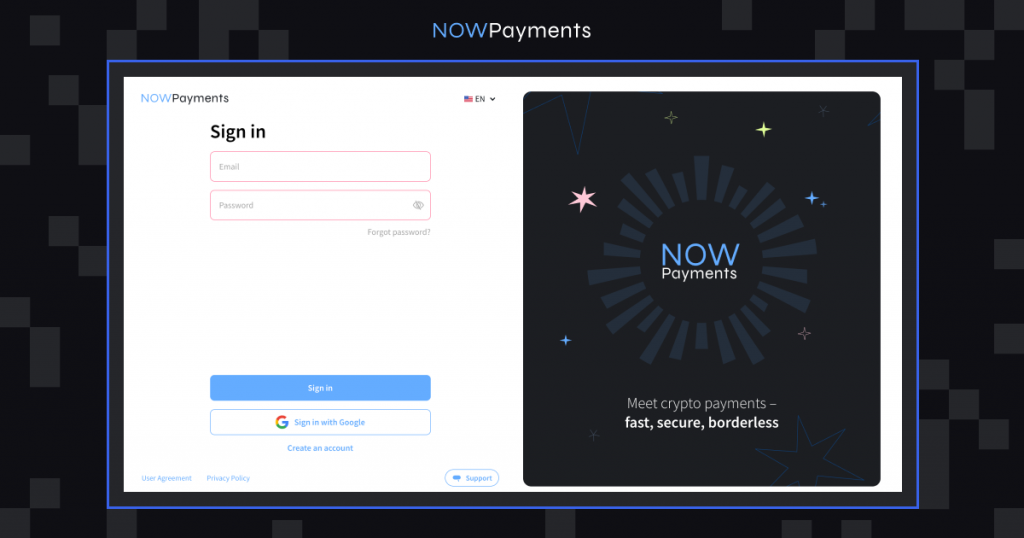
2. Activate the currencies you want to accept payments in.
- Go to Settings → Payments → Coins.
- Type the name of the currency in the search field or use the icon search to find the currency.
- Click on the coin’s image to enable it as a payment currency.
3. Set the chosen currencies as your preferred currency.
- Navigate to Settings → Payments → Payment Details.
- In the Preferred Currencies section, select chosen currencies as your preferred payment method.
4. Choose Your Integration Method
- Payment Link: Simple setup for quick payments.
- API Integration: For custom payment processing and automation.
- Invoices / POS: For invoicing or retail payments.
5. Create Payment Link or Button
- Go to Payment Solutions → Create Payment Link.
- Enter payment details and confirm, selecting XVG as the payment currency.
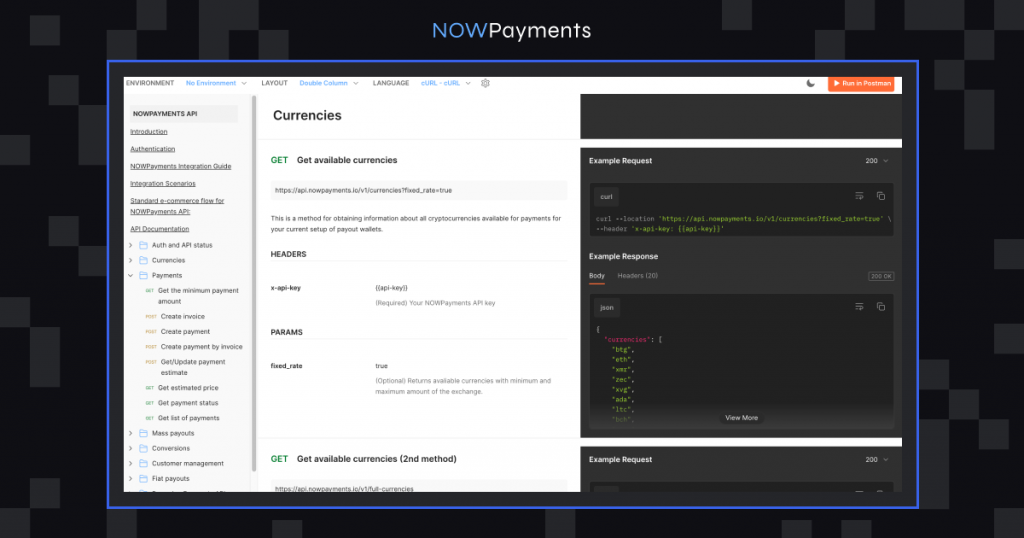
6. Optional: Implement API Integration
- Access API documentation to set up dynamic payment requests using your preferred currency.
- Handle callbacks and automate the payment confirmation process.
7. Share the Link or Button
- Share the payment link directly with customers or embed the payment button on your site.
8. Monitor Payments
- Track and manage incoming payments in your NOWPayments dashboard.
Conclusion
This article set out to show what real transaction data says about how businesses move money in crypto. The picture is sharper than most would expect. Stablecoins own the rails. iGaming operates at a scale that demands infrastructure built for spikes, not averages. The split between API‑first platforms and invoice‑first providers is structural, not cosmetic. And payouts, consistently larger than payments, are where the real volume concentrates.
The NOWPayments platform that surfaced these patterns exists to help businesses capture more value from every transaction by matching the payment flow to actual user behavior. A single integration runs payments, mass payouts, custody, and conversion, so you can tailor the stack to what your industry actually needs. When the infrastructure fits the business model, every transaction acts as a growth lever instead of an operational cost.


Be the first to comment