



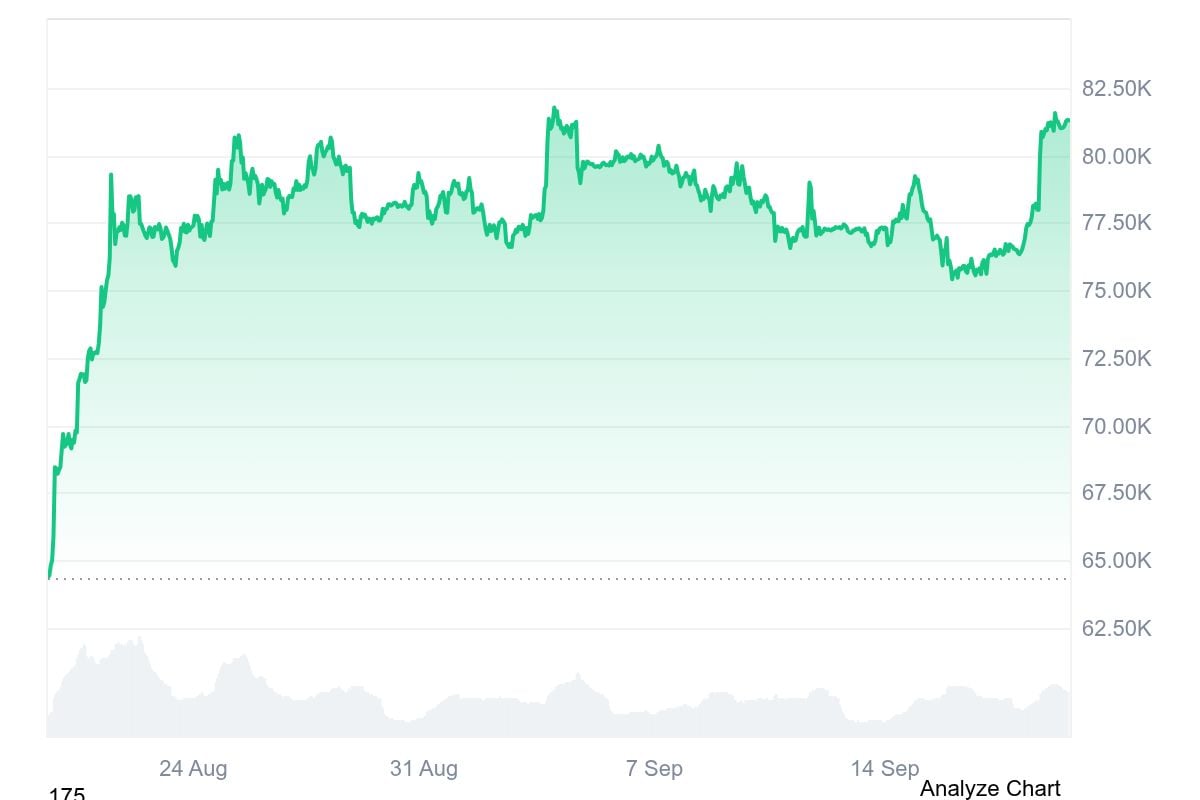
Bitcoin has staged a notable recovery after a turbulent stretch that saw its price fall from the low-$80,000 range to around $75,000 before returning above $80,000.
The move unfolded against a complicated macro and regulatory backdrop. The Federal Reserve raised interest rates for the first time since 2023, while the US Senate failed to advance the Clarity Act, dealing a setback to efforts to establish a comprehensive federal framework for digital assets.
Bitcoin began September trading around $80,000 to $81,000. Its momentum weakened during the first half of the month, however, with the decline becoming more pronounced around Sept. 10. BTC fell to approximately $76,500 and spent the following sessions largely within the $76,000-$79,000 range.

A short-lived recovery on Sept. 14 pushed the price toward $78,200, but buyers were unable to maintain the move. Bitcoin subsequently came under renewed pressure as broader market concerns intensified.
Regulatory and macro risks converge
The sell-off accelerated on Sept. 15, when Bitcoin dropped below $76,000 following the Senate’s failure to pass a procedural vote needed to move the Clarity Act forward.
The legislation requires 60 votes to overcome the Senate’s procedural threshold. The vote fell short, leaving the bill stalled and creating additional uncertainty around the timeline for a US crypto market structure framework.
The setback affected the wider digital-asset market, although its direct implications for Bitcoin are more limited than for many other cryptocurrencies. Bitcoin already operates under a more established regulatory framework in the US, meaning the Senate vote did not fundamentally alter its legal status.
The price decline continued into Sept. 16, with BTC reaching approximately $75,000. Market data at the time also pointed to weaker capital flows across crypto. Glassnode highlighted negative Bitcoin ETF flows, slower growth in new capital entering the market and a slowdown in stablecoin expansion.
The combination of weaker flows and uncertainty around regulation left Bitcoin vulnerable to further selling as it approached the middle of the month.
On Sept. 16, the Federal Reserve increased its benchmark interest-rate target by 25 basis points to 3.75%-4%. The decision marked the Fed’s first rate increase since July 2023.
The rate move itself was widely anticipated. More important for markets was the outlook accompanying the decision. The Fed’s projections pointed to another potential rate increase in 2026 and suggested that interest rates could remain elevated for longer than previously expected.
That environment can make speculative assets less attractive by increasing the appeal of interest-bearing investments and tightening overall financial conditions. Bitcoin nevertheless avoided another major leg lower following the announcement.
ETF Inflows help Bitcoin reverse course
After hovering near $76,000 on Sept. 16 and Sept. 17, Bitcoin suddenly moved higher. BTC gained more than 5% on Sept. 18, briefly trading above $80,000 and reaching approximately $80,700-$80,900, according to market reports. The move effectively erased much of the decline recorded earlier in the week.
The rebound also coincided with a change in Bitcoin ETF flows. US-listed spot Bitcoin ETFs attracted roughly $160 million in net inflows on Sept. 18 after recording outflows during the previous two sessions.
ETF activity has become an important component of Bitcoin’s market structure because flows provide a direct channel through which institutional and traditional-market investors can gain or reduce exposure to the asset. Sustained inflows can therefore coincide with additional spot-market demand, although daily flows can fluctuate considerably.
The move does not, however, resolve the underlying uncertainties. The Fed’s latest projections indicate that monetary policy remains relatively restrictive, while the failure of the Clarity Act leaves the timing of broader US crypto legislation uncertain.
At the same time, the Senate vote did not stop regulatory activity altogether. The SEC and CFTC continued pursuing separate initiatives related to digital assets, meaning the US regulatory process remains active even without the Clarity Act moving forward.
For Bitcoin, the immediate focus is likely to remain on the interaction between institutional flows, monetary policy and broader risk appetite. ETF inflows could provide support if they persist, while renewed outflows or another deterioration in risk sentiment could put pressure on the latest recovery.
Bitcoin’s move from below $75,000 to above $80,000 in only a few sessions underscores the degree of volatility currently present in the market. Whether the recovery develops into a longer-lasting trend or remains part of a broader range will depend on how these competing forces evolve.



Be the first to comment