



The U.S. stablecoin framework, the GENIUS Act, has hit the initial deadline of the 18th of July. Passed into law on the 18th of July 2027, the framework set multiple milestones for its progressive enactment.
For the first year after passage, regulators, including the Federal Reserve and the OCC, were mandated to finalize rulemakings for the GENIUS Act by the 18th of July, 2027.
In 18 months, or by January 2027, the framework should begin taking effect after the regulators publish final rules.
Finally, the transition period will end after three years, by mid-2028. After this, there will be no firm allowed to offer or handle stablecoins in the U.S. without GENIUS Act compliance.
Why are the final rules delayed?
Six regulators have issued 10 rulemaking proposals related to the law. But none of the proposals have been officially completed, at least as of writing. Only six of the proposals have closed their comment period, meaning the regulators could issue final rulings for them.


Still, four other proposals, including Bank Secrecy Act and sanction compliance for FDIC-supervised stablecoin issuers, are still open for comment.
In other words, despite hitting the rulemaking deadline, the GENIUS Act was still far from finalizing key rules.
What’s next for the GENIUS Act?
However, it’s worth noting that in a recent Congress hearing, Kevin Warsh, the chairman of the Federal Reserve, said that the final rules could be issued soon.
We’re racing to put that out (GENIUS Act final rules) by this deadline, this Saturday.
For the banking industry, which has opposed the legislation due to the stablecoin yield loophole, it called for a review of the proposed rules to avoid.
Uneven playing field or opportunities for regulatory arbitrage, unintended policy consequences, or unworkable or incongruous requirements.
How has the stablecoin market responded?
The GENIUS Act is the first formal stablecoins framework in the U.S that aims to advance innovation and protect consumers. To achieve this, it has reserve requirements and anti-money laundering provisions.
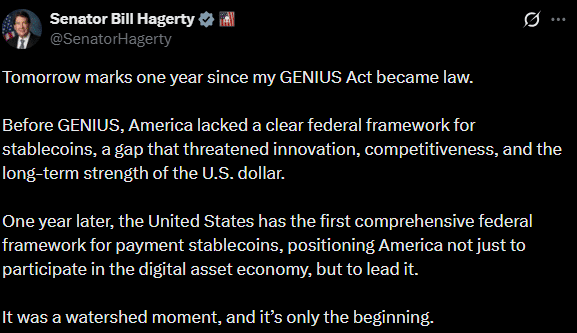
Commenting on the legislation, Senator Bill Hagerty, who co-sponsored it, said,
The United States has the first comprehensive federal framework for payment stablecoins, positioning America not just to participate in the digital asset economy, but to lead it. It was a watershed moment, and it’s only the beginning.
Since the law, the stablecoin market supply surged from $250B to over $300B. Even several firms like Fidelity have begun their stablecoin offerings.
Additionally, some crypto platforms like Phantom recorded a 20% increase in stablecoin balance from $2.33B to $2.82B since the GENIUS Act was passed.
It remains to be seen how the growth will accelerate when regulators publish final rules as the legislation enters its second year.
Final SummaryThe
- GENIUS Act has entered its second year, but final rules will likely stretch beyond the rulemaking deadline
- Stablecoin market supply increased by over $50B after legislation became law, with Sen. Hagerty calling ‘watershed moment’


Be the first to comment