

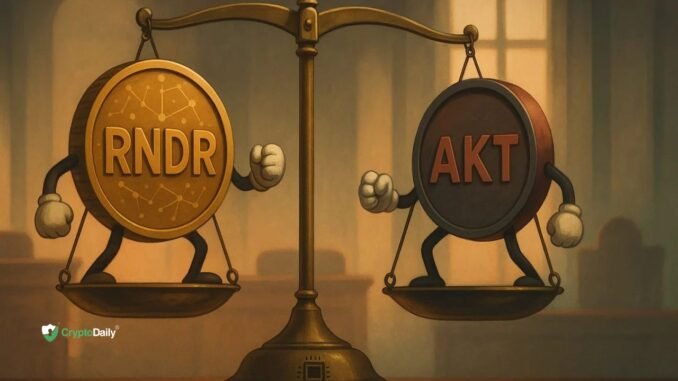

AI models are hungry for compute, and centralized clouds can be pricey, rationed, or closed to smaller teams. That gap has propelled a new class of crypto networks that coordinate GPUs and CPUs in open marketplaces. Two standouts at the center of this trend are Render (RNDR) and Akash Network (AKT).
Both promise permissionless access to compute and a way for hardware owners to monetize idle capacity. Yet they approach the market from different angles, with distinct architectures, pricing models, and token incentives.
This side-by-side analysis looks at how RNDR and AKT work, where they shine, how they price resources, the risks to consider, and what could matter most for builders and token holders. It is not financial advice.

| Point | Details |
|---|---|
| Focus | Render zeroes in on GPU-heavy rendering and AI inference; Akash is a general-purpose decentralized cloud with growing GPU support. |
| Architecture | Render operates on Solana with a job marketplace; Akash is a Cosmos SDK chain with a lease-based compute market via on-chain orders. |
| Pricing | Render emphasizes task quotes and reputation-driven rates; Akash uses a bid/ask marketplace that tends toward a clearing price for leases. |
| Token Role | RNDR is used to pay for completed jobs and reward providers; AKT secures the network via staking, governs parameters, and settles leases. |
| Best Fit | Render suits creative rendering, 3D pipelines, and GPU inference workflows; Akash suits containerized web services, APIs, and training/inference experiments. |
| Key Risks | Workload verification, job failure, token volatility, chain congestion, regulatory uncertainty, and provider reliability on both networks. |
The AI compute bottleneck these tokens try to solve
As models grow and experiments multiply, compute procurement has turned into a bottleneck. Major clouds gate GPUs during demand spikes, early-stage teams struggle with credit limits, and running a fleet of on-prem cards is operationally heavy.
Decentralized compute networks aim to invert that model. Anyone can supply hardware, users can permissionlessly request resources, and pricing can be discovered in a market rather than set by a single provider. Tokens coordinate incentives, payments, and—where applicable—security.
Render and Akash occupy different layers of that vision. Render started with distributed GPU rendering and has expanded toward AI workloads. Akash began as a decentralized alternative to cloud providers and has added a permissionless GPU marketplace for AI. Both are worth watching as AI demand collides with crypto’s open-market design.
Under the hood: How each network allocates compute
Render’s job-first pipeline
Render is built around a task marketplace for GPU jobs. Creators submit rendering or inference tasks, specify quality and budget parameters, and source capacity from independent node operators. Payments and reputation flow through the RNDR token on Solana. The network leans on mechanisms such as reputation, job redundancy, and partial result validation to keep outputs reliable. Integrations with existing creative tools help match specialized workloads to suitable GPUs.
Put simply: Render brokers specialized GPU work from creators to operators and pays for verified results in RNDR.
Akash’s lease-based cloud market
Akash is a Cosmos-based chain that matches buyers and sellers of compute through on-chain orders. Users define containerized workloads (e.g., Docker images) with resource requirements and a max price. Providers advertise inventory and minimum acceptable rates. The network negotiates a lease at the market-clearing price, and workloads run on the chosen provider’s infrastructure. Payments are streamed in AKT over the life of the lease, with governance and staking aligning validators and network parameters.
In short: Akash offers a decentralized cloud where containers (including GPU jobs) run on providers who win leases via market pricing.
RNDR vs AKT: Token design and incentives
RNDR: Payment unit for verified results
RNDR functions primarily as the medium of exchange between job requesters and node operators. Users fund tasks in RNDR; operators earn RNDR upon successful completion and verification. The network’s reputation and job-checking logic are critical because they tie directly to token flows: the more reliable the output, the more predictable the earnings and the better the user experience.
Render’s migration to Solana—approved via community governance—positions it to benefit from faster finality and lower fees. That matters when splitting payments across many micro-tasks or distributing rewards to numerous nodes. Token holders also care about how economic policies (such as job pricing rules or fee mechanisms) evolve under governance, as these affect long-term utility and demand for RNDR. For current details, consult the foundation’s documentation and governance pages on the official site (Render Network and docs).
AKT: Security, governance, and settlement
AKT secures the Akash chain through staking and supports on-chain governance for parameters like marketplace rules and incentives. Leases for compute settle in AKT, providing native demand when workloads run on the network. Stakers and validators have skin in the game via potential slashing if they misbehave at the consensus layer. Token holders should be aware of staking rewards and inflation dynamics as set by governance; these can change over time. For authoritative specifications, refer to the Akash official site and documentation (Akash Network and docs).
Why it matters: RNDR’s value proposition revolves around throughput and verified job output. AKT’s value proposition is tied to the security and liquidity of a live marketplace for generic compute. Both derive token demand from real usage, but through different mechanisms.
Pricing, performance, and workload fit
Choosing between RNDR and AKT often comes down to workload characteristics, tolerance for setup complexity, and how you prefer to price risk.
Pricing dynamics
- Render: Requesters typically submit jobs with desired parameters and budget ranges. Operator reputation, hardware quality, and current demand influence quotes. For rendering or specific inference pipelines, this quote-driven model can be efficient, especially when you can benchmark time-to-completion against previous runs.
- Akash: Buyers post a bid (max price) for a given container spec while providers post asks. The network pairs them at a market-clearing rate for a lease period. This can lead to competitive pricing for persistent services (APIs, microservices) and batch jobs when providers compete on cost.
Performance considerations
- Render: Optimized for GPU tasks, with an ecosystem rooted in media, design, and now AI inference. Expect workflows tuned for high-throughput render frames and batch inference outputs. Verification and partial-redundancy strategies help ensure quality.
- Akash: General-purpose containers mean you can run web stacks, databases (with care), model training, inference servers, or orchestration layers. Performance will vary by provider hardware, network connectivity, and how well your container is optimized.
Where each excels
- Pick Render when you need specialized GPU rendering, 3D/VR content pipelines, or clearly defined inference jobs where per-task validation is straightforward.
- Pick Akash when you want to deploy and iterate with containerized services, build a pipeline end-to-end (data prep to inference), or negotiate persistent leases for APIs and apps.
| Factor | Render (RNDR) | Akash (AKT) |
|---|---|---|
| Primary Workloads | GPU rendering, AI inference batches | General cloud workloads, training/inference, APIs |
| Market Mechanism | Task quotes and operator reputation | Bid/ask marketplace and leases |
| Settlement Layer | Solana | Cosmos SDK chain |
| Onboarding Curve | Creator-oriented tools and portals | DevOps-friendly (CLI, container specs) |
| Verification Model | Redundancy, reputation, output checks | Provider audits/attributes, lease enforcement, monitoring |
| Best For | Specialized GPU tasks with predictable outputs | Flexible, containerized compute with competitive pricing |
Pro tip: Run a small benchmark on both networks for your exact workload. A single test job can reveal more about price/performance than generic comparisons.
Onboarding and workflow: What builders actually touch
Render: Creator-first
Render’s roots are in the creative industry. Expect a user experience tailored to artists, studios, and builders focused on visual outputs and GPU kernels. Job submission surfaces key quality toggles and budget constraints, and operators are discoverable via marketplace tools. If your team already uses 3D or visual effects pipelines, Render’s integrations can feel familiar and lower the switching cost.
Akash: DevOps-native
Akash expects you to describe deployments in a declarative spec and interact through a CLI or compatible tooling. If your team already works with containers and infrastructure-as-code, the learning curve is manageable. The payoff is flexibility: you can re-use the same container you would deploy on a traditional cloud, then iterate on provider selection and price until you hit the target service level.
- Good fit for: backend engineers, MLOps teams, and anyone comfortable with Docker, CI/CD, and YAML-based specs.
- Extra work: you may need to handle observability, failover, and secrets management as you would on any cloud.
Security, verification, and reliability trade-offs
Decentralized compute adds a new trust model: the network matches you with unknown providers. Both Render and Akash include controls to make this workable, but users should plan for failure modes.
- Workload verification: Render leans on reputation, redundancy, and output checking to pay only for valid results. For deterministic renders and inference outputs, this works well. For novel or non-deterministic jobs, verification can be trickier.
- Provider assurances: Akash providers can publish attributes (e.g., audits or identity attestations) so tenants choose who they trust. Monitoring, restart policies, and multi-provider strategies help keep services up.
- Chain dependencies: Render relies on Solana finality and liveness; Akash relies on its Cosmos-based consensus and IBC links. Congestion or outages on the base layer can impact settlement or orchestration.
- Payments and escrow: Both networks aim to pay for results or ongoing service, not promises. That reduces counterparty risk, but doesn’t remove it entirely.
Operational checklist:
- Split large jobs into smaller tasks to limit rework if a provider fails.
- Use redundancy or re-run thresholds for critical outputs.
- Benchmark providers and keep a shortlist of reliable operators.
- Automate alerts and budget limits to avoid runaway spend.
Regulatory and economic risks to keep in view
Tokens tied to real-world utility still carry crypto-native risks:
- Volatility: RNDR and AKT can swing in price. If you fund jobs in volatile tokens, your cost basis can change during long runs. Consider hedging or topping up gradually.
- Governance changes: Economic parameters (fees, rewards, marketplace rules) evolve via governance. Follow proposals on the respective forums and docs.
- Regulatory landscape: Token classification and marketplace rules differ by jurisdiction and can change. Teams should consult counsel for commercial deployments.
- Smart contract and protocol risk: Bugs, misconfigurations, or chain-level issues can disrupt operations. Review architecture diagrams and incident reports on official sites.
- Scams and impersonation: Only use official links and verified marketplaces. Cross-check token contract details on reputable aggregators like CoinMarketCap (RNDR) and CoinMarketCap (AKT).
So, which token has the stronger case for AI compute?
It depends on what you’re optimizing for.
- If your core workloads are GPU-heavy rendering or structured inference batches and you value a creator-oriented workflow and verification tuned to predictable outputs, Render makes a compelling case. Its focus and integrations may translate to better turnaround and fewer surprises for these tasks.
- If you need a flexible, containerized environment for APIs, data processing, training experiments, or multi-stage ML pipelines—and you’re comfortable with DevOps—Akash’s lease market and Cosmos-first design make it a strong pick. Price discovery can be particularly attractive when providers compete.
For investors evaluating token exposure rather than running workloads, the calculus shifts:
- RNDR demand is more directly tied to completed job volume and network adoption in rendering/inference niches. Watch metrics like active node operators, job throughput, and integrations listed on the official site.
- AKT demand reflects both marketplace activity (leases, providers, GPU capacity) and chain security/governance dynamics. Track on-chain leases, provider growth, and staking participation on official explorers and dashboards linked from akash.network.
There is room for both to succeed: RNDR specializing in high-value GPU tasks with strong verification and creator UX; AKT generalizing to a broader cloud with competitive pricing and flexible deployments. The “winner” for your team or thesis is whichever aligns with your workload profile and risk tolerance.
For continuing coverage of decentralized compute, network upgrades, and market data, Crypto Daily tracks these ecosystems and the broader AI x Web3 intersection at cryptodaily.co.uk.
Frequently Asked Questions
Are RNDR and AKT direct competitors?
They overlap in AI-related GPU demand but approach the market differently. Render is optimized for specialized GPU jobs (rendering and inference). Akash is a general-purpose decentralized cloud with containers and leases, now including GPUs. Many teams could reasonably use both at different stages of a pipeline.
Which is cheaper for AI inference or training?
It varies by timing, hardware, and job shape. Render often shines for batch GPU jobs with clear verification, while Akash’s bid/ask market can deliver sharp prices for persistent services or flexible experiments. The only reliable answer is to benchmark your exact workload on both.
Can I earn by supplying hardware?
Yes. On Render, you can operate a node to process jobs and earn RNDR upon verification. On Akash, you can register as a provider and lease compute to tenants for AKT. Review the latest operator requirements and security practices on the official docs before committing hardware.
Do these networks support AI model training?
Akash’s container-based approach can support training runs if suitable GPUs and memory are available from providers. Render is geared toward rendering and inference jobs; training support depends on provider setups and network tooling. Always confirm resource specs before launching large runs.
How do I manage reliability on decentralized providers?
Break big jobs into chunks, use redundancy or checkpoints, monitor performance, and maintain fallback providers. On Akash, deploy across multiple providers. On Render, leverage reputation and re-run strategies. Design for failure the way you would on any large-scale cloud.
What are the main token risks for holders?
Price volatility, potential changes in token economics via governance, and adoption risk if demand for compute doesn’t materialize as expected. There is also regulatory uncertainty in some jurisdictions. None of this is financial advice; do your own research.
Where can I find authoritative updates?
For Render, start with the official site and documentation: rendernetwork.com and docs.rendernetwork.com. For Akash, use akash.network and docs.akash.network. For token listings and contract references, cross-check aggregators like CoinMarketCap or CoinGecko.
Disclaimer: This article is provided for informational purposes only. It is not offered or intended to be used as legal, tax, investment, financial, or other advice.



Be the first to comment