

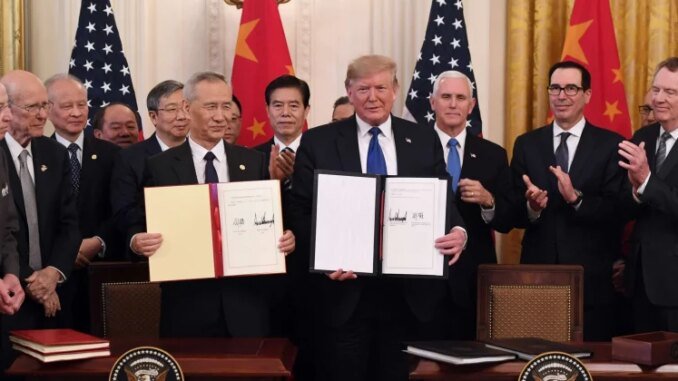

The White House has published details of a sweeping trade package between the United States and China, marking what could be the most significant thaw in economic relations between the two superpowers since tariff hostilities escalated during the trade war era. The agreements span critical minerals, agriculture, semiconductors, and tariff rollbacks.
What’s actually in the deal
The centerpiece is China’s commitment to eliminate export controls on rare earths and critical minerals destined for US end users. China currently dominates global rare earth processing. Removing export restrictions for American buyers could ease a pressure point that has quietly inflated costs across multiple industries.
On the agricultural front, China has pledged to purchase at least 12 million metric tons (MMT) of US soybeans in late 2025. That’s not a one-time gesture, either. The commitment extends to maintaining 25 MMT in annual purchases from 2026 through 2028, giving American farmers a multi-year demand floor that hasn’t existed in recent memory.
The US, for its part, is offering tariff relief. Washington will reduce reciprocal tariffs on Chinese imports by 10 percentage points and extend certain tariff exclusions through November 2026.

Perhaps the most strategically significant provision involves semiconductors. China will suspend retaliatory tariffs and measures targeting US semiconductor firms, ensuring that critical chip production resumes from Nexperia’s facilities.
The broader context
US-China trade relations have been defined by escalation for the better part of a decade, beginning with tariff confrontations in 2018-2019. Tariffs, counter-tariffs, entity lists, export bans defined that period. Previous agreements, including the Phase One deal, focused heavily on purchase commitments that China often fell short of meeting. The new package appears designed differently, with reciprocal concessions on both sides rather than a one-directional demand list. The tariff exclusion extensions through November 2026 give businesses a longer planning horizon than the rolling 90-day windows that characterized earlier arrangements.
What this means for crypto and hardware-dependent sectors
Cryptocurrency mining, particularly for proof-of-work networks like Bitcoin, is fundamentally a hardware business. Miners need ASICs, ASICs need semiconductors, and semiconductors need rare earth materials. The elimination of rare earth export controls for US buyers could stabilize input costs for hardware manufacturers, meaning more predictable ASIC pricing and allowing mining operations to model their economics with greater confidence.
The semiconductor provisions matter even more directly. Chip production bottlenecks have delayed deliveries of next-generation mining hardware, forcing operators to run older, less efficient machines longer than planned. Resuming production at Nexperia’s facilities and lifting retaliatory measures against US chip firms should help ease those constraints over time.
The 10-percentage-point reduction in reciprocal tariffs on Chinese imports is relevant for any US-based mining operation importing equipment. The extension of exclusions through November 2026 provides multi-year cost visibility that large-scale mining operations need when making capital allocation decisions.
The risk, as always with US-China agreements, is execution. Purchase commitments can slip. Tariff exclusions can be quietly reversed. Investors would be wise to watch implementation milestones rather than treating the announcement itself as a settled outcome.


Be the first to comment