

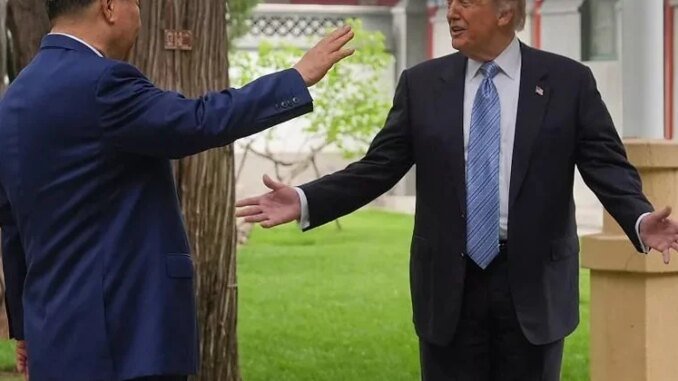

Instead of swinging for a grand bargain, the US and China have opted for something more pragmatic. The White House confirmed that President Trump and President Xi Jinping agreed to establish a new “Board of Trade” framework at their latest summit, a mechanism designed to manage bilateral trade flows on a product-by-product basis rather than through sweeping, all-or-nothing negotiations.
The framework would create stable trade lanes for permitted goods while keeping advanced technologies, particularly cutting-edge semiconductors, firmly off the table.
What the Board of Trade actually does
The concept reportedly originated during March talks in Paris, where top US and Chinese officials laid the groundwork for a more modular approach to trade management. Under the proposed structure, the Office of the US Trade Representative and China’s Commerce Ministry would work together to identify categories of imports eligible for lower tariffs.
The two sides could jointly flag $30 to $40 billion worth of imports for tariff reductions, while simultaneously raising duties on goods deemed sensitive to national security or strategic competition.

The agreement also includes commitments from Beijing to roll back recent export controls on rare earths, a category of minerals essential to everything from electric vehicles to missile guidance systems.
On the semiconductor front, China has agreed to suspend retaliatory measures against US chipmakers and continue allowing trade in legacy chips, the older-generation semiconductors that power everything from cars to washing machines. The distinction matters: cutting-edge chips remain restricted, but the vast majority of semiconductor trade by volume involves these legacy products.
Why this isn’t a Phase One deal redux
Phase One was built around purchase commitments, where China pledged to buy specific dollar amounts of US agricultural and energy products. The targets were ambitious, the enforcement mechanisms were weak, and the pandemic made the whole thing largely irrelevant within months of signing.
The Board of Trade framework takes a different approach entirely. Rather than setting purchase targets, it creates a permanent institutional structure for categorizing goods and adjusting tariffs in real time.
Legal experts who have reviewed the framework believe it could meaningfully stabilize the US-China commercial relationship, giving corporate planners something to anchor to for capital expenditure decisions.
What this means for investors
The direct market implications depend heavily on which products end up in which bucket. A $30 to $40 billion tariff reduction package would provide measurable relief for US importers and the consumers who ultimately bear those costs.
For crypto-adjacent sectors, Bitcoin mining operations in the US depend heavily on hardware manufactured in or with components sourced from China. Greater stability in those supply chains could improve equipment availability and pricing, lowering one of the key input costs for domestic miners.
The rare earth provisions deserve particular attention. Blockchain hardware, data centers, and the broader tech infrastructure that underpins digital asset markets all rely on minerals that China dominates. Any reduction in export restrictions on those materials benefits the entire technology stack, from traditional cloud computing to decentralized networks.
By explicitly excluding advanced chips from the Board of Trade framework, both sides are signaling that the technology cold war isn’t going anywhere. Companies building AI infrastructure, high-performance computing systems, and next-generation blockchain solutions should expect continued supply chain complexity for the most advanced components.



Be the first to comment