



In the first six months of 2026, the crypto industry lost $939.86 million across 135 verified security incidents. To anyone reading high-level headlines, the diagnosis seems obvious: projects are still shipping unvetted code to mainnet, leaving protocol treasuries exposed to textbook exploits.
The data tells a far more troubling story.
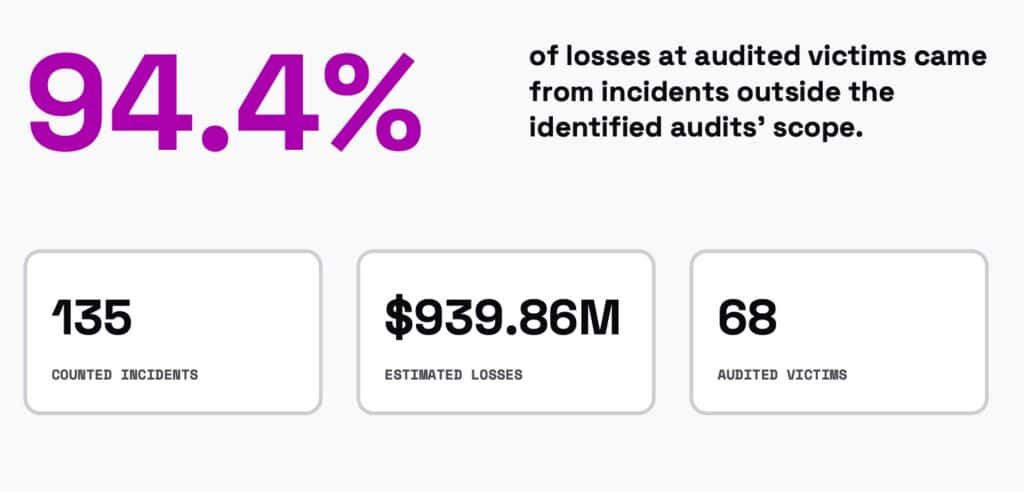
More than half of the exploited projects, accounting for over $721 million in total losses, carried the industry’s coveted seal of approval: a completed security audit. Yet, in 94.4% of those cases, the exploit didn’t stem from a missed reentrancy bug in a reviewed smart contract. The money vanished because the attack path ran through terrain the auditors never touched:
- Compromised private keys
- Hijacked front-end scripts
- Leaky cloud infrastructure
- Unreviewed off-chain relayers
The findings come from a comprehensive H1 2026 security report published by ack3, an AI-native cybersecurity firm formerly known as Ackee Blockchain Security. Having completed 237 protocol reviews since 2021, ack3 has spent years watching the security boundary shift. As attackers stopped staring at isolated Solidity files and started hunting for weak links across whole architectures, ack3 adapted its approach, combining expert manual review with Wake-based fuzzing, off-chain threat modeling, and proprietary AI scans designed to trace cross-component dependencies.

Their latest data exposes a fundamental flaw in how Web3 evaluates risk: the industry treats “audited” as a permanent, binary status, while attackers treat protocol architectures as fluid, interconnected web services.
“An audit is a timestamp and a boundary, not a lifetime warranty,” says Josef Gattermayer, Founder at ack3. “The old question was: ‘Was it audited?’ The useful questions are: ‘What exactly was audited, when, and what has changed since?’ A contract report cannot protect a leaked signing key, a compromised front end, or a legacy deployment that no longer matches the reviewed code.”
To understand how nearly a billion dollars slipped through the cracks of an audited ecosystem, we have to look past the marketing badges and trace where the assurance actually stopped.
The H1 2026 Loss Landscape
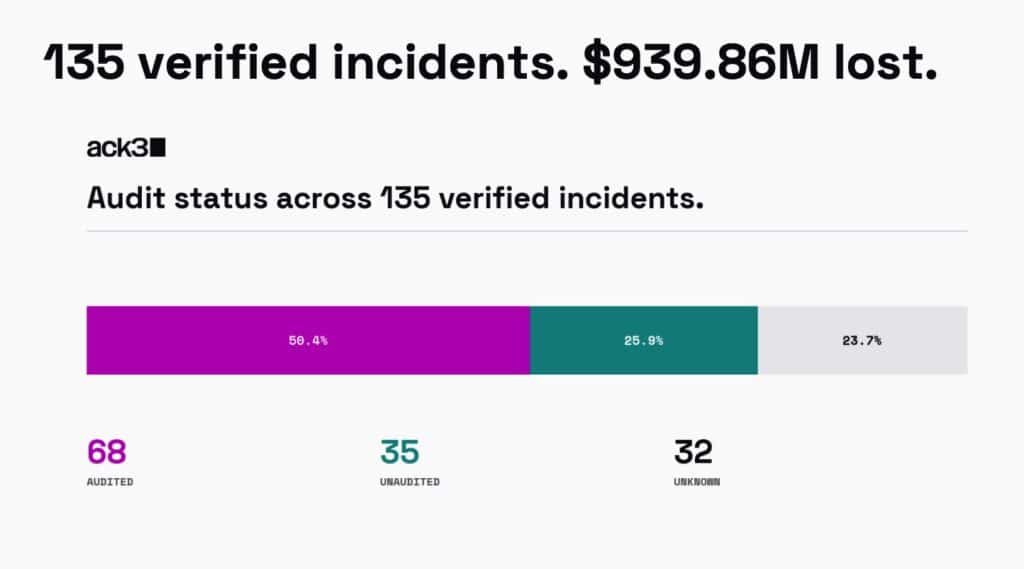
Across the first six months of 2026, the Web3 security ecosystem recorded 135 verified security incidents, draining a staggering $939.86 million from decentralized protocols and their users. Every exploit counted in ack3’s dataset met a strict two-source verification bar, capturing a comprehensive slice of on-chain and off-chain breaches.
When categorizing these 135 incidents by historical audit status, the initial breakdown appears almost evenly split:
- Audited Victims: 68 incidents (50.4% of total count) targeted projects with at least one completed, publicly verifiable security review prior to the attack.
- Unaudited Victims: 35 incidents (25.9%) affected protocols operating without formal third-party security reviews.
- Audit Status Unknown: 32 incidents (23.7%) involved projects where audit history was insufficient or unverified at the dataset cutoff.
The Audit Illusion
At first glance, seeing that audited protocols accounted for roughly half of all incidents might suggest that security reviews offer a coin-toss level of protection. But when you map those counts to financial damage, the true scope of the crisis emerges.
Audited protocols absorbed $721.24 million of the $939.86 million lost in H1 2026, a massive 76.7% of all stolen capital. Unaudited projects and those with unknown audit histories accounted for a combined $218.62 million.
This disparity exposes The Audit Illusion. Capital naturally accumulates where security badges are displayed. Institutional allocators, yield farmers, and retail traders treat an audit report as a green light, driving liquidity into protocols that present a polished security posture.
This creates a paradox: audits attract capital, which turns audited protocols into high-value targets.
While a thorough code review deters opportunistic hackers hunting for low-hanging Solidity bugs, sophisticated threat actors don’t walk away when they see an audit badge. Instead, they shift focus from the reviewed smart contracts to the unmonitored infrastructure surrounding them. As H1 2026 demonstrated, attackers are no longer trying to smash through the front door of audited code; they are walking through the unreviewed side entrances.
The Scope Gap: Where $680 Million Disappeared
The single most dangerous misconception in Web3 security is equating a smart contract audit with whole-system protection. When a protocol posts an audit report, it typically covers a specific commit hash for a designated set of Solidity or Rust files. It does not cover the deployment environment, the developer workstations, the cloud infrastructure, the DNS records, or the private keys used to manage protocol parameters.
ack3’s research reveals that this delta, the “scope gap”, is where almost all stolen capital actually vanishes.
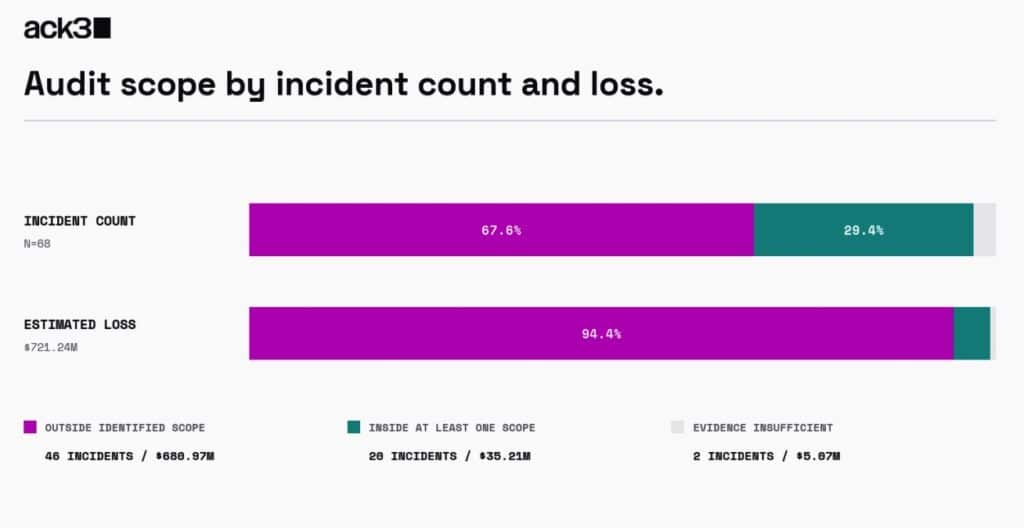
Out of 68 audited protocols breached in H1 2026, 46 projects fell victim to attack vectors entirely outside the scope of their published audits. Those 46 incidents resulted in $680.97 million in losses, accounting for 94.4% of all financial damage suffered by audited victims.
The Count vs. Value Gap
To understand how audit scope skews risk perception, compare the raw incident counts against the actual financial damage.
Incidents where the exploit path ran inside the audited code accounted for 20 out of 68 audited breaches, roughly 29.4% of incidents by count. Yet those 20 in-scope exploits netted attackers just $35.21 million, or a mere 4.9% of total audited losses
The contrast is stark. Traditional code audits are doing a reasonably good job of catching catastrophic smart contract bugs, limiting in-scope losses to under 5% of the total hit. But protocol teams are leaving the back door wide open, losing the remaining 94.4% to infrastructure and operational breaches.
Anatomy of the Modern Attack Surface
Attackers have recognized that smart contracts are often the strongest link in the chain, so they systematically target the operational surface around the code.
ack3’s findings highlight four recurring operational attack vectors responsible for driving out-of-scope drain:
- Compromised Private Keys and Signing Authorities: Admin keys, multisig signers, and operational hot wallets remains the quickest path to total drain. Once a signing authority is compromised via phishing or bad key management, the attacker can upgrade contracts, alter parameters, or trigger emergency mints through legitimate protocol functions, completely bypassing on-chain logic checks.
- Front-End Script Injections and DNS Hijacking: Rather than breaking on-chain logic, attackers hijack the interface users trust. By compromising DNS records or injecting malicious JavaScript via third-party web dependencies, attackers swap target addresses or trick users into signing approvals for malicious spenders while interacting with a legitimate UI.
- CI/CD Pipelines and Cloud Infrastructure Credentials: Attack vectors increasingly route through GitHub Actions, cloud environment variables, and build pipelines. Hardcoded secrets or leaked API keys allow attackers to tamper with build artifacts or access infrastructure assets before code ever touches the blockchain.
- Unreviewed Off-Chain Provers, Relayers, and Cross-Chain Infrastructure: Modern DeFi protocols rely heavily on off-chain components, provers, oracle relayers, zero-knowledge sequencers, and cross-chain messaging bridges. These complex services sit outside standard contract audits, yet they dictate the inputs that trigger on-chain execution. When an off-chain relayer or prover fails, the on-chain contract simply processes the bad state update as instructed.
Point-in-Time Assurance and the Aging Problem
Even when an exploit hits code that was explicitly inside an audit’s scope, the data points to another vulnerability in Web3 security practices: assurance decay.
An audit report is not a continuous shield; it is a static snapshot of a system at a single point in time. Yet protocols routinely market two-year-old PDF reports as proof of present-day security. ack3’s research demonstrates that as time passes, the protective value of a historical review steadily degrades, even if the underlying smart contract logic remains untouched.
The Decay Rate of Security
Among the 20 incidents where the attack path fell directly inside a protocol’s audited scope, 17 occurred at least six months after the closest relevant audit. The median time elapsed between the audit date and the exploit was 18 months, with gaps ranging from three months to as long as 56 months.
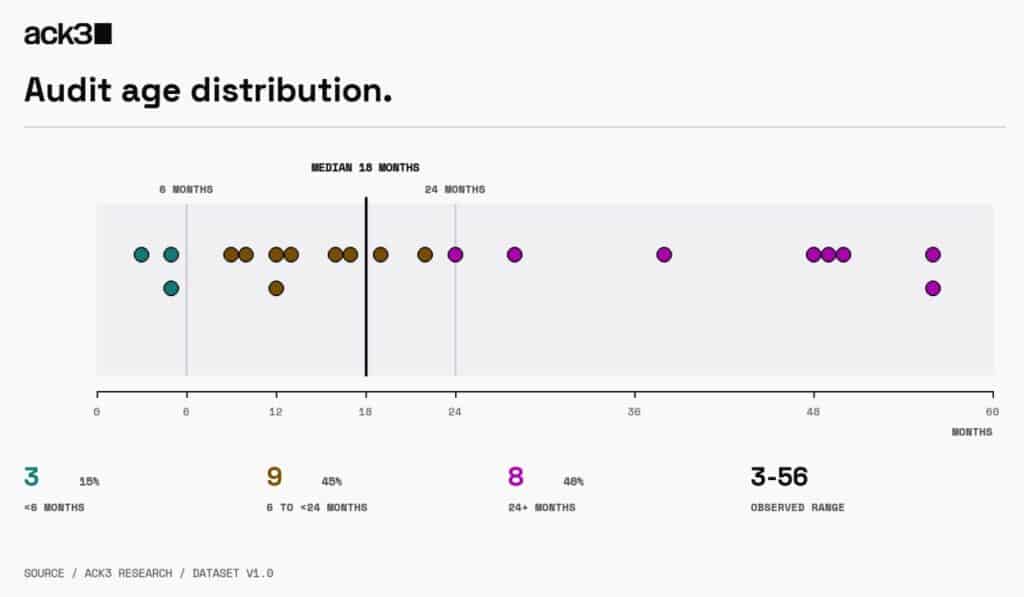
Only three protocols suffered in-scope exploits within six months of receiving an audit report. The vast majority of in-scope failures occurred long after the original audit team had signed off:
- Under 6 Months: 3 incidents (15% of in-scope cases)
- 6 to 24 Months: 9 incidents (45% of in-scope cases)
- 24 Months or More: 8 incidents (40% of in-scope cases)
This distribution highlights a glaring takeaway: an audit report’s relevance decays quickly in a fast-moving ecosystem. While age alone does not cause a smart contract bug, it measures how long code remains exposed while everything around it changes. That is why it is important for crypto protocols to have multiple audits completed frequently and not rely on a 2-year-old audit.
AI as an Attack Multiplier & The Shift to Living Assurance
Specialized AI tools have permanently altered the speed and scale of security research. While ack3’s H1 2026 dataset does not attribute any specific incident to autonomous AI agents, it highlights a shift in the threat landscape:
Attackers are using AI as an operational pressure multiplier.
The New Threat Realism
Finding a complex reentrancy bug in a heavily reviewed Solidity contract takes significant time and expertise. Finding an exposed enclave key in an unindexed off-chain repository or identifying an unpinned third-party script in a front-end build pipeline used to require tedious manual reconnaissance.
AI models have crushed that time cost to near zero.
Attackers no longer sit and stare at isolated smart contract logic. Instead, they leverage AI tooling to ingest entire protocol ecosystems with superhuman speed, mapping cross-repository relationships, tracing off-chain to on-chain parameter flows, and probing the unmonitored seams between cloud infrastructure, front-end delivery networks, and smart contracts.
With security benchmarks like EVMbench actively measuring AI agents on vulnerability detection, automated patching, and exploit synthesis, the asymmetrical advantage belongs to whoever scans the broadest surface area fastest. If defenders limit their view to a directory of smart contracts, attackers using AI will routinely find the surrounding operational vulnerabilities first.
Replacing the PDF Artifact
The industry’s habit of treating a static PDF audit report as a permanent security credential is now an existential risk. A static document cannot alert a team when a developer commits an API secret to a public repository, nor can it evaluate how a smart contract behaves after an upstream liquidity pool changes its fee structure.
To survive an ecosystem where attack vectors cross-component boundaries at AI-driven speeds, protocols must shift from point-in-time reviews to living assurance. ack3 outlines three core pillars for this transition:
1. Dynamic Scope Mapping
Defenders must replace static contract lists with an active, real-time registry of the total system surface. This means continuously cataloging:
- On-chain smart contract deployments and proxy addresses.
- Off-chain infrastructure, relayers, provers, and oracle pipelines.
- Administrative roles, multisig signers, and key management schemes.
- Web dependencies, CDNs, and front-end build pipelines.
2. Event-Driven Re-Review Triggers
Assurance should not be renewed on a rigid annual calendar, nor should it be assumed permanent. Protocols need explicit operational triggers that immediately flag code or infrastructure for targeted re-audit, including:
- Deployment of new proxy implementations or parameter updates.
- Key rotations, administrative role transfers, or multisig threshold changes.
- Integration of new cross-chain bridges, oracle feeds, or upstream liquidity protocols.
- Discovery of novel attack classes or exploit vectors in peer protocols.
3. Continuous Hybrid Review
Machine analysis and human expertise should operate in tandem before and after mainnet deployment. Automated AI scanners and Wake-based fuzzing engines excel at broad machine search, tracing cross-component dependencies, catching logic drifts, and monitoring live infrastructure for unexpected state changes. Human security engineers then step in where machines fail: verifying exploitability, evaluating high-level economic threat models, and validating business logic.
The goal is not to eliminate audits, but to ensure assurance keeps pace with system changes. When security models mirror the connected, evolving reality of modern protocols, the binary “audited” label becomes what it always should have been: a continuous process rather than a static badge.
Conclusion: Rethinking Security Posture in Web3
The $940 million lost in H1 2026 makes one thing undeniably clear: treating a historical point-in-time audit as a permanent green light is operational negligence. Smart contracts do not exist in a vacuum. An audit that covers Solidity files while ignoring front-end dependencies, administrative signing keys, cloud infrastructure, and off-chain provers isn’t a security guarantee.
As capital allocation in Web3 matures, the mechanisms used to evaluate risk are shifting from point-in-time reviews toward whole-system monitoring. The future of Web3 security belongs to teams that treat assurance as an active operational discipline. Those that continue to hide behind static PDF reports will simply remain the highest-value targets on the board.
References:

Why you can trust 99Bitcoins
Established in 2013, 99Bitcoin’s team members have been crypto experts since Bitcoin’s Early days.
90hr+
Weekly Research
100k+
Monthly readers
50+
Expert contributors
2000+
Crypto Projects Reviewed


Follow 99Bitcoins on your Google News Feed
Get the latest updates, trends, and insights delivered straight to your fingertips. Subscribe now!





Be the first to comment