



Outflows from the US spot ETFs on bitcoin and ether, forced closures of long positions worth more than $651 million and a central bank minutes pointing to a further rate rise: these three documented reasons have pulled the crypto market lower since Tuesday. Bitcoin fell 4.2 percent within 24 hours from its high of $86,592 on Tuesday afternoon, October 6, 2026, to $82,952. Ether lost 6.3 percent from high to low on Wednesday evening and XRP 7.1 percent, each measured against CoinGecko hourly prices.
Little had changed by Thursday morning. Bitcoin costs $83,401, which is 2.4 percent less than 24 hours earlier, ether $2,582 (down 4.1 percent), XRP $1.43 (down 4.6 percent) and solana $116.63 (down 3.1 percent). A crash it is not: over seven days bitcoin is only 0.25 percent lower, so the price has slipped back to where it stood the previous week. The market capitalisation of all cryptocurrencies stands at $2.85 trillion according to CoinGecko.

Crypto Market in the Red: Eight of the Ten Largest Coins Are Falling
The decline is broad. Of the ten largest cryptocurrencies excluding stablecoins, eight are lower over 24 hours on Thursday morning. The heaviest losses are XRP at 4.6 percent, dogecoin at 4.5 and ether at 4.1 percent, followed by hyperliquid at 3.7 and solana at 3.1 percent. Bitcoin and zcash each give up 2.4 percent. Almost unchanged are only BNB, down 0.5 percent, along with tron and monero, which edge higher.
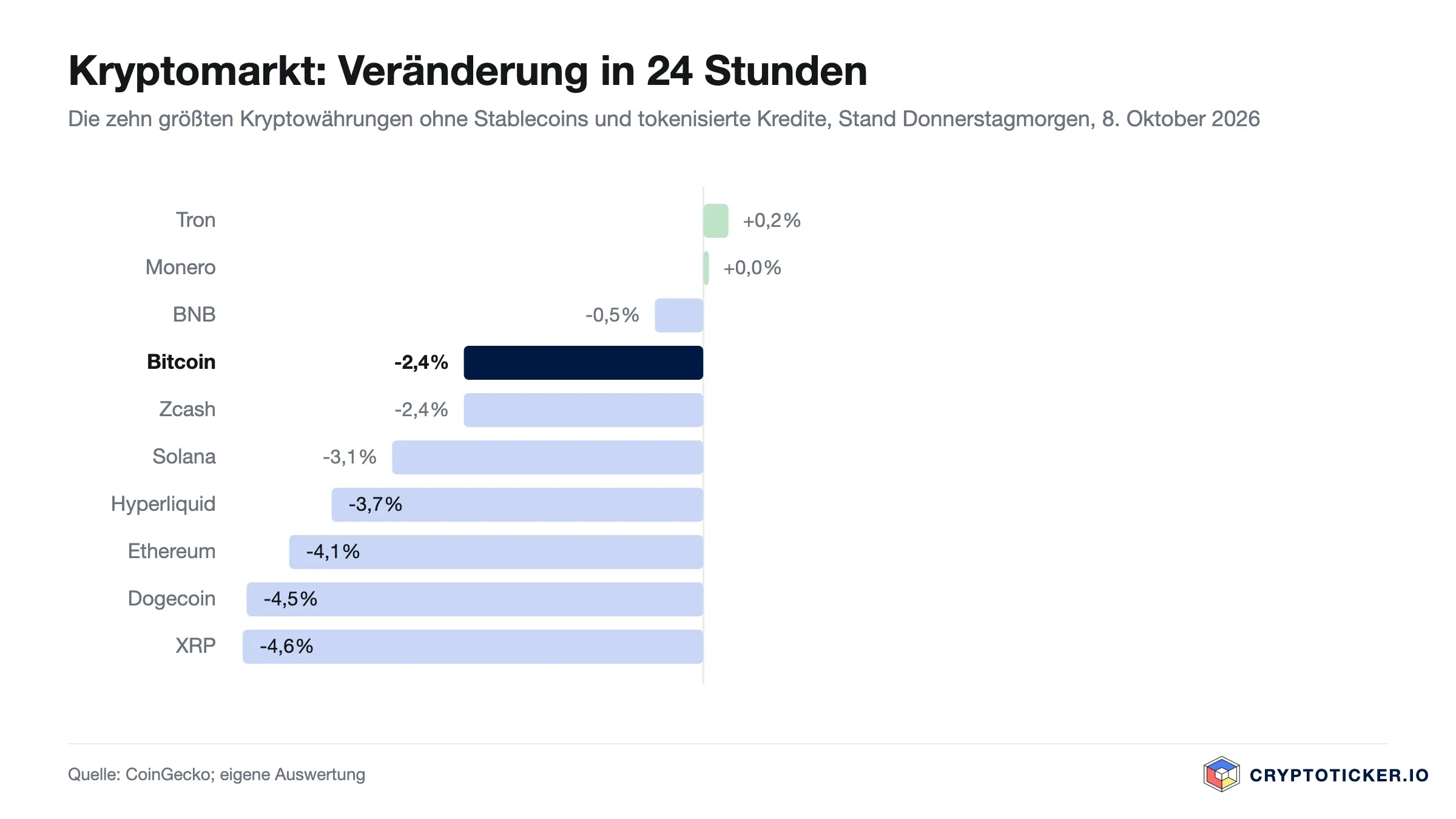
Ether is falling almost twice as hard as bitcoin, and that is exactly where the reasons can be measured most clearly: in the ETF outflows and in the liquidations. How individual coins fared on Wednesday is set out in our analyses of cardano after the end of the Leios rally and of dogecoin below 9 cents.

Reason 1: The US ETFs Are Pulling Money Out, and With Ether for Seven Trading Days
The US exchange-traded spot funds are the largest regulated route for institutional investors into bitcoin and ether, which is why their daily inflows and outflows are treated as a sentiment gauge. On Tuesday, October 6, the bitcoin ETFs still took in $118.8 million according to Farside Investors data, almost all of it into Blackrock’s iShares Bitcoin Trust. On Wednesday the picture turned: the remaining funds together reported outflows of $277.2 million, among them $105.1 million from Fidelity’s bitcoin fund and $101.7 million from the fund run by Ark and 21Shares. The iShares fund’s figure was still outstanding on Thursday morning, and the bitcoin ETF overview at CoinGlass shows the same daily total.
With ether the trend runs longer and clearer. Since September 29 the ether ETFs have reported net outflows on every trading day, on Wednesday for the seventh time in a row. On Tuesday alone investors pulled $201.9 million out of the iShares Ethereum Trust, and on Wednesday a further $44.8 million came from the smaller funds, again without the two Blackrock funds’ figures. Across the seven trading days that adds up to at least $452.7 million, as set out in the ether ETF overview at CoinGlass. What the continuing outflow means for the ether price is something we described on Wednesday in our analysis of the sixth straight day of outflows.
Reason 2: $651 Million in Long Bets Closed Out by Force
The second push came from the futures market. According to CoinGlass data, positions worth $713.2 million were closed out by force in the 24 hours to Thursday morning, $651.2 million of that on the long side, meaning bets on rising prices. That is a good 91 percent. The liquidations hit 123,822 traders, and the single largest was an ether position worth $26.6 million on Binance.
The distribution is striking: long positions worth $236.8 million were liquidated in ether against $173.9 million in bitcoin, even though the bitcoin market is many times larger. Solana and XRP follow with roughly $20 million each. That fits the price picture, in which ether fell almost twice as hard as bitcoin. The mechanism behind it is always the same: as the price falls, the collateral behind a leveraged long position no longer suffices and the exchange sells the position by force. That sale pushes the price down further and catches the next layer of positions. Open interest, the value of all outstanding futures contracts, fell only 1.5 percent in the process, to $152 billion. Most of the leveraged positions are therefore still in the market.
Reason 3: The Fed Signals a Further Rate Rise
On Wednesday evening at 8pm German time the US central bank published the minutes of its September 15 and 16 meeting. At that meeting the open market committee, chaired by Kevin Warsh, had raised the policy rate unanimously by 0.25 percentage points to 3.75 to 4.00 percent. The minutes show that it is not meant to stop there: most participants thought a further increase by the end of the year would probably be appropriate. Several described the policy rate as not restrictive, or only slightly so, meaning that in their view it is barely holding the economy back.
Higher rates make credit more expensive and interest-bearing investments more attractive, which is a headwind for risk assets such as cryptocurrencies. The timing, however, is no proof that the minutes triggered the pullback: bitcoin had already reached its low three hours before publication. Ether, by contrast, marked its lowest hourly price at $2,550 in the hour of publication, and XRP kept giving ground into Wednesday night. The next rate decision is due on October 28 according to the Fed’s meeting calendar. Before that, the US labor department publishes September consumer prices on October 14.
Bitcoin Is Leaving the Exchanges, and the Price Falls Anyway
One signal appears at first glance to argue against the decline: bitcoin holdings on Binance shrank by 41,700 BTC to around 663,100 BTC between September 20 and October 5, according to data from the analytics firm CryptoQuant. Fewer coins on the exchange means, on the common reading, less short-term selling supply. That did not support the price this week. An exchange balance falling over two weeks is a slow measure, while liquidations and ETF outflows act on the same day. Why a reserve figure says less than it promises is set out in our analysis 41,700 bitcoin leave Binance in a little over two weeks. If you move your coins off the exchange after buying, suitable devices are in the hardware wallet comparison.
What the Pullback Means for Investors in Germany
A decline of four to seven percent in two days is no exceptional event in the crypto market. What counts is how you react to it. Four points are worth checking before you sell or buy more.

Leverage and liquidation: if you trade with leverage, start by knowing your position’s liquidation price and work out the distance to the current price in percent. At tenfold leverage a countermove of roughly 10 percent eats up the entire collateral, at twentyfold one of roughly 5 percent already does, and because of the maintenance margin the exchange usually closes the position earlier still. Bitcoin’s 4.2 percent fall has therefore taken a twentyfold leveraged long to the edge of liquidation or beyond. The $651 million of liquidated long bets shows how many traders had cut that distance too fine.
Buy in tranches rather than on a hunch: a pullback tempts you to put the whole amount in at once because the price looks cheap. Nobody knows whether the low is already in. If you want to buy more, it is better to split the amount into three or four parts and invest them at fixed intervals, weekly for instance. That spreads the entry across several prices, and a further decline then hits only part of the money. Which providers sit under European supervision is shown in the comparison of regulated crypto exchanges.
Watch the levels instead of hedging blindly: this week’s lows are useful levels to watch, roughly $82,950 for bitcoin, around $2,550 for ether and around $1.41 for XRP. If the price holds above them, that argues for an ordinary pullback. If it drops below, that is a reason to review your position afresh, but not an automatic sell signal. A stop order placed directly on such a level is easily triggered by a brief spike without anything having changed in the situation. How prices might develop over the medium term is weighed up in our predictions for bitcoin, ethereum and XRP.
Check the holding period before selling: if you want to sell, know the purchase date first. Until a new law is promulgated, the one-year holding period under section 23 of the German income tax act applies unchanged: gains on coins you have held for more than a year stay tax-free, while a sale inside the period is taxable. A loss from such a sale can be offset against gains from other private disposals. The federal finance ministry’s draft bill of September 30, 2026 would abolish the holding period for purchases from January 1, 2027, and the cabinet is to decide on it on October 14. Under the draft, buying more this year keeps the one-year period. What tax advisers and associations criticise in the draft is set out in our piece on the crypto holding period before the cabinet, and software for profit and loss accounting across several exchanges is in the comparison of crypto tax tools.
Crypto Market After the Pullback: These Dates Count Until the End of October
- October 14: US consumer prices for September, and the cabinet date on the crypto holding period. A cabinet decision is not yet a law.
- October 28: the Fed’s rate decision. After Wednesday’s minutes, the majority on the committee considers a further increase by the end of the year probably appropriate.
- Every trading day: the ETF flows. If the ether ETFs turn positive again after seven days of outflows, one of the three reasons falls away.
- Before every leveraged trade: the distance to the liquidation price. Open interest still stands at $152 billion, so the leverage is still in the market.
(As of October 8, 2026. This article is not investment advice. Prices and fee structures change; check the terms with the provider before you buy.)





Be the first to comment