

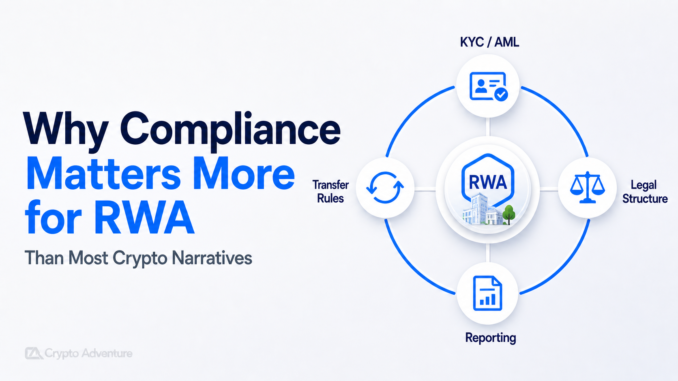

Most crypto narratives can grow before the rules become clear. Meme coins, NFTs, DeFi tokens, and open liquidity pools often launch first and deal with legal questions later. Real-world assets cannot work that way for long because the token is connected to a regulated claim outside the blockchain.
A tokenized Treasury product, private credit fund, real estate interest, stock, bond, or commodity claim needs more than a token contract. It needs a legal issuer, investor eligibility rules, custody, transfer controls, redemption terms, disclosures, recordkeeping, and jurisdiction-specific compliance. Without those pieces, the token can become a blockchain wrapper around an unclear or unenforceable claim.

This is why compliance matters more for RWA than most crypto narratives. The asset behind the token already lives inside legal systems. Tokenization can improve settlement and transparency, but it cannot erase securities law, fund rules, transfer-agent obligations, sanctions screening, or investor protection requirements.
The Token Is Not The Whole Product
A normal crypto token can often be understood through its smart contract, supply, liquidity, governance, and community. An RWA token needs more context. The token contract shows balances and transfers, but the legal documents explain what the holder owns.
That ownership claim may be a fund share, debt claim, beneficial interest, tokenized receipt, equity-like right, commodity claim, or contractual entitlement. Each structure has different rules. Some can be held only by qualified investors. Some cannot be sold in certain jurisdictions. Some require transfer-agent approval. Some allow redemption only through the issuer.
Backed’s legal documentation shows this clearly by limiting direct purchases of its tokenized financial assets to qualified investors under the relevant terms. That type of restriction is not a side detail. It is part of how regulated tokenized assets can exist.
KYC And Investor Eligibility
RWA products often need KYC because issuers must know who owns the asset. They may need to screen for sanctions, jurisdiction, accreditation status, qualified investor rules, tax status, or transfer restrictions.
This is a major difference from permissionless DeFi. A user can swap many crypto tokens without proving identity. A user may not be able to buy, hold, redeem, or transfer a tokenized security unless the wallet is approved.
The strongest RWA systems do not bolt compliance on after the fact. They build eligibility into the token lifecycle. ERC-3643 is one example. The ERC-3643 standard uses permissioned tokens and digital identity, so transfers can occur only when investor rules and offering rules are satisfied.
Transfer Restrictions
Transfer restrictions are essential for many RWAs. If a token represents a regulated security or fund interest, the issuer may need to stop transfers to ineligible wallets. This can affect secondary-market liquidity, DeFi composability, lending integrations, and user exits.
A normal ERC-20 token assumes open transferability. A regulated RWA token often cannot. The transfer logic may check identity registries, compliance contracts, jurisdiction rules, holding periods, accreditation status, or issuer permissions before allowing movement.
That can frustrate crypto users who expect instant transfers. It also protects the product’s legal structure. If regulated assets could freely move to anyone, issuers would struggle to meet securities, AML, and investor-protection obligations.
Transfer Agents And Official Records
Tokenized securities need recordkeeping. In traditional markets, transfer agents maintain ownership records, handle corporate actions, process dividends, and support shareholder communications. Tokenization can move some records on-chain, but official ownership and compliance duties still need a regulated framework.
The 2026 NYSE and Securitize partnership shows where the market is heading. Intercontinental Exchange and Securitize agreed to develop standards for digital transfer agents and tokenization agents for institutional-grade tokenized securities infrastructure through a memorandum of understanding. The focus is regulatory, operational, and technology requirements, not only token minting.
That direction matters because serious RWA adoption needs official records, corporate-action support, compliant transfers, and settlement clarity. A token cannot replace the full securities lifecycle unless the legal and operational layers match the asset.
Why Compliance Helps Liquidity
Compliance can look like friction, but it can also improve liquidity for institutional RWAs. Large investors, asset managers, banks, and market makers usually need clear rules before they provide capital. A permissionless token with unclear rights may attract speculation, but it may struggle to attract regulated buyers.
Compliant transfer controls can make market participants more comfortable providing liquidity because they know who can hold the asset, how transfers work, and what happens if a token moves improperly. This is especially important for tokenized securities, funds, and private credit.
The trade-off is buyer-pool size. Strict eligibility rules can reduce liquidity because fewer wallets can buy. Good RWA design balances regulatory requirements with enough investor access to keep markets functional.
Why Compliance Matters For DeFi Integrations
DeFi protocols cannot treat every RWA token like a normal ERC-20. A token with transfer restrictions may not move during liquidation. A lending market may not be able to seize or sell collateral if the liquidator is not whitelisted. A DEX pool may fail if transfers are blocked.
That means compliance rules need to be understood before integration. Lending protocols, vaults, aggregators, and market makers should know whether tokens can transfer freely, whether contracts can hold them, whether redemptions are permissioned, and whether liquidations can execute under stress.
This is why RWA-DeFi growth will likely include permissioned pools, whitelisted collateral markets, regulated counterparties, and compliance-aware smart contracts rather than fully open markets for every asset.
The Main Compliance Risks
- The first risk is unclear ownership. Users may not know whether the token gives direct asset rights, fund exposure, debt claims, or a weaker platform claim.
- The second risk is illegal distribution. If a tokenized security is sold to ineligible users, issuers and platforms can face enforcement risk.
- The third risk is transfer failure. Users may buy a token and later discover they cannot sell or redeem it without approval.
- The fourth risk is redemption friction. KYC, jurisdiction, sanctions checks, and investor classification can all affect exit timing.
- The fifth risk is governance changes. Issuers may update transfer rules, eligible jurisdictions, or redemption terms when regulations change.
How Users Should Evaluate RWA Compliance
Users should start with the issuer and legal documents. The most important question is what the token holder actually owns and which entity owes the obligation.
Next comes eligibility. Users should check whether they are allowed to buy, hold, transfer, and redeem the asset. Qualified investor rules, geographic restrictions, and KYC requirements should be clear before purchase.
Then comes transferability. A token that cannot move to ordinary wallets is not a problem if users understand the restriction. It becomes a problem when users expect DeFi-style liquidity and later meet a compliance block.
Finally, users should check whether the product can work inside DeFi. Transfer restrictions, oracle design, custody, and redemption timing must align with any lending, collateral, or trading use case.
Conclusion
Compliance matters more for RWA than most crypto narratives because the token is tied to a real financial claim. Real-world assets bring securities law, fund rules, custody duties, investor eligibility, transfer-agent records, sanctions screening, and redemption obligations into the blockchain environment.
The strongest RWA projects will not be the ones that ignore compliance for faster growth. They will be the ones that make legal rights, transfer rules, investor eligibility, custody, and redemptions clear enough for both users and institutions. Tokenization can make finance faster and more transparent, but only when the compliance layer is strong enough to make the asset enforceable.



Be the first to comment