

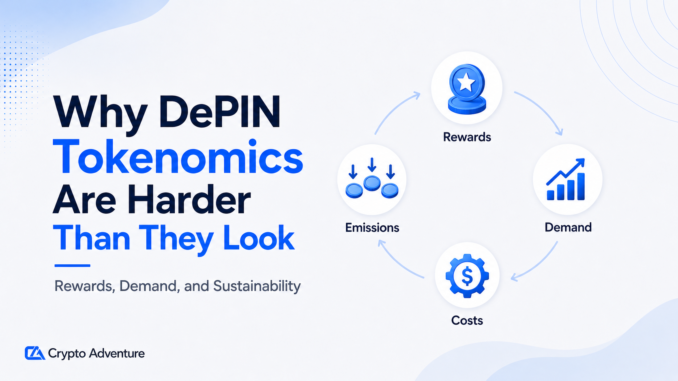
DePIN tokenomics are difficult because they connect digital assets to physical-world behavior. A normal crypto application can reward liquidity, staking, governance, or transaction activity inside a mostly digital system. A DePIN network has to reward people for buying hardware, placing it somewhere useful, keeping it online, maintaining it, and delivering a service that customers may not fully demand yet.
That timing gap creates the central problem. Supply has to arrive before the network becomes useful, but demand usually arrives only after supply is dense, reliable, and easy to access. Tokens are used to bridge that gap. They pull operators into the system early, compensate them for risk, and create a reason to build coverage, compute, storage, mapping data, or bandwidth before the customer base is mature.

The same mechanism can also break the network. If rewards are too generous, operators chase emissions instead of useful service. If rewards are too weak, supply never appears. If the token price collapses, operators may unplug hardware. If the protocol pays for the wrong activity, the network fills with low-quality supply. That is why DePIN needs stronger economic design than a simple “reward users for contributing” model.
A good starting point is the broader DePIN infrastructure model: independent participants contribute physical resources, while the protocol coordinates incentives, verification, payments, and governance. Tokenomics is the part that decides who gets paid, why they get paid, how long rewards last, and whether real usage eventually supports the system.
Two Markets Have To Work At Once
Every DePIN network has at least two markets. The supply market includes operators, hardware providers, node runners, storage providers, GPU owners, wireless hotspot deployers, drivers, or sensor contributors. The demand market includes users who pay for compute, storage, data, bandwidth, maps, or coverage.
Those two markets rarely grow at the same speed. Supply is often subsidized early because a network with no coverage, no storage, no GPUs, or no data is not useful. Demand tends to follow only when the service is reliable enough to trust. Token incentives therefore act like a temporary bridge between future demand and present supply.
The difficulty is that the bridge can become the whole economy. If operators earn mostly from emissions and users do not pay enough for the service, the token becomes a subsidy claim rather than a value-capture asset. Once emissions slow or market sentiment fades, supply can leave quickly.
Healthy DePIN tokenomics need a credible transition from subsidy-led growth to usage-led economics. That does not mean rewards disappear. It means rewards become increasingly tied to paid demand, useful work, measurable quality, and long-term service reliability.
Utility Pricing And Token Volatility Pull In Opposite Directions
Users want predictable pricing. A business buying wireless data, compute time, storage, mapping data, or energy services does not want costs to double because a token rallied overnight. Operators and token holders, however, often want upside exposure. Those goals pull in different directions.
Helium is one of the clearest examples. Its Data Credits are designed for network usage, while HNT sits at the center of the wider economic system. This separates customer-facing usage pricing from the volatile asset that powers the broader network economy. That structure can make the service easier to price, but it also adds complexity because burns, rewards, emissions, and governance have to remain aligned.
Render Network uses a different version of the same economic logic. Its Burn Mint Equilibrium model connects GPU service usage with token burning and emissions for operators. The goal is to create a loop where real work and token flows are connected rather than fully separate.
These designs show why DePIN tokenomics are harder than normal token utility. The token has to support operator incentives, user payments, network growth, governance, and value capture without making the actual service too unpredictable to buy.
Measurement Is A Tokenomics Problem
DePIN rewards depend on proof of useful work. That makes measurement part of tokenomics, not just engineering. If the protocol cannot measure useful work accurately, the reward system will pay the wrong actors.
Wireless networks have to measure real coverage and traffic, not just hardware registration. Storage networks have to measure whether data is stored correctly over time. Compute networks have to measure whether jobs completed correctly on the claimed hardware. Mapping networks have to measure location accuracy, freshness, road coverage, and spam resistance. Energy networks have to measure production, availability, and grid value.
The harder the work is to verify, the harder the tokenomics become. A simple emission schedule cannot solve fake coverage, low-quality data, unreliable compute, or idle hardware. The protocol needs oracles, proofs, audits, reputation systems, hardware checks, slashing, or customer payments that expose bad supply.
That is why security and verification have to be considered from the start. Broader smart contract auditing and security tools help with code-level risk, but DePIN also needs physical-world verification. The network has to defend against both smart contract bugs and real-world gaming.
Hardware Creates A Slow Feedback Loop
DePIN incentives are not as easy to adjust as DeFi incentives. If a DeFi liquidity pool changes rewards, liquidity can move quickly. If a DePIN network changes rewards, operators may be left with hardware they bought based on earlier assumptions.
That makes governance more sensitive. Reward rules need to adapt when the network learns where demand exists, where coverage is redundant, where providers are gaming the system, or where customer revenue is stronger than expected. But sudden changes can damage operator trust. A network that changes too slowly can leak emissions. A network that changes too aggressively can discourage future deployment.
Hardware also creates regional differences. Electricity costs, bandwidth costs, real estate access, device density, regulation, shipping, taxes, and local demand vary widely. One reward formula may overpay operators in one region while underpaying another. DePIN tokenomics often look clean at the protocol level, then become messy once geography and hardware economics enter the model.
Collateral, Slashing, And Penalties Add Discipline
Some DePIN sectors need penalties, not just rewards. Storage is the clearest example because users need confidence that providers will keep data available as promised. Filecoin collateral gives providers economic exposure, while slashing can penalize failures or malicious behavior.
Penalty systems can improve reliability, but they also raise the barrier to participation. If collateral requirements are too high, smaller providers may be excluded. If penalties are too harsh or poorly designed, honest operators may avoid the network because technical failures become financially dangerous. If penalties are too weak, users may not trust the service.
This is a recurring DePIN trade-off. Open participation helps networks scale supply, but infrastructure buyers need reliability. Tokenomics has to decide how much capital operators must risk, how failures are judged, how disputes are resolved, and how the system separates honest downtime from abuse.
Unlocks, Float, And Insider Supply Still Matter
Even if the service model is strong, normal token market structure still matters. Low float, aggressive unlocks, insider-heavy allocations, thin liquidity, and weak market-making can distort the token economy. Operators may earn rewards that fall in value before they can cover hardware costs. Buyers may hesitate to use a network if the token model looks unstable. Governance may become concentrated if insiders control too much voting power.
The same concerns raised in Token Generation Event analysis apply to DePIN networks, but with an added physical layer. A token unlock does not only affect traders. It can affect operator confidence, hardware deployment, and the network’s ability to maintain supply.
This is why DePIN analysis should separate product demand from token market structure. A network can have useful infrastructure and still suffer from poor float design. Another can have attractive token charts while the underlying service demand remains weak. Both sides have to work.
The Flywheel Is Easy To Draw And Hard To Sustain
The standard DePIN flywheel is attractive: token rewards attract supply, supply creates useful service, useful service attracts demand, demand creates revenue or burns, and revenue supports token value, which attracts more supply. Recent DePIN tokenomics research treats this kind of flywheel as a central design pattern, but the diagram hides the hard parts.
Supply may arrive in the wrong location. Demand may be slower than expected. Service quality may be inconsistent. Token price may outrun usage, then collapse. Governance may overcorrect. Providers may learn how to game rewards faster than the protocol learns how to measure value. Customers may prefer centralized alternatives if reliability or support is weak.
A sustainable flywheel needs more than growth. It needs high-quality supply, real customers, measurable usage, credible sinks, disciplined emissions, and a path for operators to earn from demand rather than only from token issuance.
How To Evaluate DePIN Tokenomics
The strongest DePIN tokenomics can answer five questions clearly. First, what physical service is being rewarded? Second, how does the network verify that the service is real and useful? Third, who pays for the service, and in what unit? Fourth, how do emissions change as demand grows? Fifth, what happens to operators if token prices fall or reward rules change?
A DePIN token should not be judged only by supply cap or reward rate. Better analysis looks at emissions, unlocks, customer revenue, token sinks, operator payback periods, provider concentration, governance power, oracle design, slashing rules, and geographic economics. The best token model is the one that keeps useful infrastructure online without overpaying activity that customers do not value.
That is also why headline APR can be misleading. The lesson from staking due diligence carries directly into DePIN: rewards are only attractive when the risk path is understood. For DePIN, that risk path includes hardware, demand, measurement, governance, token liquidity, and service reliability.
Conclusion
DePIN tokenomics are harder than they look because tokens are coordinating real-world supply before demand is fully mature. The network has to reward operators early, prevent fake or low-value activity, keep user pricing predictable, connect token flows to usage, and adapt rules without destroying operator trust.
The strongest models treat token incentives as a bridge to real infrastructure demand, not as the product itself. Helium, Render, Filecoin, and other DePIN networks show different ways to connect service usage, rewards, burns, collateral, and verification. None of those models removes the core challenge: physical infrastructure is expensive, location-specific, and slow to redeploy.
A DePIN token economy becomes credible when useful work is measurable, customers pay for the service, emissions become more disciplined over time, and operators can stay profitable without relying only on speculative token prices. Until those pieces align, DePIN tokenomics should be treated as one of the sector’s hardest design problems, not a simple reward formula attached to hardware.


Be the first to comment