



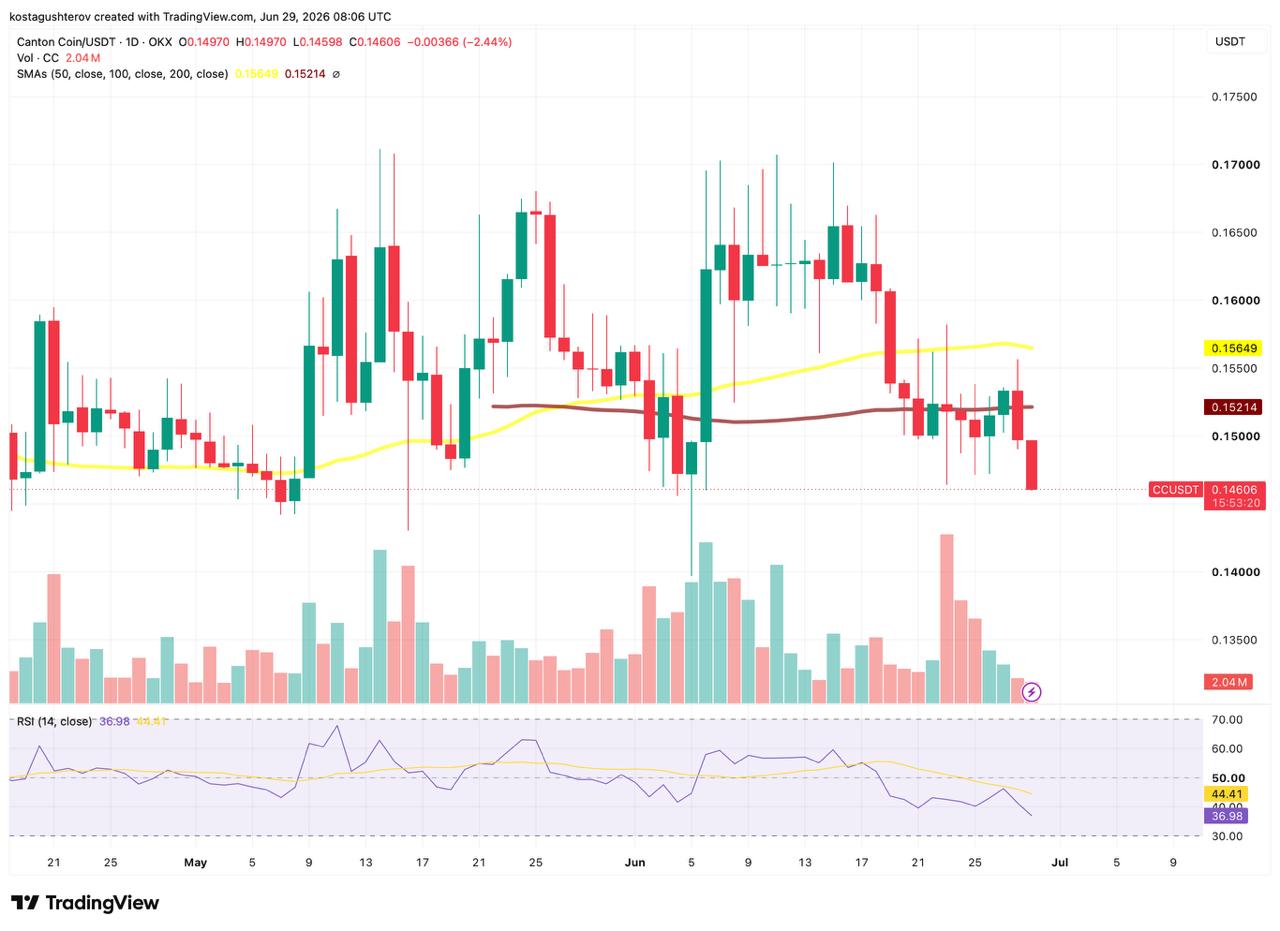
Canton (CC) is testing the lower boundary of a two-month range as momentum deteriorates, with both key moving averages now sitting overhead as resistance heading into July.
Key Takeaways
- Canton is a public, permissioned Layer-1 blockchain built for regulated finance.
- It lets institutions keep private ledgers while settling across them atomically.
- DTCC, Goldman Sachs, BNY Mellon, and others are active participants.
- Canton Coin is a burn-and-mint utility token, not a typical speculative asset.
For years, large financial institutions wanting to use blockchain faced an awkward choice. Public networks like Ethereum put every transaction in the open, which clashes with banking privacy and confidentiality rules. Private, permissioned ledgers solved the privacy problem but created isolated “walled gardens” that couldn’t easily talk to one another. Canton Network is the most serious attempt yet to escape that trade-off, and the reason names like DTCC and Goldman Sachs are paying attention.
The “Network of Networks” Idea
Canton is a public, permissioned Layer-1 blockchain purpose-built for institutional finance, developed by Digital Asset, a firm founded in 2014 and now backed by a long list of Wall Street institutions. Its core design is what the project calls a “network of networks.” Rather than forcing every participant onto one shared, transparent ledger, each institution runs its own sovereign sub-ledger with its own privacy and governance rules, then connects to others through a shared coordination layer called the Global Synchronizer.
That structure is the whole point. It gives institutions the interoperability of a blockchain, the ability to move value and data across counterparties, without the exposure that comes with a fully public chain. The significance isn’t “blockchain for banks” as a slogan; it’s a structural change in how settlement and collateral could move through the financial system, which is why it deserves to be understood as infrastructure rather than as another token launch.
The Problem It Targets: Settlement and Counterparty Risk
To see why this matters, consider how traditional settlement works. Many securities trades still settle on a delayed cycle, often a day or more after the trade is agreed. During that gap, each side carries counterparty risk: the chance the other party fails to deliver. Across the global system, that delay and risk represent a significant, long-standing source of friction and cost.
Canton’s answer is atomic settlement, the ability to swap, say, a tokenized bond for cash so that both legs execute simultaneously or not at all, across different private sub-ledgers, without exposing the transaction to the public. Either the whole exchange completes or nothing happens, which removes the window where one side has paid and the other hasn’t. The clearest way to think about it: it’s the difference between mailing a paper check and waiting days for it to clear, versus a real-time settlement that finalizes instantly with no period of uncertainty in between.
The Old Way: Siloed Ledgers
→
Manual
Reconciliation
→
Slow, days to settle, counterparty risk in between
The Canton Way: Synchronized Ledgers
↔
Global
Synchronizer
↔
Instant, atomic settlement, privacy preserved on each side
Who Actually Governs It
This is where Canton diverges most from a typical crypto project. Governance runs through the Canton Foundation, formerly the Global Synchronizer Foundation, an independent non-profit established in July 2024 under the Linux Foundation, the same neutral, enterprise-friendly body behind much of the world’s open-source infrastructure. The Global Synchronizer itself went live in July 2024 and operates on a Byzantine Fault Tolerant consensus model requiring a two-thirds majority among its Super Validators.
The participants are best understood not as marketing “partners” but as infrastructure stakeholders, institutions testing and using the ledger to move real value. In December 2025, DTCC announced a partnership with Digital Asset to tokenize a subset of US Treasury securities custodied at its depository, and took a co-chair position in Canton’s governance alongside Euroclear. That a body like DTCC, which sits at the center of US post-trade infrastructure, is taking a leadership role is the single most telling signal of how seriously the institutional world is treating this, far more meaningful than any retail-facing announcement.
What It’s Being Used For
The use cases are concrete and already moving from pilots toward production, which separates Canton from purely theoretical projects.
- Real-world asset tokenization: issuing traditional assets, government bonds, money market funds, repos, and more, as on-chain tokens.
- Atomic settlement: complex, multi-leg trades that complete simultaneously across applications without counterparty risk.
- Collateral mobility and repo: moving collateral and running short-term financing with synchronized, around-the-clock settlement rather than within legacy market hours.
The momentum is real. An industry working group has executed on-chain US Treasury financing over a weekend, using on-chain Treasuries as collateral against stablecoin cash, demonstrating settlement outside traditional market hours. And in April 2026, the Japan Securities Clearing Corporation launched a pilot tokenizing Japanese government bonds, extending the model beyond US markets.
The Token: Canton Coin as a Utility Layer
For an investor audience, the most important distinction is what Canton Coin (CC) actually is. It’s a utility token that powers the network’s operations, not a conventional speculative asset, and notably it launched with no pre-mine, no presale, and no founder allocation. It runs on a burn-and-mint model:
- Burn: network usage fees are paid by burning CC, removing tokens from supply as activity rises.
- Mint: new CC is minted to reward the validators and infrastructure providers who keep the network running.
The design intent is to tie the token’s economics to the volume of genuine financial activity on the network rather than to speculation: as more institutional value moves across Canton, more CC is consumed. For anyone analyzing it, that means the relevant lens is network adoption and usage, the volume of real activity and how it relates to the token’s market cap, rather than short-term price action. Because fee and activity metrics remain visible on-chain even with the privacy architecture, that adoption is something analysts can actually track. None of this is a recommendation; it’s simply the right framework for evaluating a utility token whose value proposition rests on usage, not hype.
Market Availability and Liquidity
Canton Coin (CC) is currently available for spot and derivatives trading on several global exchanges, including HTX, Bybit, OKX, and Bithumb. Because the asset is viewed primarily through the lens of institutional utility rather than retail speculation, the more useful gauge of its health is the volume-to-market-cap ratio, which tracks how much real activity is occurring relative to the token’s size, rather than price alone. Liquidity is currently concentrated in USDT pairs, and price discovery tends to be driven by the pace of new institutional integrations and network throughput rather than the retail-sentiment trends that move most cryptocurrencies.
For context on recent trading, CC was changing hands at $0.14606 on OKX at the time of writing, taking the 15th place in CoinMarketCap’s top 100 cryptos by market cap, down 2.44% on the day, sitting below both its 50-day ($0.15649) and 100-day ($0.15214) moving averages. The two-month chart shows a rangy structure: price rallied from around $0.14 in early May to a high near $0.170 in mid-May, then failed to hold those gains through June, grinding back toward the lower end of the range. RSI at 36.98, with the signal line at 44.41, points to weakening momentum approaching but not yet at oversold territory, with the latest daily candle the sharpest down-close in several weeks.
The Risks
Most likely Canton is not going to replace SWIFT or the traditional clearing system, and it would be a mistake to frame it that way. What it represents could be looked as substantive real-world testing ground for what tokenized capital markets may look like over the next five to ten years, backed by exactly the institutions that would have to adopt such a system for it to matter.
The risks are worth naming plainly. Regulatory frameworks are still evolving: MiCA in Europe and the SEC and CFTC in the US will shape what’s permissible, and rules can change. Adoption depends on developers building in Daml, Canton’s smart-contract language, and on traditional banks managing a genuinely hard migration away from decades-old legacy systems. And institutional pilots, however impressive, are not the same as full production at scale. The technology and the participant list are real; whether they translate into the daily plumbing of global finance is the open question that the coming years, not this article, will answer.
This article is for informational purposes only and does not constitute financial advice. Consult a professional before making investment decisions.

Alex is Editor-in-Chief of Coindoo and co-founder of Millennial Media Group, with nearly a decade of experience covering financial markets – crypto first, then everything else.
It started in 2016 with Bitcoin. Like most people at the time, he didn’t fully understand it – so he kept digging. Blockchain, tokenomics, the projects, the cycles. That curiosity never stopped, and eventually pulled him into traditional markets too: equities, commodities, macro. Not because he left crypto behind, but because you can’t properly understand one without the other.
What drives him is straightforward: he wants to know why something is happening, not just that it’s happening. Most market coverage stops at the headline – price up, price down, here’s a chart. Alex finds that kind of reporting actively unhelpful. If you walk away from an article without understanding the mechanism behind the move, what did you actually learn?
He holds a degree in Tourism from New Bulgarian University – not the most obvious path into financial markets, but markets have a way of pulling in people who are simply too curious to stay out. He has authored over 200 in-depth analyses and more than 10,000 articles across crypto and traditional finance. He still thinks every day in markets teaches him something new. That’s probably why he hasn’t stopped.



Be the first to comment