

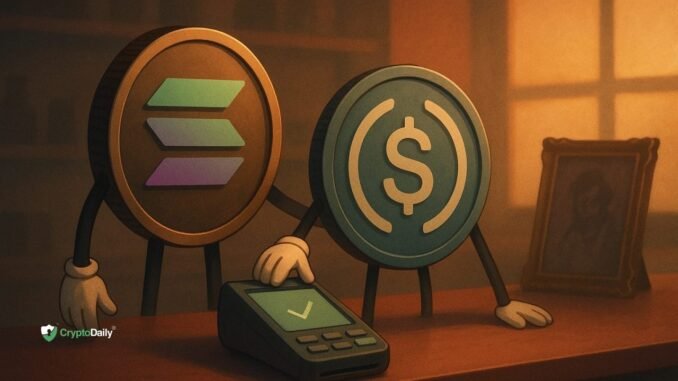

A customer scans a QR code at checkout and pays in USDC. The receipt lands instantly, the fee is a fraction of a cent, and inventory updates in real-time—no chargebacks, no waiting days for settlement. That flow is now live on Solana via Solana Pay and a growing set of merchant tools.
At the same time, Solana’s NFT markets surge and cool with each cycle. Collections rise and fade, while merchants ask a simpler question: can crypto quietly process everyday payments better than cards?
This is where USDC on Solana could matter more than NFT volume. Stablecoin rails promise predictable pricing for shoppers and cash-like settlement for businesses, potentially anchoring Solana’s consumer story in utility rather than speculation.

The Big Picture: Solana’s Consumer Thesis Is Shifting
Solana’s reputation was forged in high-throughput trading, memecoin frenzies, and headline NFT drops. But the network’s low fees, fast finality, and mobile-friendly tooling increasingly point toward a different killer app: stablecoin payments at retail scale.
Speculation attracts attention, but stablecoins retain users by solving a daily problem: paying and getting paid with predictable value.
Two threads are converging. First, USDC is natively issued on Solana, enabling fast, low-cost transfers without bridging wrappers. Second, merchant-facing integrations have advanced from demos to production: Solana Pay supports QR-based checkouts; and in 2023–2024, major payment headlines—like Visa’s expansion of USDC settlement to Solana—signaled that established processors are testing stablecoins for real commerce. Together, these rails could give Solana durable consumer relevance.
From NFTs to Paychecks: Why Stablecoins Win at the Checkout
NFTs were a powerful onboarding ramp for culture and creators. Yet at checkout, volatility and pricing noise get in the way. Stablecoins, by design, remove that friction.
Merchants care about price certainty
Retailers run on tight margins and predictable cash flow. Asking a merchant to price a coffee in a volatile token—or to hedge between mint and settlement—adds operational risk. USDC maps one-to-one to dollars, so prices stay stable while transfers settle near-instantly on-chain.
Consumers want intuitive, repeatable UX
For everyday purchases, shoppers prefer a payment flow that “just works.” With USDC on Solana, wallet balances match fiat mental models, QR codes replace card taps, and confirmation is immediate. No guessing exchange rates or waiting through congested chains.
| Dimension | NFT Trading on Solana | USDC Payments on Solana |
|---|---|---|
| Price Exposure | Speculative; floor prices fluctuate | Stable; denominated in USDC |
| Usage Frequency | Episodic; tied to drops and cycles | Daily; groceries, subscriptions, services |
| Counterparty | Collectors and traders | Merchants and consumers |
| Operational Fit | Creator royalties, community perks | Receivables, payroll, refunds, loyalty |
| Compliance Posture | Variable across platforms | Aligns with stablecoin KYC/AML flows |
| Stickiness | High during hype, lower between cycles | High if embedded in recurring payments |
The upshot: NFT volume signals cultural reach, but USDC usage can signal real economic throughput—payroll, subscriptions, marketplace settlements—flows that persist beyond market cycles.
How USDC Moves on Solana: Rails, Wallets, and Ramps
Solana’s consumer stack is maturing across rails, wallets, and fiat bridges. The pieces interlock to create a checkout experience that can rival web2 payments while keeping crypto’s programmable benefits.
Rails: Solana-native USDC and QR checkouts
USDC is natively issued on Solana, avoiding synthetic wrappers and enabling direct mint/burn through the issuer’s treasury infrastructure. Developers can build payment flows that settle in seconds with fees often a fraction of a cent. Solana Pay specifies a simple URL/QR schema that passes amount, token, and merchant references—useful for point-of-sale and e-commerce plugins.
Cross-chain transfers are improving as well. Circle’s Cross-Chain Transfer Protocol (CCTP) expanded to more networks and added Solana support in 2024, enabling native USDC to move between chains without third-party bridges. That matters for merchants sourcing liquidity across ecosystems. See Circle’s CCTP overview for mechanics and supported networks.
Wallets: Familiar flows with crypto-native perks
Popular Solana wallets increasingly abstract token selection at checkout, auto-suggesting USDC for fiat-priced carts and providing human-readable requests. Features like session keys, in-app purchase approvals, and support for mobile deep links reduce friction. The result feels like a card tap, with the added benefits of on-chain receipts and programmable loyalty.
On/Off-ramps and settlement partners
USDC’s fiat bridges span exchanges, fintech apps, and direct redemption with the issuer for eligible customers. On the acceptance side, established processors have begun incorporating stablecoin settlement. In 2023, Visa announced it was expanding pilot settlement of USDC to Solana with partners, positioning stablecoins as a treasury tool alongside card rails. See Visa’s announcement for context.
A typical Solana USDC checkout flow
- The merchant displays a QR code generated by a Solana Pay–compatible app specifying amount, USDC token address, and order metadata.
- The customer’s wallet scans the QR and prepares a USDC transfer on Solana to the merchant’s receiving address.
- The transaction is signed and submitted; Solana finalizes in seconds with fees typically well below a cent.
- The merchant verifies on-chain confirmation and updates the order in their POS/e-commerce system.
- Funds are spendable immediately on-chain; optional off-ramp to bank accounts can follow standard settlement windows.
This flow compresses authorization and clearing into a single on-chain action, reducing reconciliation complexity for on-chain-native merchants.
Costs and Settlement: Where Solana’s Design Matters
Solana’s architecture favors low-latency, high-throughput settlement. For payments, that translates to minimal network fees and near-instant finality, which can be meaningful when multiplied across thousands of transactions.
| Rail | Typical Settlement Speed | Fee Model | Operational Notes |
|---|---|---|---|
| Solana + USDC | Seconds to finality | Tiny network fee per transfer | Programmable receipts; on-chain reconciliation |
| Card Networks | Authorization in seconds; clearing can take days | Percentage-based merchant fee stack | Chargebacks and dispute workflows |
| Ethereum L2 + USDC | Typically seconds to minutes | Variable network fee, often cents | Bridging and withdrawal times vary by rollup |
For digital-native merchants and marketplaces, on-chain settlement is not just cheaper; it is also programmable. Loyalty points, refunds, and revenue shares can be codified into transactions. That composability is harder to achieve in legacy rails, where data and money move on separate systems.
Network Effects: Why Payments Create Stickier Daily Demand
Consumer networks thrive on repeated behaviors. While NFTs ignite bursts of attention, payments embed into routines—rent, rides, food delivery, game items, creator subscriptions—building durable demand for block space and stablecoin liquidity.
Recurring flows beat one-off mints
A household paying three recurring bills in USDC creates at least three monthly transfers—more if they split expenses, shop online, or top up a game wallet. Over time, those flows can dwarf sporadic trading volume and create a baseline of non-speculative activity on Solana.
Developers follow demand
When merchants and consumers rely on USDC flows, developers prioritize tooling—POS integrations, invoicing, accounting, and analytics—further improving UX. That, in turn, invites more merchants and use cases. The flywheel looks like this:
- Reliable, low-cost USDC settlement attracts early merchant adopters.
- Consumers discover faster checkout and transparent pricing.
- Developers build better wallets, plugins, and analytics around that usage.
- Payment frequency rises; on-chain liquidity deepens.
- Solana accrues a base layer of non-speculative transactions.
Unlike hype cycles, this loop compounds quietly. It produces metrics that merchants care about—cart conversion, refund times, and reconciliation accuracy—not just headline trading numbers.
What To Watch: Integrations, Compliance, and UX Milestones
Several catalysts could accelerate USDC adoption on Solana over the next cycles. None guarantee outcomes, but each is directionally important.
Deeper e-commerce and POS integrations
Broader availability of Solana-compatible plugins for major platforms and point-of-sale systems reduces deployment friction. Merchants want drop-in solutions that handle taxes, refunds, and reporting without custom code.
Stablecoin policy and bank connectivity
Clearer rules for stablecoin issuance and redemption, especially in the US and EU, could encourage conservative merchants to experiment. MiCA’s phased rollout in Europe and ongoing US policy discussions are worth monitoring for their effect on treasury and accounting treatment.
Cross-chain liquidity via issuer-native bridges
With CCTP, merchants and fintechs can source USDC where liquidity is deepest and move it natively to Solana for settlement. As more wallets and exchanges integrate issuer-native bridging, friction drops for both pay-ins and payouts.
Mobile-first experiences
QR and tap-to-pay UX, combined with mobile wallets and session approvals, will likely define mainstream adoption. The bar is simple: if it feels slower or more confusing than a card tap, it won’t stick. Expect competitive iteration here.
Programmable commerce
On-chain receipts enable new experiences: instant rebates, token-gated discounts, proof-of-purchase for warranty claims, and creator revenue splits at the point of sale. These are natural fits for Solana’s low-fee environment.
Risks & What Could Go Wrong
- Stablecoin regulatory shifts: New requirements for issuance, reserves, or distribution could change USDC availability or compliance obligations for merchants.
- Issuer and reserve risks: While USDC is designed to be fully reserved, users still rely on the issuer’s operations, banking partners, and transparency; disruptions could impact confidence.
- Depegging episodes: Market stress or operational issues can cause temporary deviations from the peg, creating pricing headaches at checkout.
- Network reliability: Solana has experienced outages; downtime or degraded performance could undermine merchant trust during peak hours.
- Wallet security and UX: Phishing, malware, and poor key management can lead to loss of funds; consumer protections differ from card chargebacks.
- Compliance and blacklisting: Address screening and sanctions controls can create edge cases for refunds or marketplace payouts.
- Accounting and tax complexity: Recognizing revenue, handling refunds, and reconciling on-chain activity with fiat ledgers requires careful workflows.
- Concentration risk: Heavy dependence on a single stablecoin or issuer concentrates counterparty and policy risk.
Payments are a trust business. Even tiny odds of downtime, depegging, or compliance missteps loom large when scaled across thousands of checkouts.
For ongoing coverage of Solana, stablecoins, and crypto payments, Crypto Daily tracks announcements and ecosystems shifts across chains and regulators. Explore the latest analyses at Crypto Daily.
Frequently Asked Questions
Why use USDC on Solana instead of paying with SOL?
SOL is volatile and better suited as a network asset or for staking and fees. USDC maps one-to-one to dollars, making pricing intuitive for consumers and straightforward for merchant accounting. Solana’s low fees apply to both, but USDC reduces price risk at checkout.
How does Solana Pay actually work for a merchant?
Solana Pay defines a URL/QR standard that encodes payment details. A compatible wallet scans the code and submits a USDC transfer on Solana. The merchant app listens for confirmation and marks the order as paid. Developers can add order references to tie on-chain payments to invoices or carts.
Are fees really lower than cards?
Solana network fees for USDC transfers are typically a fraction of a cent. Overall acceptance costs depend on your stack—gateways, analytics, and optional off-ramps may charge. For many digital-native merchants, total costs can be lower than percentage-based card fees, but results vary by setup and volume.
Is USDC on Solana safe for consumers?
USDC is issued by a regulated company with published reserve attestations, and it is natively supported on Solana. That said, risks remain: wallet security, phishing, and potential disruptions at the issuer or banking layer. Use reputable wallets, verify addresses, and consider small test payments before large transfers.
What about refunds and chargebacks?
On-chain transfers are final. Merchants implement refunds by sending a new transaction to the customer’s address, ideally referencing the original order. There are no card-style chargebacks by default, so clear refund policies and automated flows are important.
Do NFTs still matter for Solana’s consumer adoption?
Yes—NFTs bring culture, community, and new commerce formats. The point is prioritization: sustained USDC payment flows may provide a more reliable base of activity and revenue for builders and merchants than NFT trading cycles alone.
How can a business start accepting USDC on Solana?
Evaluate a Solana Pay–compatible provider, connect a business wallet, and pilot with a limited product line. Map refunds and accounting upfront, train staff on wallet security, and consider an off-ramp partner if you need fiat settlement. Start small, measure conversion and support tickets, then scale.
Disclaimer: This article is provided for informational purposes only. It is not offered or intended to be used as legal, tax, investment, financial, or other advice.






Be the first to comment