



London, United Kingdom, July 2nd, 2026, Chainwire
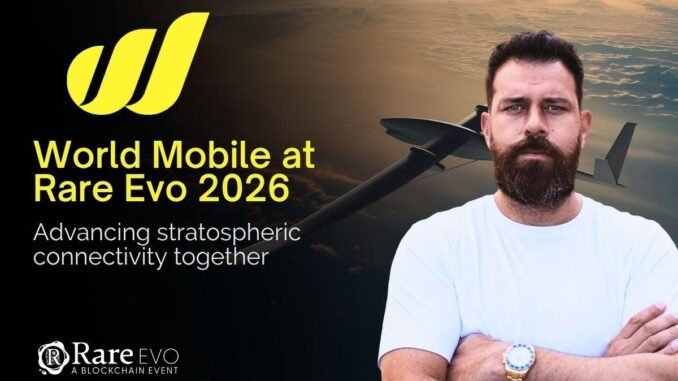
World Mobile will be one of the headline presences at Rare Evo 2026, taking place July 28-31 at ARIA Resort & Casino in Las Vegas. The company joins the event as a premier sponsor of the conference and will deliver a keynote address featuring Micky Watkins, Co-Founder & CEO of World Mobile.
At the center of World Mobile’s presence at Rare Evo is what the company is calling its biggest story yet: the World Mobile Stratospheric direct-to-device connectivity roadmap. Attendees can hear the full details during Watkins’ keynote and connect with the World Mobile team on the exhibitor floor. The details of the initial announcement can be found below:

World Mobile Stratospheric today set out its direct-to-device connectivity roadmap, highlighting the role of its StratoMast high-altitude platform and the SkyMast flight-test pathway with Britten-Norman as the company develops an airborne network layer between terrestrial towers and satellite systems.
The timing is significant. AI is moving from centralised data centres into phones, machines, vehicles, sensors and public infrastructure at the edge. According to the International Energy Agency, global electricity consumption from data centres is projected to double to around 945 TWh by 2030, reflecting the scale of demand being created by AI and high-performance computing. But compute alone is not enough. To turn AI into real-world utility, intelligence must be able to reach the places where people, devices and infrastructure operate.
Mobile networks are already carrying more of that burden. The Ericsson Mobility Report says 5G subscriptions have passed three billion globally and that mobile network data traffic grew 22 percent between Q1 2025 and Q1 2026. At the same time, Omdia forecasts smartphone satellite direct-to-device services will reach 411 million monthly active users and generate approximately $12 billion in revenue by 2030.
World Mobile Stratospheric believes the next connectivity era will not be defined by one layer alone. Towers, satellites and stratospheric platforms each have a role to play. The stratosphere sits in the critical space between terrestrial infrastructure and orbit: close enough to serve real demand on the ground, high enough to cover large areas from above, and flexible enough to be repositioned around changing network needs.
A layer built for AI at the edge
AI will not create value only inside data centres. Its impact will increasingly depend on how reliably intelligence can reach people, sensors, enterprises, vehicles and public services in the real world. That makes connectivity a strategic AI infrastructure requirement, not a secondary utility.
World Mobile Stratospheric is focused on the airborne layer that can help carry that intelligence to the edge. By combining wide-area reach with direct-to-device connectivity, the company aims to support use cases where terrestrial networks are difficult to deploy, slow to extend, or vulnerable during disruption.
StratoMast: a high-capacity airborne connectivity layer
At the centre of the World Mobile Stratospheric roadmap is StratoMast, a hydrogen-powered high-altitude platform designed to fly at around 20,000 metres and carry a mobile network payload in the stratosphere. The phased-array antenna carried by StratoMast is being developed to concentrate reusable 5G capacity across approximately 15,000 square kilometres per platform, putting targeted coverage where demand actually sits.
Published technical material from Cambridge Consultants describes the full-scale airborne antenna as more than three metres square, with more than one million components, 480 individual beams, a coverage diameter of up to 140 km, aggregate mobile speeds in excess of 100 Gbps and a weight of around 120 kg. These specifications relate to the antenna payload at the heart of the StratoMast system, which is designed to provide high-performance 5G coverage across vast geographies and highly targeted areas from stratospheric altitude.
World Mobile has outlined the proprietary phased-array antenna as the core network capability within StratoMast, responsible for shaping coverage, steering capacity and maintaining direct-to-device connectivity from the airborne platform.
This creates an innovative but practical proposition: a programmable airborne network layer capable of shaping coverage around demand. Instead of relying only on fixed towers or distant orbital assets, StratoMast is being developed to place capacity over cities, rural communities, transport routes, disaster zones or enterprise sites where connectivity is needed most.
The next stage is to validate key elements of this airborne network architecture through SkyMast.
SkyMast and the Britten-Norman flight-test pathway
World Mobile Stratospheric is advancing the SkyMast pathway using a Britten-Norman BN2T-4S Islander aircraft as an airborne testbed for 5G system integration and validation. In its partnership announcement, Britten-Norman said the collaboration will demonstrate a pioneering airborne 5G communication system using an Islander aircraft and validate how aircraft-based systems can extend mobile coverage to remote areas and restore communications following disasters.
The programme has since moved from announcement to integration. Britten-Norman has confirmed that the BN2T-4S Islander is prepared for the next phase of system integration, with the aircraft ready for installation of the airborne 5G antenna system. The same update says installation is underway at Britten-Norman’s MRO facility, test flights are scheduled to commence in the summer, and flight assessment will be conducted with World Mobile Stratospheric in cooperation with BT at its Adastral Park R&D facility near Ipswich.
SkyMast is designed to be the bridge between engineering ambition and operational validation. It gives World Mobile Stratospheric a near-term test platform to assess airborne 5G performance, integration, safety, certification considerations and network behaviour before full-scale stratospheric operations.
Beyond coverage: resilience, sovereignty and scale
World Mobile Stratospheric sees stratospheric connectivity as part of a wider shift in how critical communications infrastructure is planned, deployed and governed. For governments, operators and enterprises, the next generation of connectivity is not only about expanding coverage. It is about resilience when ground infrastructure is damaged or overloaded, flexible capacity when demand shifts, and greater control over how national and regional communications systems are designed.
A stratospheric layer can support underserved regions, emergency response, temporary capacity and data-sovereignty-focused network architectures, while integrating with terrestrial infrastructure and future non-terrestrial network standards. This is especially relevant as telecom moves toward a more intelligent, multi-layered network model for 5G, 6G and AI-enabled services.
Direct-to-device is more than a satellite story
Direct-to-device connectivity is often discussed through the lens of satellite networks. World Mobile Stratospheric is advancing a complementary perspective: the sky is not one layer, and all airborne or orbital systems should not be treated as interchangeable.
The stratosphere offers a distinct position between towers and orbit. It can provide wide-area reach from above while remaining closer to terrestrial users and infrastructure than satellite systems. World Mobile Stratospheric believes this layer can play a decisive role in the future connectivity stack, particularly as AI, emergency response, industrial automation and digital inclusion place greater pressure on networks to be available wherever demand appears.
“The next generation of connectivity will not be defined by coverage alone. It will be defined by how effectively networks connect people, devices and intelligence wherever demand exists. As AI moves from the data centre to the edge, and as direct-to-device becomes a major telecom category, the stratosphere gives us a powerful new layer between towers and satellites. World Mobile Stratospheric is building for that future,” said Micky Watkins, CEO, World Mobile Group.
About World Mobile Stratospheric
World Mobile Stratospheric is developing high-altitude airborne connectivity systems designed to support direct-to-device mobile coverage from the stratosphere. The initiative is focused on building a resilient airborne network layer capable of extending mobile connectivity across underserved regions, high-demand areas, disaster-affected locations and future AI-enabled edge environments. Learn more at wmstratospheric.com.
About World Mobile
World Mobile is building a decentralised mobile network designed to expand connectivity through a sharing economy model. Its ecosystem combines telecom infrastructure, community-operated nodes and blockchain-enabled coordination to support wider access, network participation and new models for digital connectivity. Learn more at worldmobile.io.
About Rare Evo
Rare Evo is an annual blockchain and AI conference held at ARIA Resort & Casino in Las Vegas, bringing together builders, enterprises, investors, policy makers, and communities from across Web3 and emerging technology. Rare Evo 2026 takes place July 28-31. General Admission Tickets are currently free. You can secure your ticket now at https://www.rareevo.io/?tracking=mawmtx
Contact
Director of Operations
Evan Fischer
Rare Network
[email protected]
Disclaimer: This is a sponsored press release and is for informational purposes only. It does not reflect the views of Crypto Daily, nor is it intended to be used as legal, tax, investment, or financial advice.


Be the first to comment