

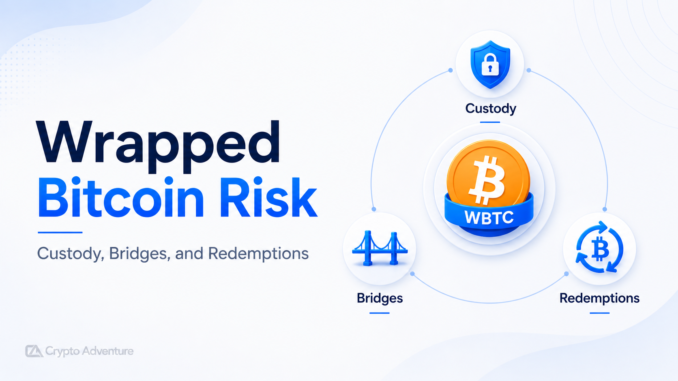

Wrapped Bitcoin is a tokenized version of BTC that can move on another blockchain. The user deposits or locks native Bitcoin, then receives a token such as WBTC, cbBTC, tBTC, rBTC, sBTC, or another BTC representation on a smart contract chain. That token can be used in DeFi for lending, borrowing, trading, liquidity provision, collateral, and yield strategies.
The basic promise is simple: keep Bitcoin price exposure while gaining access to smart contract applications. The risk is that the token is not native BTC in a Bitcoin wallet. It is a claim, representation, bridge asset, or peg asset with its own custody, redemption, smart contract, and liquidity assumptions.

This is the most important user distinction. One BTC held in cold storage is not the same risk profile as one wrapped BTC token on Ethereum, Base, Rootstock, Stacks, or another chain.
How Wrapped Bitcoin Works
Most wrapped BTC systems follow one of four models. A custodial model holds BTC with a custodian and mints an equivalent token elsewhere. A bridge model uses smart contracts and operators to lock and release BTC. A sidechain peg locks BTC on Bitcoin and issues a native asset on the sidechain. A threshold or signer model spreads custody across a group of operators.
Coinbase Wrapped BTC is a custodial example. cbBTC is backed 1:1 by BTC held by Coinbase, and the underlying BTC is not meant to be sold, transferred, or used for another purpose. WBTC uses a merchant and custodian model, where minting and burning connect token supply with BTC reserves. tBTC uses Threshold Network operators and threshold cryptography instead of a single custodian. sBTC is a Stacks-based BTC representation designed to convert between BTC and sBTC through its peg system.
Each design solves the same user need in a different way. The risk depends on who controls the BTC, how redemptions work, what can pause the system, and whether users can exit under stress.
Custody Risk
Custody risk is the biggest difference between native BTC and wrapped BTC. Native BTC custody depends on the user’s private keys and Bitcoin’s base chain. Wrapped BTC custody depends on additional parties or contracts.
In a custodial wrapped asset, the user depends on the custodian holding the backing BTC properly. The custodian may be regulated, audited, insured, or institutionally trusted, but it is still a trusted party. If the custodian fails, freezes redemptions, faces legal restrictions, or suffers an operational problem, the token can lose confidence.
In a threshold or bridge model, custody risk shifts from one institution to a system of signers, operators, smart contracts, and governance. That can reduce single-custodian dependence, but it introduces operator coordination, contract, and upgrade risks.
Bridge Risk
Bridge risk appears when BTC moves from Bitcoin into another execution environment. The bridge must know that BTC was deposited, mint the correct representation, and later process redemption back to Bitcoin.
A bridge can fail through contract bugs, compromised keys, dishonest operators, oracle failures, governance attacks, or liquidity problems. Bitcoin bridges are especially sensitive because BTC is high-value collateral. A weak bridge can turn the strongest crypto asset into a fragile wrapped claim.
tBTC v2 reduces centralized intermediary risk by using a randomly selected group of node operators and threshold cryptography. That is a stronger design than a simple single-custodian bridge, but it still requires users to understand fees, redemption batching, governance, and operator assumptions.
Redemption Risk
Redemption is the real test of wrapped Bitcoin. Minting is only half the product. Users need to know how wrapped BTC returns to native BTC.
For cbBTC, Coinbase customers can unwrap by depositing cbBTC into a Coinbase account and redeeming the corresponding BTC through the supported flow. For tBTC, redemption requests require a Bitcoin address, fee calculation, batching, and proof submission through the bridge system. For sBTC, withdrawals convert sBTC back to BTC through the Stacks peg-out flow.
Redemption risk increases when the process is slow, permissioned, dependent on a single platform, limited by minimum amounts, or exposed to governance changes. A wrapped BTC token can trade near BTC during calm markets, then lose its peg if users doubt the exit path.
Liquidity And Peg Risk
Wrapped Bitcoin should trade close to BTC, but the peg depends on confidence, liquidity, and redemption reliability. If arbitrage is easy, price differences usually stay small. If redemption becomes slow or uncertain, the token can trade at a discount.
Liquidity also differs by token. WBTC has deep DeFi history on Ethereum. cbBTC benefits from Coinbase distribution and Base ecosystem access. tBTC targets more decentralized bridging. rBTC and sBTC are tied to Bitcoin-layer ecosystems. Each token may be useful in one market and thin in another.
Users should check where the wrapped BTC is liquid, whether it can be used as collateral, how deep the pools are, and whether the asset can be redeemed directly or only sold on a market.
Smart Contract And Governance Risk
Wrapped BTC also carries smart contract risk. Token contracts, bridge contracts, custody scripts, signer contracts, and redemption modules can all fail. Upgrade keys and governance permissions matter because they may control minting, pausing, limits, fees, or emergency recovery.
Users should check whether contracts are audited, whether there are admin keys, who can pause transfers, and how upgrades work. A wrapped BTC system with strong custody but weak contract controls can still create risk.
How Users Should Compare Wrapped Bitcoin
Users should start with custody. Who holds or controls the native BTC? A company, a federation, a threshold network, a peg system, or a smart contract process?
Next comes redemption. Can the user redeem directly? Is redemption permissioned? Are there fees, delays, minimums, or batching rules?
Then comes liquidity. A wrapped BTC token is more useful when it has deep markets, lending support, and reliable arbitrage back to BTC.
Finally, users should check chain risk. Holding wrapped BTC on Ethereum, Base, Solana, Rootstock, or Stacks creates exposure to that chain’s execution environment and bridge route.
Conclusion
Wrapped Bitcoin makes BTC usable in DeFi, but it changes the risk profile. The user no longer holds only native BTC. The user holds a token that depends on custody, bridges, redemptions, liquidity, contracts, and governance.
The strongest wrapped BTC products make the backing, custody, redemption path, fees, and liquidity easy to verify. The weakest ones rely on vague promises or thin markets. Users should treat wrapped BTC as a tool for active DeFi use, not as a perfect substitute for Bitcoin cold storage.



Be the first to comment