


XRP Ledger activity has dropped to one of its weakest readings of 2026, with 25,350 active wallets marking the network’s second-lowest daily count of the year.
New wallet creation also fell to 2,130, the lowest level since November 2024. The decline follows late-June dip-buying activity and puts XRP back into a quieter market phase, with traders waiting for a stronger catalyst instead of chasing another short-range bounce.
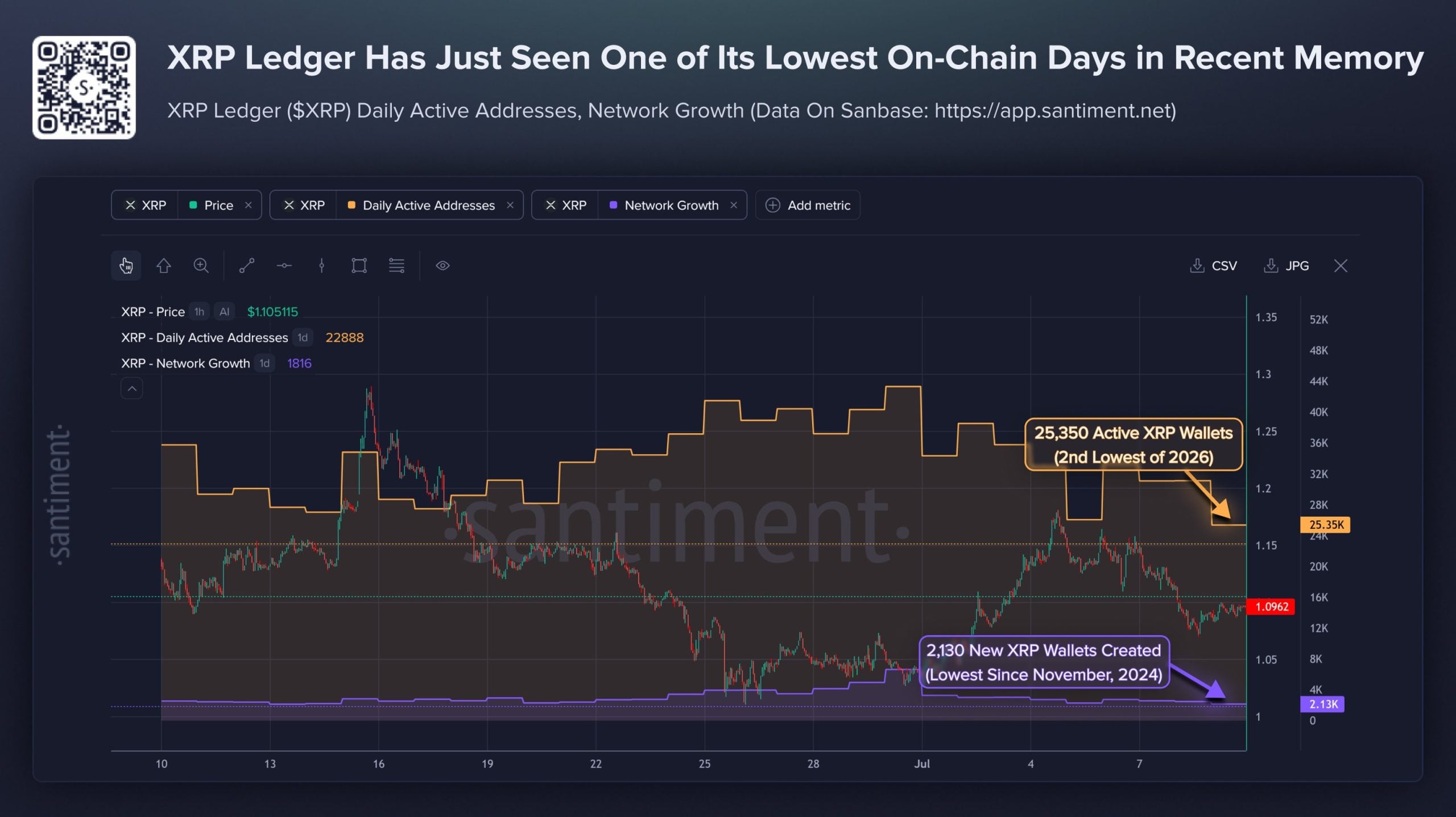
XRP traded near $1.11, with about $1 billion in 24-hour volume and a market cap near $69.1 billion. The token still ranked sixth among crypto assets by market value, but price remained below the $1.50 area that has repeatedly acted as the cleaner recovery level for bulls.
The slowdown marks a sharp contrast with XRP’s previous onchain bursts. In May, 4,300 new addresses appeared in 24 hours, giving traders a stronger network-growth signal while XRP still struggled to break out.
$1.50 Remains The Market Line
The $1.50 area has become the level where XRP’s market structure looks meaningfully different. A move back into that zone would not only recover recent losses, but also bring the token closer to the range it tested when large-holder accumulation was stronger.
XRP whale wallets had already built their largest combined balance in nearly eight years, with wallets holding at least 10 million XRP controlling 45.83 billion tokens during the earlier push toward $1.50.
That holder backdrop has not been enough to keep network activity elevated. Active-address weakness now leaves XRP dependent on a fresh driver from payments, stablecoins, tokenized assets or broader altcoin liquidity.
RLUSD And RWA Flows Stay In Focus
The XRP Ledger still has several live narratives that can bring activity back onchain. RLUSD adoption, institutional payment routes, tokenized assets, the EVM sidechain and proposed lending tools all sit inside the current XRP market debate.
XRPL recently led 90-day RWA inflows with $1.9 billion, putting the network back into the institutional asset conversation even as daily wallet activity cooled.
Ripple’s work with Ondo and JPMorgan also linked XRP Ledger activity to tokenized Treasury redemption and bank-payment rails, while Ripple’s Flutterwave investment added another test for RLUSD and XRPL in commercial settlement.
The current onchain reading leaves XRP with a clear split: network usage is near rare lows, while the asset still has large-cap liquidity, RWA traction and stablecoin-driven payment narratives.



Be the first to comment