



TL;DR
- The XRP Ledger activated the XLS-56 Batch amendment on October 9, enabling up to eight transactions to execute as a coordinated package.
- The upgrade supports atomic swaps, delivery-versus-payment settlements, NFT exchanges, and integrated fee collection, expanding the network’s potential for DeFi and tokenized financial markets.
- XRP traded near $1.38 following the activation, while RippleX advanced a separate lending-related amendment into validator voting.
The XRP Ledger has activated its XLS-56 Batch amendment, introducing a transaction framework that allows multiple operations to be grouped and executed within a single ledger close. The upgrade expands the network’s capabilities for decentralized finance (DeFi) by enabling coordinated transactions across different accounts, potentially simplifying complex financial operations for developers, businesses, and individual users.
Batch feature is now LIVE !!
Major props to all the engineers and validators to get this over the finish line.
Its a massively important functionality for the XRP Ledger to allow crucial use cases for institutions and also retail builders.
Think of OTC trades, DvP, NFT for NFT… https://t.co/gbRj0MwuJG pic.twitter.com/NxjnnyFEWt
— Vet (@Vet_X0) October 9, 2026
How XRP Ledger Batch Transactions Expand DeFi
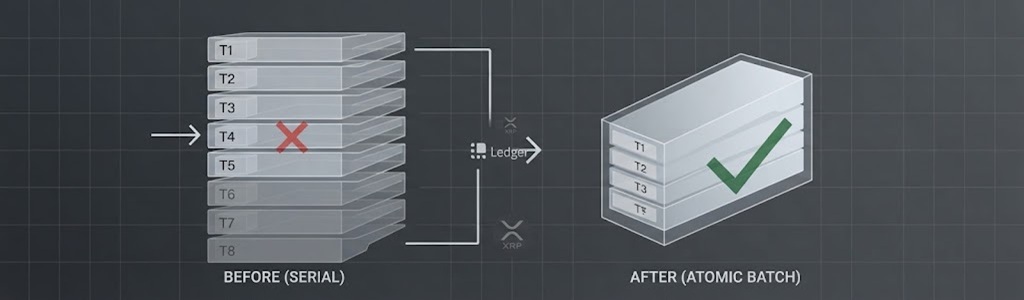
The Batch amendment allows up to eight transactions to be combined into a single package, with dependencies determining how individual operations relate to one another. Its all-or-nothing execution mode means that if an inner transaction fails, the entire batch is reverted, preventing users from being left with incomplete exchanges.
This functionality addresses a practical challenge in blockchain finance. Some transactions require two or more actions to succeed together, such as transferring a tokenized security and delivering its corresponding payment. Without atomic execution, one side of an exchange could occur while the other fails, creating additional settlement risks.

According to the XRP Ledger Foundation’s community leadership, the amendment supports delivery-versus-payment arrangements, cross-asset swaps involving NFTs and other tokenized assets, and service-fee collection within the same transaction package. Developers can also coordinate decentralized exchange swaps with different slippage parameters, allowing a batch to incorporate alternative execution paths.
These capabilities could make the XRP Ledger more useful for tokenized securities, automated trading, and multi-party settlements. By combining related operations, applications can reduce the need for separate transaction submissions and simplify the user experience. However, atomic execution does not eliminate every risk associated with liquidity, pricing, or smart-contract design.
XRP Ledger Developments Extend Beyond Batch Execution
The activation follows an earlier version of the amendment that entered validator voting without reaching activation. The successful rollout on October 9 therefore brings the functionality to the mainnet, where applications can build around the newly available transaction structure.
Separately, RippleX opened the LendingProtocolV1_1 amendment for validator review and voting. The proposal introduces closed-ended vaults and changes to interest recording within the network’s developing lending infrastructure. It must activate alongside two other amendments before the planned lending functionality can go live on mainnet.
The lending work builds on XLS-65 and XLS-66, which established the foundations for Single Asset Vaults and fixed-term lending arrangements. Together, these proposals reflect continued efforts to expand the XRP Ledger beyond payments into more sophisticated onchain financial services.



Be the first to comment