



XRP whale outflows on Binance have fallen to their lowest levels since October 2021, showing that large holders have become much less active.
XRP Whale Outflows Reach 5-Year Low
Notably, the 90-day moving average (90-dma) of XRP whale outflows now stands at $49.7 million, far below the levels recorded during the previous market rally.
In February 2025, when XRP traded near its cycle peak of around $3.30, the same metric reached $3.5 billion. Daily outflow spikes also regularly exceeded $10 billion, as large investors moved significant amounts of XRP away from Binance.
These withdrawals confirmed that XRP witnessed strong accumulation as whales transferred their tokens to private wallets. Since February 2025, however, whale outflows have declined steadily.

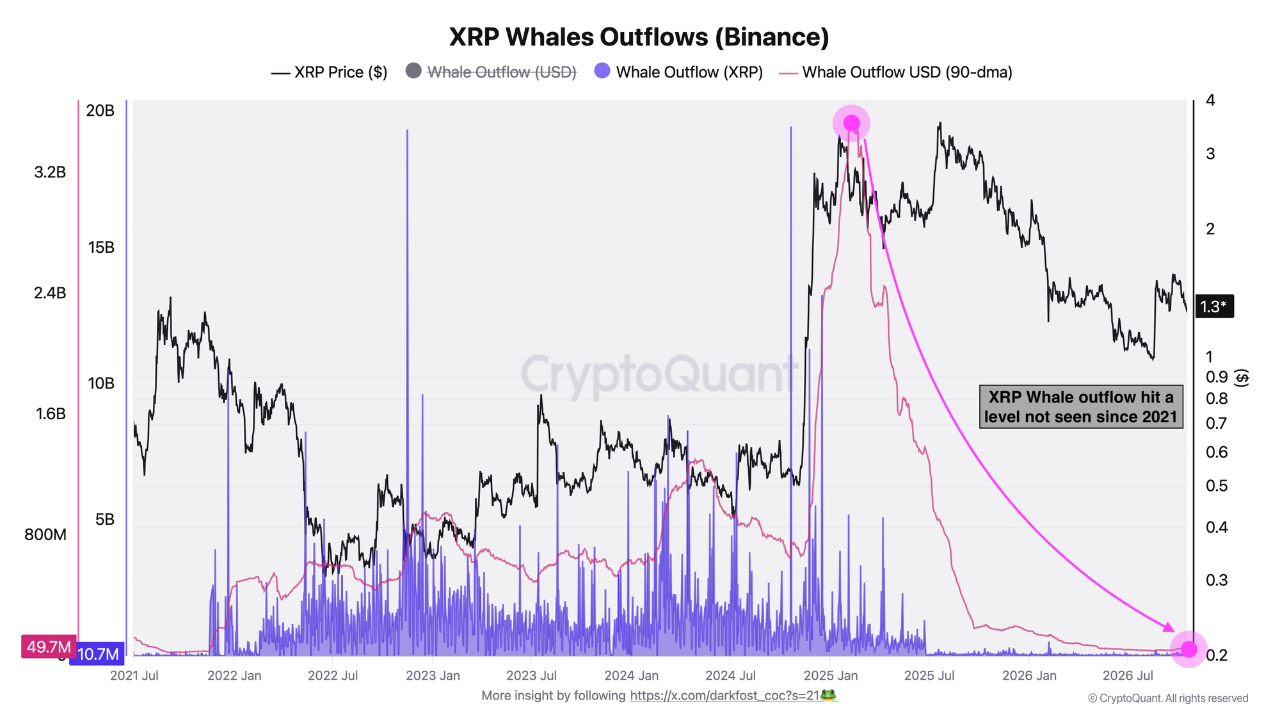
The 90-day moving average has dropped from $3.5 billion to $49.7 million, returning to levels last seen in October 2021. This period coincided with the peak of the previous Bitcoin market cycle, when institutional interest began to weaken, and large investors pulled back from aggressive market positions.
This comparison raises questions about XRP’s current position in the market. Although past trends do not guarantee similar outcomes, the latest reading shows that large holders are far less active than they were during the previous rally.
Why Lower XRP Whale Outflows Matter for Price Action
Whale outflows from exchanges such as Binance often indicate accumulation. Large holders withdraw their tokens into private wallets, reducing the amount of XRP available for immediate sale on exchanges.
When these withdrawals fall considerably, it may mean whales have slowed their buying activity and are waiting for better prices before committing more money.
XRP’s relative strength during the current bear market may help explain this change. During the previous downturns in 2022 and 2023, sharp price drops created deeper discounts that attracted large investors looking to build substantial positions.
This cycle has not offered the same opportunity, as XRP has held up better than several other cryptocurrencies. The resilience may have made it harder for whales to find a price that justifies large purchases.
Instead of accumulating XRP aggressively at current levels, large investors may be waiting for lower prices or better signs that the market is recovering.
The decline in whale outflows does not prove that large holders have stopped buying altogether. However, the drop in the 90-day average from $3.5 billion in February 2025 to $49.7 million in October 2026 shows how much their withdrawal activity has slowed.
XRP Price Decline Adds to Selling Pressure
Currently, XRP trades at around $1.30, down approximately 61% from its cycle peak. The token has also fallen about 4.81% over the past seven days amid continued pressure on its price.
The lack of strong buying from whales could make a sustained recovery more difficult. Without greater demand from large investors, XRP may struggle to overcome selling pressure and maintain an upward move.
Meanwhile, on-chain data shows another challenge, confirming that approximately 60% of the circulating XRP supply has a realized price of around $1.48.
This means a large portion of circulating XRP last changed hands at prices above the current market level. If the price climbs toward $1.48, some holders may sell to recover their initial investment. This could create additional resistance.
Could Low Whale Outflows Signal a Market Turnaround?
Despite the current weakness, history shows there’s room for a possible recovery. Markets sometimes turn around after trading activity and investor interest fall to very low levels. As selling pressure eases, new buyers can begin to influence prices even before market sentiment improves.
For XRP, the question is whether the sharp decline in whale outflows indicates a prolonged wait for better prices or the later stages of the current market downturn. A decisive push above $1.65 alongside stronger buying activity could improve the bullish outlook. On the other hand, a break below $1.27 could expose XRP to further losses.



Be the first to comment