



Large XRP holders are accounting for an increasingly larger share of exchange outflows, according to new data from CryptoQuant.
The trend confirms whales are playing a much bigger role in moving XRP off centralized exchanges than retail investors.
Whale Share Reaches New High
Data from CryptoQuant contributor Amr Taha shows that whale outflow dominance across all centralized exchanges (CEXs) climbed to a record 77.8% on July 22. Retail investors accounted for just 22%, the lowest share on record.
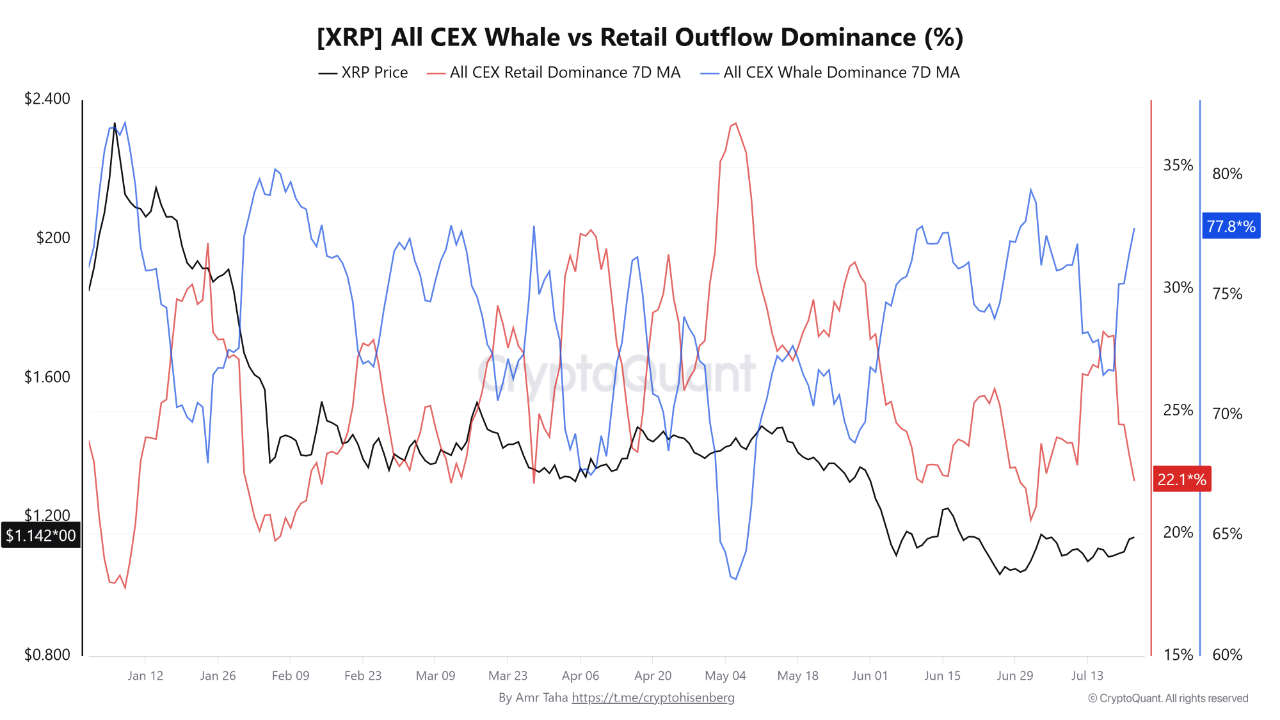

The shift is notable compared with May 6. At that time, whales represented 63% of XRP outflows, while retail investors accounted for 36%.
Since then, whale dominance has risen by 14.8 percentage points, while retail participation has fallen by about 14 percentage points.
The data suggests that large holders are increasingly driving XRP outflows, while retail investors make up a shrinking share of activity.
Binance Shows the Same Pattern
The same trend is visible on Binance, the world’s largest cryptocurrency exchange by trading volume.
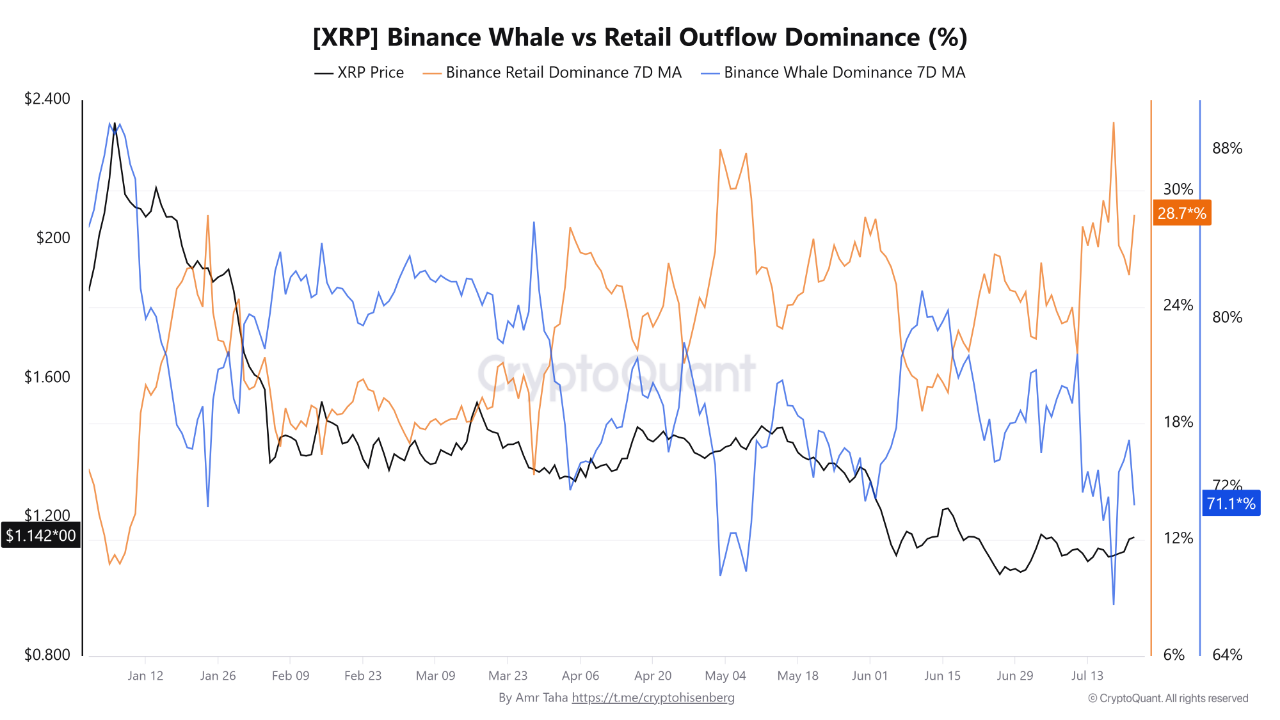
Whale outflow dominance on Binance reached 71% on July 22, up from 67% on May 3. Retail dominance fell to 28.7%, compared with 32% in early May.
Binance still has a slightly larger share of retail-driven outflows than the broader market. Even so, whale participation continues to grow.
Whale Activity Spreads Across Exchanges
Whale dominance across all centralized exchanges now stands 6.8 percentage points higher than on Binance. This suggests the shift is taking place across the broader market rather than on a single exchange.
The gap between whale and retail activity has also widened. Across all exchanges, whales exceed retail participants by 55.8 percentage points. On Binance, the gap is 42.3 percentage points.
The data shows that whales are responsible for a much larger share of XRP leaving exchanges. However, it does not reveal the total amount of XRP transferred, where the tokens were sent, or whether the transfers represent accumulation, custody moves, or preparations for future transactions.
What It Could Mean for XRP
The growing share of whale outflows may indicate that large holders are moving XRP into self-custody. That could reduce the supply immediately available on exchanges.
However, the data is not inherently bullish or bearish. If whale outflows continue while exchange balances decline, XRP could benefit from lower selling pressure and stronger price support. On the other hand, if those tokens later return to exchanges, they could signal renewed selling.
Notably, this observation comes as XRP’s price climbed to $1.16 over the past day for the first time since June. However, the momentum has quickly reversed as the market cools from the ongoing relief rally. XRP is now trading at $1.13, erasing all of its gains from the past 24 hours.
DisClamier: This content is informational and should not be considered financial advice. The views expressed in this article may include the author’s personal opinions and do not reflect The Crypto Basic opinion. Readers are encouraged to do thorough research before making any investment decisions. The Crypto Basic is not responsible for any financial losses.



Be the first to comment