



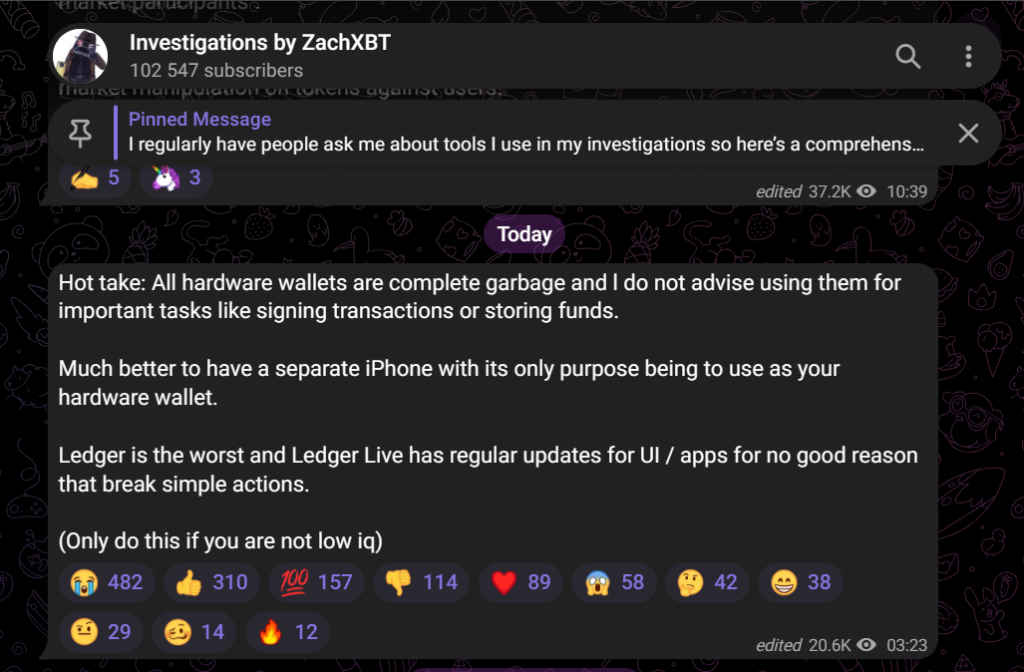
- ZachXBT advised users with some experience in crypto to use a smartphone for storing their wallets instead of a hardware wallet.
- In his opinion, the development of the software ecosystem at Ledger was an example of growing danger for crypto wallets’ security.
- The new wave of phishing and fraudulent apps increased worries about the safety of crypto wallets.
This week, the topic of crypto security became a relevant one because of blockchain researcher ZachXBT’s remarks on the reliability of hardware wallets in relation to self-custody of funds. In fact, his views were in contrast to the current practices and drew attention to the issue of crypto wallets’ protection in general, rather than that of hardware only. ZachXBT recommended using an iPhone instead of a hardware wallet for experienced users.
Security Threats Extend Beyond Hardware Wallets
Ledger transitioned from Ledger Live to Ledger Wallet, adding buying, swapping, staking, and yield management features. ZachXBT noted that the most serious accusation was against Ledger. Too many software updates complicate normal activities while posing additional security threats. Critics argue that every new feature expands the attack surface. It poses security threats owing to software vulnerabilities, while making no addition to the security of transactions.
These positions were justified by hacking events in which attacks did not take place on hardware but on its users. The fake Ledger application available in the Apple App Store is claimed to have stolen about $9.5 million from the accounts of its users who have revealed their recovery phrases. Another case of a social engineering attack resulted in the loss of more than $282 million by one cryptocurrency holder while interacting socially during the security procedure of a hardware wallet. Other cases involved losing USDC in an air-gapped Ledger and phishing letters with references to quantum computing breakthroughs.
Dedicated iPhones Join the Discussion about Self-Custody
ZachXBT claimed that a factory-reset iPhone specifically for storing cryptocurrencies is very safe due to the use of Secure Enclave, biometrics, and app sandboxing by Apple. Also, anonymous purchase of such a phone does not allow user data to be exposed after previous database breaches at Ledger. Yet, smartphones are online devices that will never be able to compete in terms of isolation from the Internet with traditional cold wallets. The researchers mentioned the existence of phishing crypto apps in the Apple App Store.

Highlighted Crypto News:
Stanford Research Warns Polymarket’s 5-Minute Bitcoin Contracts May Enable Price Manipulation






Be the first to comment