


Zcash price has started recovering from its recent selloff, with easing selling pressure on shorter timeframes raising the possibility of a move back toward $1,300.
Summary
- Zcash price recovered above $1,200 after recent losses, with easing selling pressure raising the possibility of a move toward $1,300.
- Developers are targeting January for quantum resistant payment support, while institutional interest in ZEC continues through ETF developments.
- ZEC remains above its 50 day EMA near $1,185, although the 20 day EMA at $1,337 continues to act as resistance.
- The 4 hour MACD remains negative, but its contracting histogram and a CMF recovery to negative 0.03 suggest that selling pressure is easing.
- A sustained move above $1,250 could bring $1,300 into focus, while a break below $1,185 risks another decline toward $1,100.
ZEC was trading near $1,213 on October 9, up approximately 2.2% on the daily session, after recovering from an intraday low of $1,183.24. The token had fallen toward $1,100 during the previous session, following several days of losses that erased part of its September rally.
The privacy-focused cryptocurrency remained more than 25% below its late September peak near $1,670. However, buyers returned after the latest decline, lifting ZEC above $1,200 as traders assessed upcoming network developments and institutional interest in the asset.
The recovery coincided with an improvement in short-term momentum indicators. Selling pressure has eased considerably since the latest downturn, although ZEC has yet to recover several important resistance levels.
Zcash developers target quantum-resistant payments in January
One development attracting attention to Zcash is a proposal to introduce quantum-resistant signature support for transparent transactions.
According to developers working on Zakura, a software implementation used to validate Zcash transactions, plan to introduce post-quantum signature instructions in January.
The proposed changes would allow the network to verify hash-based signatures designed to withstand attacks from sufficiently powerful quantum computers. January remains a development target, with no confirmed network activation date.
Initial protections would focus on transparent transactions, which account for a substantial portion of ZEC holdings.
Around 11.96 million of the approximately 16.98 million ZEC issued were held in transparent addresses as of October 8, representing roughly 70% of the supply.
Shielded transactions, which conceal information about senders, recipients and transferred amounts, would require separate protections because they use different cryptographic mechanisms.
The development followed warnings from Ethereum researcher Justin Drake about potential risks to existing cryptocurrency cryptography from future advances in artificial intelligence and quantum computing.
Zakura developers have separately introduced an experimental private lookup feature that allows wallets to check balances without revealing which addresses belong to the same user. The feature is available through the Vizor wallet’s private queries setting.
Zcash’s next major network upgrade, NU7, remains another event on the project’s development calendar. The proposed schedule includes an October 20 activation decision and a November 5 mainnet target, subject to confirmation.
Institutional interest provides another potential catalyst
Institutional investment developments have provided another source of attention for ZEC despite the recent correction.
Winklevoss Asset Services filed an S-1 registration statement with the US Securities and Exchange Commission on October 6 for a proposed spot Zcash exchange-traded fund.
The filing included a nonbinding indication of interest from Winklevoss Capital to purchase up to $100 million worth of shares.
A spot ETF could provide investors with exposure to ZEC through a regulated investment product without requiring them to hold the cryptocurrency directly. However, the proposed fund remains subject to regulatory review, and the indication of interest does not represent a completed investment.
Existing Zcash investment products in Europe have already provided another route for institutional and professional investors seeking exposure to the cryptocurrency.
The latest filing comes as Zcash continues to attract interest in privacy-focused blockchain transactions and technologies designed to protect sensitive financial information.
Nevertheless, neither the proposed ETF nor the network upgrades establishes that institutional buying caused the October 9 price recovery. The immediate improvement in ZEC’s trading indicators provides a clearer basis for assessing whether the rebound can continue.
Grayscale’s existing Zcash investment product provides more context for institutional demand. As crypto.news previously reported, the asset manager converted its Zcash Trust into a US-listed spot ETF on August 25, with approximately $304 million in assets under management at launch.
However, institutional flows have not remained consistently positive. The fund recorded $93.56 million in net outflows during the week ended October 2, including withdrawals of $30.25 million on September 30 and $26.93 million on October 2.
On the development side, Zcash’s NU7 upgrade entered testnet on October 4. The proposed changes would reduce target block times from 75 seconds to 25 seconds and introduce a mechanism that allocates part of transaction fees toward future block rewards.
Developers are expected to review the testnet results on October 20 before deciding whether to proceed with the proposed November 5 mainnet activation.
ZEC price analysis
ZEC’s daily price structure remains bullish over the longer term, but the latest correction has pushed the cryptocurrency below its shortest major moving average.
The token was trading near $1,213 after recovering from an October 8 selloff that briefly took prices toward $1,100. The decline followed a rally that carried ZEC above $1,600 in late September.
On the daily timeframe, ZEC has fallen below its 20-day exponential moving average at $1,337.05. However, it remains above the 50-day EMA at $1,184.74, the 100-day EMA at $963.72 and the 200-day EMA at $740.22.
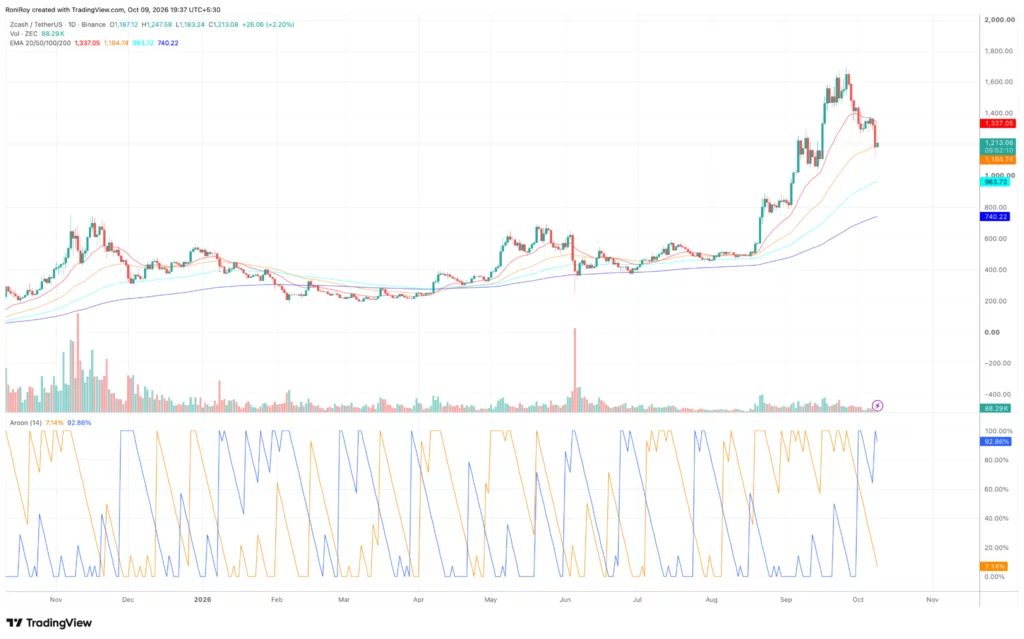
The moving averages remain arranged in bullish order, with the 20-day EMA above the 50-day, followed by the 100-day and 200-day averages. The recent decline has therefore weakened short-term price performance without reversing the longer-term moving average structure.
ZEC’s immediate support sits near the 50-day EMA at $1,185, where the latest daily candle has recovered after briefly trading below that level.
If buyers defend this area, the price could move toward $1,250 before attempting to reclaim $1,300. A sustained recovery above $1,300 would bring the 20-day EMA near $1,337 into focus, followed by the $1,400 resistance region.
However, a daily close below $1,185 would weaken the recovery attempt and expose the recent low near $1,100. Further losses could take ZEC toward the psychological $1,000 level, followed by its 100-day EMA near $964.
The daily Aroon indicator provides a separate reading of recent trend activity. Aroon Up stands at 92.86%, while Aroon Down is at 7.14%, indicating that the most recent 14-session high is considerably more recent than the corresponding low.
The high Aroon Up reading indicates that the preceding bullish trend still has influence within the indicator’s lookback period. However, ZEC’s position below its 20-day EMA means the reading has not yet translated into a recovery of the latest price losses.
On the 4-hour timeframe, the Moving Average Convergence Divergence indicator remains negative, although its latest readings suggest that selling momentum is easing.
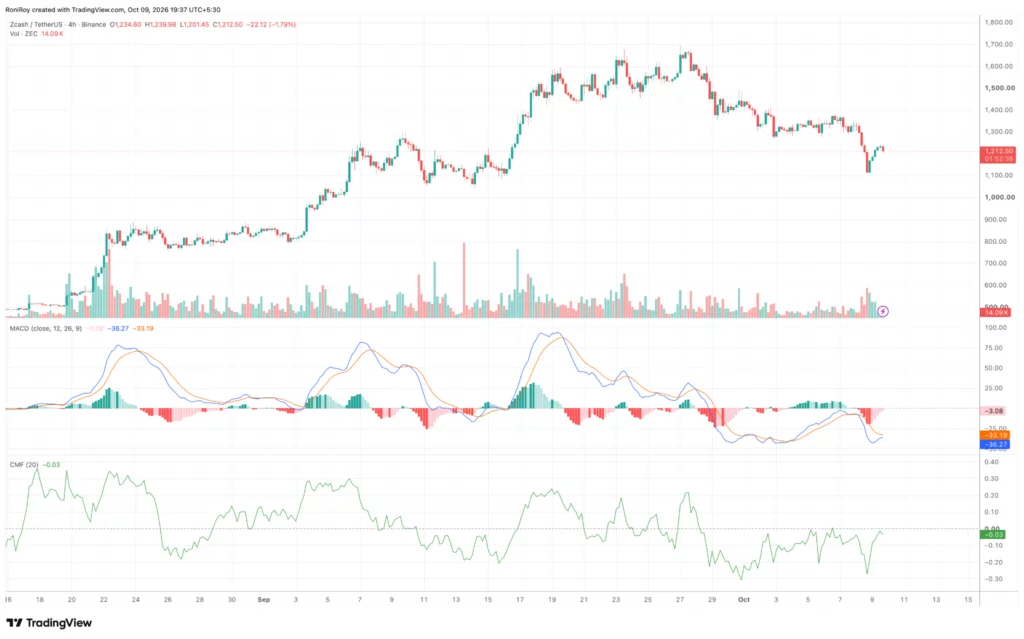
The MACD line stands at -36.27, below the signal line at -33.19, while the histogram reads -3.08.
Both lines remain below zero, confirming that bearish momentum continues to dominate the shorter timeframe. However, the histogram has begun contracting after a period of larger negative readings, while the MACD line has started turning upward.
A bullish crossover between the MACD and signal lines would provide stronger evidence that the rebound is gaining momentum. If accompanied by a move above the recent 4-hour high near $1,240, ZEC could attempt to recover $1,250 and subsequently $1,300.
The Chaikin Money Flow indicator has recovered to -0.03 on the 4-hour chart after falling toward -0.20 during the latest selloff.
The recovery toward the zero line indicates that selling pressure has moderated considerably. However, the indicator remains slightly negative, meaning buying pressure has not yet become dominant over the measured period.
A sustained move above zero would strengthen the case for a recovery toward $1,300, particularly if the MACD completes a bullish crossover and ZEC maintains support above $1,185.
Conversely, another decline in CMF alongside a widening negative MACD histogram would suggest renewed selling pressure. Under that scenario, a break below $1,185 could lead to another move toward $1,100, with the 100-day EMA near $964 remaining the next major moving average support if $1,000 fails.
Disclosure: This article does not represent investment advice. The content and materials featured on this page are for educational purposes only.



Be the first to comment