



Zcash (ZEC) is trading near $1,135 as of early September 2026, after a rally of more than 2,000% over the past year pushed it past $1,200 for the first time since 2016. Zcash price predictions for 2027, 2029, 2030, and 2040 vary widely across analysts, ranging from steady institutional-led growth to sharp corrections tied to shifting privacy-coin regulation and exchange policy.
Zcash’s recent move has been driven by a specific set of catalysts rather than broad market momentum alone. The U.S. Securities and Exchange Commission closed its multi-year inquiry into the Zcash Foundation without enforcement action in January 2026, removing a long-standing overhang on institutional participation.
Plus in August 2026 launch of the Grayscale Zcash Trust ETF (ZCSH) on NYSE Arca, the first U.S. spot ETF for a privacy-focused crypto, which has pulled in several hundred million dollars in assets within weeks.
Key Takeaways
- ZEC is trading around $1,135–$1,200 in early September 2026, up sharply after Grayscale’s ZCSH ETF listing and the SEC closing its Zcash Foundation probe.
- Zcash price prediction 2026 estimates from various platforms range from roughly $600 to over $2,000 by year-end, reflecting the asset’s high volatility.
- Zcash price prediction 2027 figures span a wide band, generally between $1,000 and $2,500, depending on ETF flow continuation and broader market conditions.
- Long-range Zcash price prediction 2029, 2030, and 2040 estimates diverge significantly across sources; some models pre-date the 2026 rally and are now outdated.
Zcash (ZEC) Price and Technical
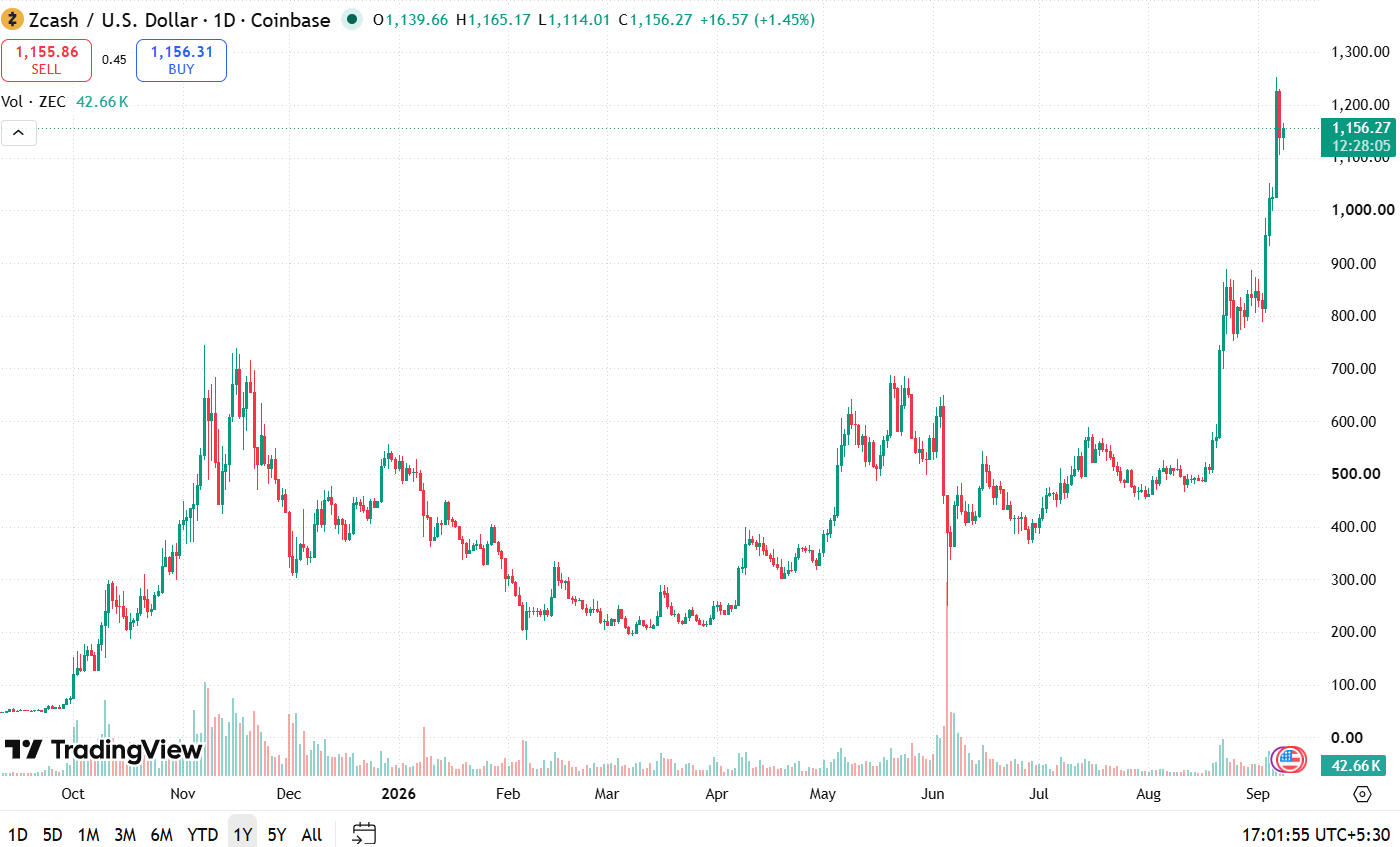

Zcash has been one of the standout performers of 2026. After trading in the low hundreds for most of the year, ZEC broke above $1,000 in early September, hitting a fresh multi-year high of roughly $1,249 before pulling back. The move came with heavy derivatives activity, including large short positions that were forced to close as the price climbed, which added further momentum to the rally.
| Metric | Value (as of Sep 2026)* |
| Current Price | ~$1,135–$1,200 |
| Market Capitalisation | ~$19–20 billion |
| 24-Hour Trading Volume | ~$1–1.5 billion |
| Circulating Supply | ~16.9 million ZEC |
| Max Supply | 21 million ZEC |
| Recent High (Sep 2026) | ~$1,249 |
| Global Rank | #7–10 by market cap |
Also Read: Bitcoin Price Prediction
Historical Price Movement of Zcash
Zcash launched in October 2016 with significant hype around its zero-knowledge privacy technology, briefly trading at extreme prices during its first day due to thin liquidity before settling into a long multi-year decline through the 2018–2019 bear market. It found renewed interest during the 2020–2021 cycle, driven by growing DeFi activity and privacy-tool adoption, before again cooling off through 2022–2023 alongside the broader crypto downturn.
The 2025–2026 period marks Zcash’s most significant re-rating to date. A June 2026 vulnerability disclosure in its Orchard shielded pool triggered a sharp sell-off, but the issue was resolved without loss of funds, and ZEC recovered strongly in the months that followed. Institutional accumulation, the SEC’s decision to close its investigation, and the Grayscale ETF listing then combined to push Zcash to its strongest price levels since its 2016 launch window, though it remains well below the extreme, low-liquidity prices briefly seen on its first trading day.
What Affects the Value of Zcash?
- Shielded Transaction Adoption:
Zcash’s core value proposition is privacy. Growth in shielded-pool usage signals genuine utility demand rather than pure speculation, which tends to support longer-term price stability.
- Regulatory Treatment of Privacy Coins
Because ZEC enables private transactions, it faces closer regulatory scrutiny than transparent assets like Bitcoin. Favourable rulings, such as the SEC closing its 2026 investigation, can unlock institutional demand, while restrictive exchange or jurisdictional policies can just as quickly cut off liquidity.
- ETF and Institutional Flows
The Grayscale ZCSH listing gave ZEC its first regulated U.S. investment vehicle. Sustained inflows or outflows from this and any future products are likely to be a recurring price driver.
- Halving Events
Zcash’s block reward halves roughly every four years, reducing new supply entering circulation. The most recent halving occurred in November 2024, with the next expected around late 2028.
- Mining Hash Rate and Network Security
Rising mining participation, which recently pushed Zcash’s network hash rate to record levels, reflects miner confidence but can also compress margins, affecting sell pressure from miners.
- Market Sentiment and Sector Rotation
Zcash currently represents the majority of total privacy-coin market capitalisation. Broader rotation into or out of the privacy-coin sector, relative to Bitcoin and large-cap altcoins, has an outsized effect on ZEC specifically.
- Competing Privacy Assets
Monero and other privacy-focused tokens compete for the same narrative and capital pool. Zcash’s relative technology, liquidity, and exchange support versus these alternatives shape its market share.
- Macro Liquidity Conditions
Like most crypto assets, ZEC is sensitive to broader risk appetite, interest rate expectations, and overall crypto market capitalisation trends.
Also Read: What is Bitcoin Halving?
Role of Technical Analysis in Price Forecast
Moving Averages
Traders commonly track ZEC’s 50-day and 200-day moving averages to identify trend direction. A price sustained above both averages, as seen through much of Zcash’s 2026 rally, is typically read as a bullish structural signal, while a break below can indicate a trend shift.
Relative Strength Index (RSI)
RSI measures the speed of recent price changes on a 0–100 scale. Readings above 70 often suggest overbought conditions, a level ZEC has touched repeatedly during its recent parabolic moves, while readings below 30 suggest oversold territory following sharp pullbacks.
MACD Indicator
The MACD indicator tracks the relationship between short- and long-term moving averages to flag momentum shifts. Given ZEC’s recent volatility, with double-digit percentage swings common within a single session, MACD crossovers have been a frequently cited tool among short-term traders positioning around the rally.
Zcash Price Prediction Models Explained
Trend Extrapolation Models
Several forecasting platforms apply fixed annual growth-rate assumptions to project ZEC’s price years into the future. These models are simple to build but can produce numbers that look disconnected from reality if the base year assumption becomes outdated, which is a live issue for Zcash right now given how sharply the price moved in just the past few months.
On-Chain and Adoption-Based Models
Other forecasts weight metrics such as shielded-pool transaction counts, active addresses, and exchange flows to estimate demand-side pressure. These models tend to track more closely with genuine network usage but still depend heavily on assumptions about future adoption rates.
Sentiment and Catalyst-Driven Models
Given Zcash’s recent price action, a number of near-term forecasts lean heavily on specific catalysts, ETF inflows, regulatory clarity, and short-covering dynamics, rather than fundamental valuation. These tend to be more accurate in capturing short-term direction but are less reliable for multi-year horizons.
Zcash Price Predictions
The ranges below reflect a synthesis of multiple analyst and algorithmic sources, adjusted for the fact that ZEC is now trading well above most of those earlier baselines. Treat all of the following as illustrative scenarios, not forecasts to plan around.
Zcash Price Prediction 2026
With ZEC already trading near $1,135–$1,200 in September, most updated year-end scenarios for 2026 cluster in a wide $700–$2,000 range, depending on whether ETF inflows and short-covering continue or whether the recent rally cools into a consolidation phase.
Zcash Price Prediction 2027
Zcash price prediction 2027 estimates vary more than almost any other year in the forecast set, from roughly $1,000 in more conservative, adoption-based models to above $2,500 in scenarios that assume continued institutional accumulation and further exchange listings for the ZCSH ETF structure.
Zcash Price Prediction 2029
Looking toward Zcash price prediction 2029, forecasts that account for growing shielded-transaction volume and potential additional privacy-asset ETF products place ZEC in a broad $1,500–$3,500 range, with the wide spread reflecting genuine uncertainty about regulatory direction for privacy coins over a multi-year horizon.
Zcash Price Prediction 2030
By 2030, several platforms that have updated for the 2026 rally point to a range of roughly $2,000–$5,000, contingent on Zcash maintaining its current lead within the privacy-coin sector and on the next halving, expected around late 2028, playing out as a supply-side tailwind rather than a non-event.
Zcash Price Prediction 2040
Zcash price prediction 2040 figures are the most speculative in this set, spanning a very wide $3,000–$8,000-plus range across different models. At this horizon, forecasts depend less on current technicals and more on assumptions about whether privacy-preserving payments become a mainstream financial category or remain a niche, regulator-scrutinised segment.
| Year | Illustrative Low | Illustrative High |
| 2026 (year-end) | $700 | $2,000 |
| 2027 | $1,000 | $2,500 |
| 2029 | $1,500 | $3,500 |
| 2030 | $2,000 | $5,000 |
| 2040 | $3,000 | $8,000+ |
*These ranges are a synthesis for informational purposes only and should not be read as ZebPay’s own forecast or financial advice.
How Investors Use Predictions in Crypto Strategies?
Zcash price prediction figures can help investors build a structured framework for evaluating ZEC, even though no forecast can reliably predict future price movements. Short-term traders often combine these projections with technical indicators like RSI and MACD to identify potential entry and exit points, particularly important for an asset as volatile as ZEC has been in 2026.
Long-term investors tend to use Zcash long-term price prediction ranges differently, treating them as one input among several when deciding on accumulation strategies. Systematic approaches such as spreading purchases over time can help reduce the impact of ZEC’s sharp short-term swings compared to a single lump-sum entry. Price projections can also help with portfolio allocation, letting investors weigh Zcash’s growth potential and risk profile against other digital assets or asset classes.
Key Considerations Before Relying on Zcash Price Forecasts
Zcash price prediction models come with more caveats than most large-cap crypto forecasts, for a few specific reasons.
- ZEC’s regulatory position is less settled than Bitcoin’s; because it enables private transactions, exchange listing policies and jurisdictional treatment can change quickly and materially affect liquidity.
- The speed of Zcash’s 2026 rally means many published forecasts, including some still circulating online, were built on price assumptions from months ago and are now significantly out of date.
- Zcash’s recent price history includes a sharp, event-driven sell-off tied to a shielded-pool vulnerability disclosure in June 2026, a reminder that technical or security events specific to Zcash’s protocol can move price independently of broader market trends.
Is Zcash a Good Investment?
Zcash occupies a distinct position in the crypto market as the largest privacy-focused cryptocurrency by market capitalisation, representing roughly two-thirds of the privacy-coin sector’s total value. Its recent institutional milestones, the SEC closing its investigation and the Grayscale ETF listing, have added a layer of legitimacy that Zcash lacked for much of its history.
Technical indicators and price prediction models can help investors assess potential scenarios, but they represent only one part of a broader research process. Understanding Zcash’s specific regulatory exposure, its competitive position against Monero and other privacy assets, and the mechanics of its shielded-pool technology can provide useful context alongside any price forecast.
Should I Invest in Zcash?
Whether to invest in Zcash typically comes down to an investor’s view on two separate questions: the long-term case for privacy-preserving payment technology, and comfort with ZEC’s short-term volatility, which has included both a steep June 2026 sell-off and a rapid multi-fold rally in the months since.
That said, on-chain and derivatives data also show significant short-side positioning against ZEC, some of which has faced sharp losses during the recent rally, underscoring that market participants remain divided on Zcash’s near-term direction. As with any high-volatility asset, informed research and appropriate risk management matter more than any single Zcash price prediction figure.
In the grand scheme of things, ZebPay blogs are here to provide you with crypto wisdom. Get started today and join 6 million+ registered users to explore endless features on ZebPay!
FAQs
Can Zcash reach $2,000?
It’s technically possible given ZEC already traded near $1,249 in September 2026. Reaching and sustaining $2,000 would require ETF inflows, sustained shielded-transaction growth, and stable regulatory treatment of privacy coins.
Is Zcash a good long-term investment?
That depends on an investor’s own risk tolerance and view of privacy-focused crypto assets. Zcash has strong technology and growing institutional interest.
What is driving the Zcash price prediction 2026 rally?
The current rally has been linked to the SEC closing its investigation into the Zcash Foundation in January 2026, the August 2026 launch of Grayscale’s ZCSH ETF.
Will Zcash price predictions for 2030 and 2040 actually come true?
No forecast, including the ranges discussed here, can be treated as guaranteed. Long-range Zcash price prediction figures for 2030 and 2040 depend on assumptions about regulation, adoption, and competition.
Disclaimer:
Crypto products and NFTs are unregulated and can be highly risky. There may be no regulatory recourse for any loss from such transactions. Each investor must do his/her own research or seek independent advice if necessary before initiating any transactions in crypto products and NFTs. The views, thoughts, and opinions expressed in the article belong solely to the author, and not to ZebPay or the author’s employer or other groups or individuals. ZebPay shall not be held liable for any acts or omissions, or losses incurred by the investors. ZebPay has not received any compensation in cash or kind for the above article and the article is provided “as is”, with no guarantee of completeness, accuracy, timeliness or of the results obtained from the use of this information.



Be the first to comment