



Zcash is showing significantly higher volatility than Bitcoin, with its one-year realized volatility reaching around 140%, according to Grayscale. The sharp volatility gap is also creating a wider options-income opportunity, with a hypothetical Zcash covered-call strategy implying roughly 70% annualized yield versus about 30% for Bitcoin.
Zcash Volatility Hits 140% as Bitcoin Settles Near 40% Risk
Zcash has averaged roughly 140% realized annualized volatility over the past year, according to Grayscale’s September analysis. That compares with about 40% for Bitcoin, whose volatility has declined as the asset matured. Grayscale also puts ZEC’s market capitalization at roughly 1% of Bitcoin’s, highlighting its smaller market depth.
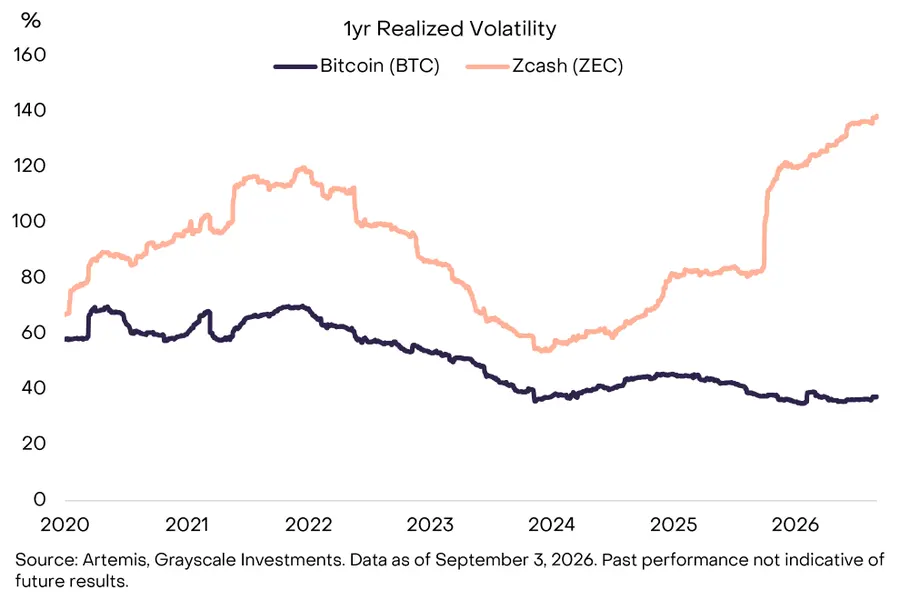
That gap matters because volatility affects returns and derivative pricing. Higher volatility generally increases option premiums, but it also signals greater uncertainty around future prices. For ZEC holders, the trade-off is higher income potential alongside greater exposure to sharp moves.
Also Read: Solana Cat Memecoin ZCAT Pays Nearly $3 Million in Zcash Rewards

Zcash Options Show 70% Covered Call Yield at Current Volatility
Grayscale estimates that a hypothetical covered-call strategy on Zcash could imply annualized yield of about 70% at current volatility.
The comparable figure for Bitcoin is around 30%, showing how options markets can translate higher volatility into larger premiums. These figures are hypothetical and should not be treated as guaranteed returns.
Covered calls involve holding the underlying asset while selling call options against it, allowing investors to collect premiums while limiting some upside.
For ZEC, the strategy could appeal to holders seeking income while retaining ZEC exposure. However, the premium does not eliminate downside risk if ZEC falls substantially.
Zcash Faces Higher Risk With Its 1% Market Size vs Bitcoin
The higher premium on ZEC options comes with an important risk distinction. Grayscale notes that covered-call strategies can suffer capital losses when the underlying asset declines by more than the premium received. A 70% implied yield should not be confused with a 70% expected total return.
The smaller market size makes liquidity, execution and price swings important considerations. ZEC uses zero-knowledge cryptography for privacy-preserving transactions, distinguishing it from Bitcoin’s publicly traceable transaction model.
Grayscale classifies ZEC as a satellite asset rather than a core portfolio holding, reflecting its specialized risk profile.
ZEC Derivatives May Gain Importance as Privacy Returns
The options discussion comes as Grayscale argues that financial privacy could receive renewed attention from stablecoins and AI-enabled surveillance.
Its August research describes ZEC as a privacy-focused digital currency allowing users to choose between transparent and shielded transactions. That distinction provides a fundamental use case beyond its role as a volatile trading asset.
For traders, ZEC’s elevated volatility can create opportunity and risk in derivatives markets. For longer-term investors, the key question is whether privacy demand can translate into sustained network usage and liquidity. Grayscale’s analysis suggests options may become useful, but underlying volatility remains the central risk.
Also Read: Zcash Price Gains as Major Short Position Losses Reach $19.03M


Be the first to comment