


Disclaimer: The below article is sponsored, and the views in it do not represent those of ZyCrypto. Readers should conduct independent research before taking any actions related to the project mentioned in this piece. This article should not be regarded as investment advice.
Djibril Cissé said the difference between confidence under pressure and paralysis comes down to one thing: whether you actually want to be the one who decides the outcome.
Across setbacks, fractured legs, and missed tournaments, his philosophy never wavered: stop looking at what didn’t happen and work with what did.
The trading panel landed on a similar truth about timing — though how you define it depends entirely on the time frame you operate in.
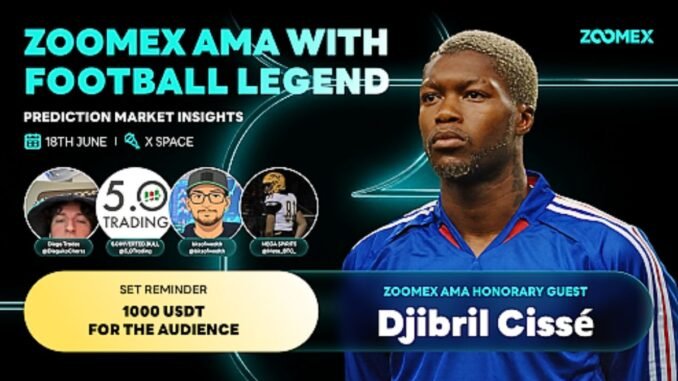
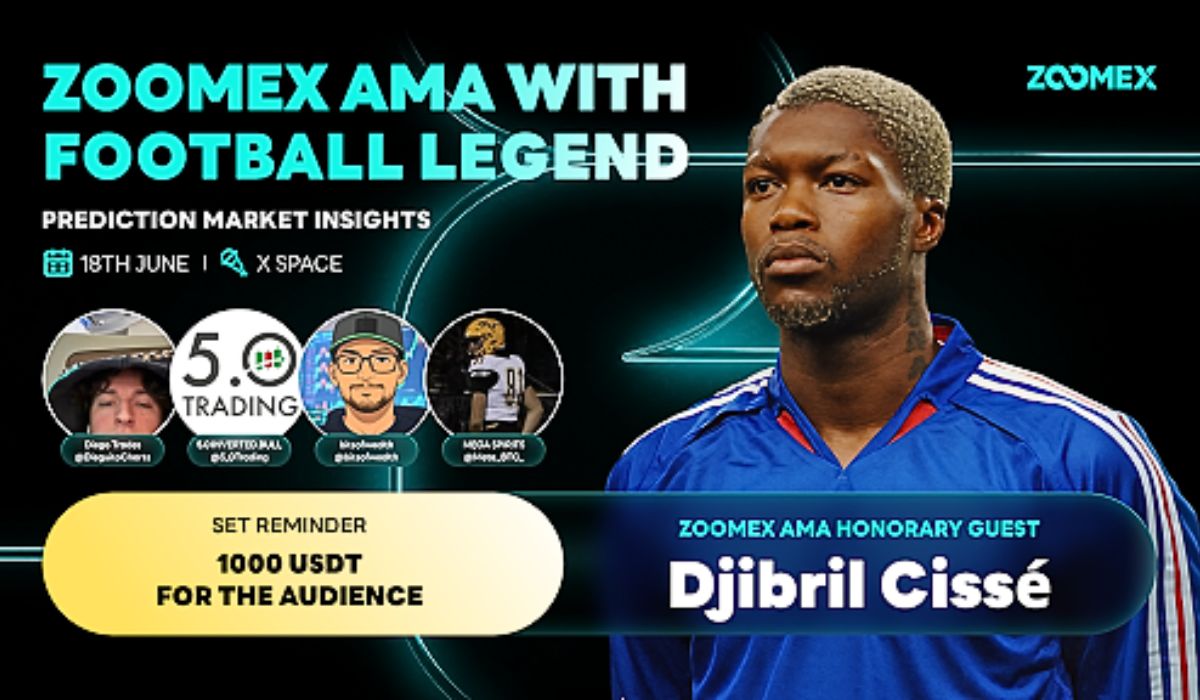
Zoomex hosted the first episode of its World Cup Edition X Space as part of the ZoomX World Cup Impact Pledge, bringing together Champions League winner Djibril Cissé and four crypto traders: Dieguito Charts, Bitsofwealth, Mega, and 5.0 Trading. Fernando Aranda hosted the session, which spanned pressure management, football analysis, career philosophy, and the kind of crypto-to-football comparisons that only work when neither side takes them too seriously.

 
The session also launched a five-part charity initiative. Across five World Cup episodes, Zoomex is committing 1,000 USDT per episode to a charity of each football guest’s choosing — rising by an additional 5,000 USDT if the guest’s World Cup prediction proves correct. Cissé picked France and nominated Maël et C’est Thérapie, a cause he has personally supported for some time.
Before the Penalty. Before the Click.
Aranda opened by asking what happens in the moment before a critical decision — for Cissé, a penalty in a Champions League final; for the traders, the second before pressing the button on a large position.
Cissé’s answer came without hesitation: “Me, as a striker, I like the pressure. I like the excitement of being the one who’s going to make the team win. The stress, the extra pressure, that’s what I lived for.”
He described taking a penalty at the 2005 Liverpool–Milan final in front of 70,000 people as something that felt ordinary — not because the stakes were low, but because his entire career had built toward exactly that moment. For some players, he acknowledged, the same situation is unmanageable. The difference isn’t preparation. It’s whether the person standing in front of the goal wants to be there.
The traders described the same split from a different angle. Dieguito Charts said professional traders lose their stress not by becoming bolder, but by eliminating ambiguity before they enter: “When you enter, you already know how much you’re going to lose if you lose and how much you’re going to win if you win. It’s not random.” Bitsofwealth added that the shift from stress to execution happens when trading stops feeling like a casino and starts feeling like a job — the system is built, you’re simply executing it. 5.0 Trading was the most direct: “If you’re getting stressed in trading, you’re doing something wrong. You either oversize, over-leverage, over-risk.”
Timing Is the Edge. Speed Is Just the Button.
Aranda asked the traders which mattered more: speed of execution or timing of entry. Timing won the room.
Bitsofwealth laid out the logic clearly — being too early and being too late produce the same outcome. The zone of entry is the whole game. Dieguito agreed. Mega agreed. Then 5.0 Trading offered a caveat that reframed the entire question. Trading above the three-day timeframe, he explained, makes split-second execution irrelevant: “Timing is relative to your time frame. Someone trading under 15 minutes is living on a completely different calendar than I am.” For short-term traders, speed and timing collapse into the same thing. For longer frames, the zone matters more than the moment.
Cissé, asked about his most dangerous weapon, answered instantly: pace — lightning quick, by his own description. But he noted that goals define a striker, not the tools used to score them. Karim Benzema spent years criticized despite being the most complete player on the pitch. Kylian Mbappé scored more than 40 goals in his first Real Madrid season and still faced criticism. “Statistics are really important in modern football. You have to be decisive.” The weapon is secondary to what it produces.
3-0 Down at Half-Time
Aranda asked Cissé about Istanbul — the 2005 Champions League final, Liverpool against an AC Milan side widely regarded as one of the best club teams ever assembled, three goals down at the break.
Cissé described the locker room not as a place of crisis, but a reset: “We came back with different intentions and in a different mood. Really: let’s try it and we’ll see what happens.”
Liverpool came back to 3-3 and won on penalties. Cissé scored one of them — by his own account, the most important game of his career.
The lesson wasn’t about tactics or fitness. It was about what a team is willing to attempt when the rational calculation says the game is over. Teams that persist with deliberate intention, rather than desperation, tend to find exits others can’t see. The same applies when a trade moves against you — panic and plan produce different outcomes, and the difference between them is usually built before the session even starts.
Injuries Are Part of the Game. So Is Coming Back.
Aranda raised Cissé’s two serious leg fractures — both season-ending, both threatening more than that. His response was the clearest expression of his underlying philosophy in the entire conversation.
“I had to put myself in a positive state of mind. I’m not going to cry, I’m going to focus, I’m going to do everything properly, and I’m going to come back.”
He extended the principle outward — to sport, trading, and life: the question after a loss isn’t whether it happened, but what you do with the information it produces. “When something bad happens to me, there’s always good behind the bad. I’m trying to analyse things and to make it better.”
Bitsofwealth noted later that fewer than 1% of traders are consistently profitable year over year — and the ones who remain aren’t the ones who avoid errors. They’re the ones who analyze and don’t repeat them. Cissé arrived at the same conclusion through a broken tibia.
The Hardest Opponents
Cissé named the defenders who gave him the most trouble: Nemanja Vidić, Rio Ferdinand, John Terry, and the Chelsea backline as a collective. Their method was consistent — identify his speed as the primary threat and collapse the space before he could use it. “They knew that if they gave me space, it would be difficult for them, so they came tight on me and tried to stop me running.”
On goalkeepers, he was candid about the tension between objectivity and loyalty, naming a technically excellent PSG goalkeeper while acknowledging his allegiance to Marseille made it harder to be fully impartial. “I work on TV as well, and I have to separate my love for my team. Even if Argentina hurt us really badly, he’s a good keeper.” The discipline to evaluate something honestly when it conflicts with allegiance is the same discipline required to close a losing trade when the narrative you entered on has stopped being true.
What Didn’t Happen, Didn’t Happen
Asked whether France would have won the 2006 World Cup had he been fit, Cissé declined the question cleanly: “I don’t dream things. I don’t overthink other things. I wasn’t there. It never happened. I might have scored an own goal in the quarterfinal. We’ll never know.”
France lost the final to Italy. That’s the event. The alternate version doesn’t exist, and reconstructing it produces nothing actionable. He acknowledged the pain of watching from the stands with his teammates — that hurt is real. The speculation isn’t.
Traders who replay missed entries and exits rarely improve from the exercise. Cissé has applied that same principle to his career for over twenty years: work with what’s in front of you, and leave the scenarios that didn’t happen where they are.
Who to Watch
With the group stages underway, Aranda asked Cissé for standout performers. He pointed to Michael Olise as a player without an obvious contemporary comparison, and gave a mention to Rayan Cherki as a talent deserving more playing time at this level.
For current form, he praised Harry Kane — a pure number nine who stays in the box and scores when it matters, a type increasingly rare in the modern game. He also acknowledged Messi’s continued output at 38 or 39 as worth appreciating regardless of allegiances.
His sharpest observations were saved for smaller nations — Congo drawing against Portugal, Curaçao conceding seven against Germany while still holding a path to best-third-place qualification, countries reaching a World Cup for the first time and competing. “I like stories like this. I like nice stories.”
On Spain’s opening draw, he was measured — Lamine Yamal had returned from injury below full fitness, as had Nico Williams. “Even 30% of Yamal can make the difference,” he said. The tempo will come.
Which Team Is Bitcoin?
The session’s lighter segment asked traders to map major cryptocurrencies to national teams.
Bitcoin landed in Brazil and France, with Mega making the case for Brazil most precisely — the longest track record, the deepest global fanbase, a talent pool that keeps regenerating, and the status of being the benchmark everything else gets compared to, regardless of current charts.
The meme coin category produced the most debate. Mexico earned the clearest consensus — enormous community, recurring cycles of hype, genuine passion, and a historical gap between pre-tournament noise and results. Japan drew multiple votes, with 5.0 Trading making a more serious point underneath the joke: “Within the next few World Cups, we’re going to see either Japan or South Korea winning. The way they have improved in the last 10, 15 years, and they play as a team. That’s something you don’t see in many European setups.”
Ethereum’s assignment revealed the most about the traders making the case. England landed on the list twice — expensive, foundational, reliably present, and still yet to fully deliver on its whitepaper. Germany drew a vote for methodical adaptability. 5.0 Trading assigned Italy, which didn’t qualify for this World Cup, on the basis that Italy’s absence was about as useful as ETH’s recent price action.
Solana went to France (fast, explosive, talented), the Netherlands, and the United States.
The Lesson From the Zoomex Space
The thread connecting the football and trading conversations wasn’t the surface-level analogy between penalty kicks and trade entries. It was about how people respond when the outcome is uncertain, and the stakes are real.
Cissé walked into those situations throughout his career and preferred them. The traders who’ve consistently stayed profitable described the same state from a different angle: once a system is built and tested under live conditions, pressure stops being a warning sign and becomes information.
The sharper point was Cissé’s refusal to inhabit the 2006 alternate history. High performance, in football and in markets, doesn’t live in the scenarios that failed to materialize. It lives in the one that did — the one that can still be worked on, adjusted, improved. What happened is the only material available.
The Zoomex World Cup Impact Pledge continues across four more episodes, each with a new football guest, a new charity selection, and a prediction already on record. France is going to win the World Cup. Djibril Cissé said so — and the charity pool depends on it.
About Zoomex
Founded in 2021, Zoomex is a global cryptocurrency trading platform with over 3 million users across more than 35 countries and regions, offering 600+ trading pairs. Guided by its core values of “Simple × User-Friendly × Fast,” Zoomex is committed to fairness, integrity, and transparency in delivering a high-performance, low-barrier, trustworthy trading experience.
As an official partner of the Haas F1 Team and global brand ambassador partner of goalkeeper Emiliano Martínez, Zoomex brings the same focus on speed, precision, and discipline from the racetrack and the pitch to trading. The platform holds regulatory licenses including Canada MSB, U.S. MSB, U.S. NFA, and Australia AUSTRAC, and has passed security audits conducted by Hacken.




Be the first to comment