



Key Insights
- Bitcoin price prediction weakened after BTC rejected the $81,300 resistance area.
- Bitcoin futures positioning remained elevated as spot prices pulled below $80,000.
- Spot Bitcoin ETF inflows extended to seven consecutive trading sessions.
Bitcoin price prediction has turned more cautious after BTC failed to sustain its move above $81,000. Bitcoin reached roughly $81,200 during Aug. 25 trading before sellers pushed the asset back below $80,000.
The rejection comes as derivatives positioning remains elevated, increasing the risk of sharper volatility around nearby technical levels. However, seven consecutive sessions of spot Bitcoin ETF inflows continue to provide a counterweight to the bearish technical setup.
Bitcoin Price Prediction Weakens Below $80,000
CoinMarketCap data showed Bitcoin near $79,172 during Aug. 26 trading. The price of Bitcoin had fallen about 1.9% over 24 hours. Its market capitalization remained near $1.59 trillion.
CoinMarketCap’s historical series showed Bitcoin at $78,379 on Aug. 25. It recorded the previous day near $78,964.

The data placed the rejection inside a volatile recovery rather than an isolated decline. Bitcoin had traded near $69,266 on Aug. 19 before accelerating toward resistance.
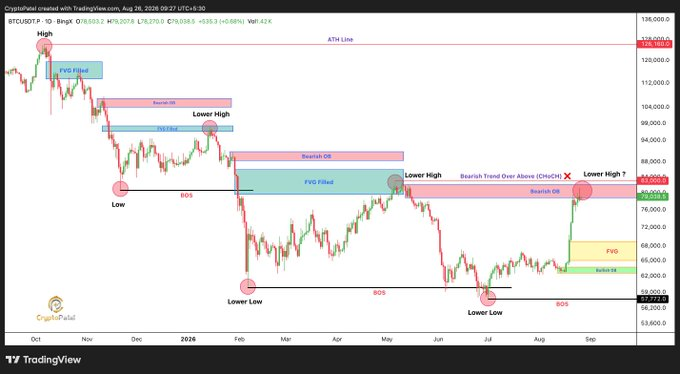
Crypto Patel wrote on X that Bitcoin faced resistance between $80,000 and $83,000. He said the daily candle formed an inverted hammer after rejection near $81,300.
That pattern can indicate selling pressure when it forms after an advance. However, one candle alone does not confirm a broader reversal.
Patel identified $83,000 as the structural invalidation level for his bearish setup. He projected $55,000 to $50,000 if Bitcoin failed to regain resistance.
His target represented technical analysis rather than a confirmed market outcome. A sustained break above $83,000 would invalidate that downside framework, he wrote.
Bitcoin Price Prediction Meets Elevated Futures Exposure
CryptoQuant data showed Bitcoin futures open interest near $55.8 billion on Aug. 26. Futures volume exceeded $98 billion during the previous 24 hours.
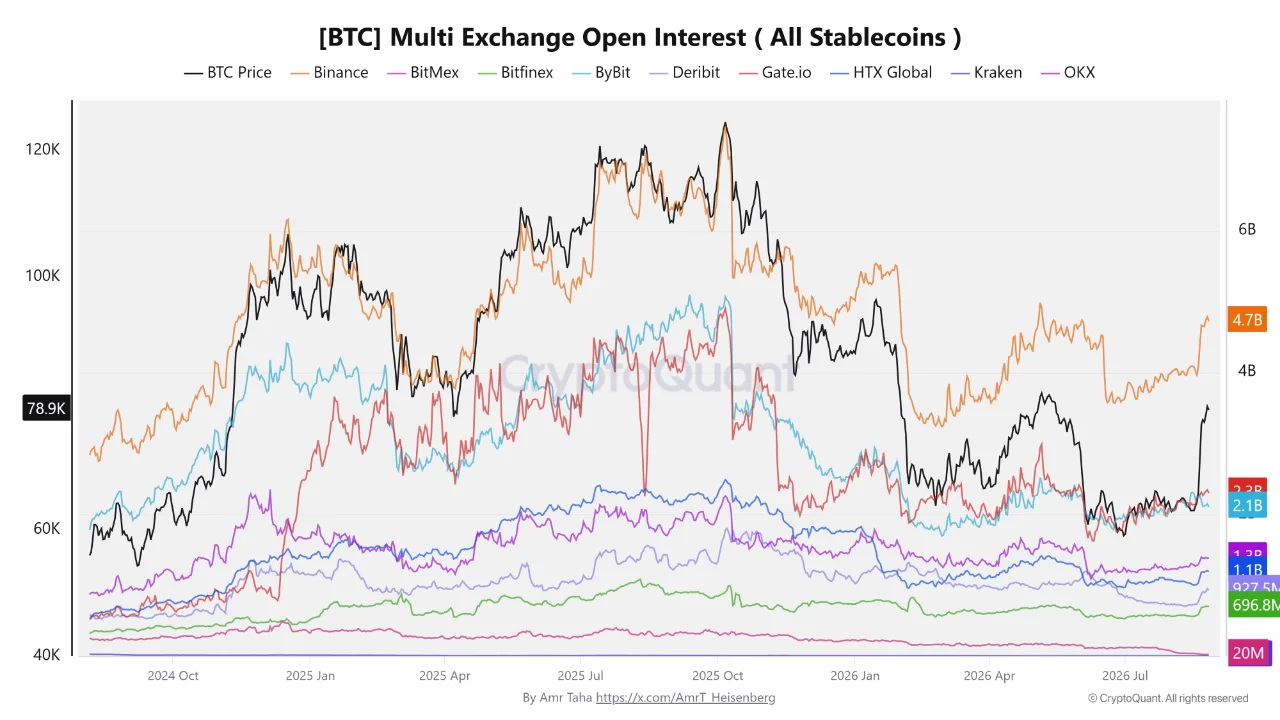
The derivatives data showed substantial leveraged participation remained active despite the pullback. CryptoQuant also recorded roughly $325 million in Bitcoin liquidations during that period.
Open interest tracks outstanding derivatives positions across exchanges. It includes long and short exposure, so elevated readings do not establish direction alone.
The supplied derivatives dataset showed Binance stablecoin-margined Bitcoin open interest reached $4.78 billion on Aug. 25. That level exceeded its May 14 peak of $4.74 billion.
The same dataset showed Gate, Bybit, and HTX remained below their earlier May peaks. The divergence suggested leverage rebuilding had concentrated more heavily on Binance.
That concentration increased Binance’s influence on short-term derivatives positioning. However, open interest growth alone could not establish bullish or bearish conviction.
Bitcoin Price Prediction Faces Counterweight From ETF Inflows
SoSoValue data cited by Wu Blockchain showed $314 million in Bitcoin ETF net inflows on Aug. 25. The reading extended the positive flow streak to seven consecutive sessions.

The ETF inflow data reduced the case for treating rejection as purely demand-driven weakness. Positive fund flows can coexist with falling spot prices.
Derivatives selling, profit-taking, or short-term positioning can offset institutional buying. That tension made confirmation above resistance more relevant than one rejection.
BlackRock’s iShares Bitcoin Trust remained central to institutional Bitcoin access. BlackRock’s prospectus described cash and in-kind creation and redemption procedures.
The filing listed Jane Street Capital, Virtu Americas, JPMorgan Securities, and Marex Capital Markets as in-kind participants. Those transactions occur through authorized participants rather than direct retail conversions.
That distinction matters for claims that holders can freely exchange Bitcoin for IBIT shares without taxes. BlackRock’s prospectus did not support that broad interpretation.
The filing described fund creation and redemption mechanics, not universal tax treatment for Bitcoin holders. Tax outcomes depend on transaction structure and investor circumstances.
The Bitcoin price prediction therefore rested on competing market signals. Technical rejection pointed lower, while ETF flows showed institutional demand remained active.
Bitcoin also remained far above early-August levels. CoinMarketCap recorded Bitcoin near $64,905 on Aug. 8.
That advance left traders assessing consolidation against deeper distribution risk. The $80,000-to-$83,000 area remained the immediate technical barrier.
A confirmed move above $83,000 would weaken Patel’s bearish case. Failure there would keep attention on lower support and liquidity zones.
Elevated open interest could amplify liquidations if BTC crypto moved rapidly through leveraged positions. ETF flows remained another measurable demand indicator.
Bitcoin’s next verifiable technical test remained the $83,000 resistance level. Traders also awaited Aug. 26 ETF flows and updated derivatives positioning.
This article is for informational purposes only and does not constitute financial advice. Cryptocurrency markets can experience sharp price movemen



Be the first to comment