



Do you believe the Internet, the “cyberspace,” must stay free and available for everyone? Cypherpunks believed it, and cryptocurrencies were born from that ideology. But they weren’t the only ones. While
Mr. Barlow wasn’t a programmer, a science expert, or even a lawyer. He was, as Bruce Sterling
However, this was the same man behind a lot of lyrics of the popular rock band The Grateful Dead, and also the same one who wrote “A Declaration of the Independence of Cyberspace,” a widely-known
Let’s learn a bit more about him and how our current crypto space came to worry him.

Grateful Dead
Barlow met Bob Weir (co-founder of the Grateful Dead) at the early age of 15 at the Fountain Valley School in Colorado Springs. They’d meet after college again, and Barlow became one of the band’s key lyricists. His songs carried a loose, open-road spirit that matched the band’s culture. In “Estimated Prophet,” the narrator sounds untethered, roaming and proclaiming his own truth. In “Throwing Stones,” the lyrics push against power and hint at disorder, with lines about ashes and rulers that echo distrust of authority.
Being a “Deadhead” (a Grateful Dead fan) sent a message in the 90s. As Sterling put it: “The Grateful Dead and their thousands of Deadhead devotees are radical Bohemians. This much is widely understood.” Barlow, a Deadhead himself, was the poet who wrote lyrics for these people, and that path would lead him to do much more.
In 1986, he joined The WELL, one of the first virtual communities. It was a dial-up gathering place where Deadheads, writers, hackers, and curious minds traded ideas in threaded conversations, shaping norms for digital life. There, Barlow connected with people who cared about speech and privacy in this new frontier that was the Internet.
Some years later, the conversation wasn’t only about music. They started to discuss more serious topics, like Operation Sundevil, which included a series of nationwide raids by the US Secret Service to curb “illegal” hacking activities. Barlow positioned himself at the center of this topic.
Internet Activism
What can a lyricist, religion-graduated, cattle rancher from Wyoming do when the government raids a game company unfairly? One would think not much. Yet, Barlow chose to raise his voice. During the 1990 crackdown on hackers, even Barlow (clearly not a hacker himself) was questioned by the FBI. An agent visited him in Wyoming while investigating a suspected hacker, and Barlow realized something bigger was happening.
People connected to computers, from hobbyists to conference attendees, were falling under suspicion. He shared that experience on The WELL, where many users already felt uneasy about aggressive law enforcement tactics, including the raid on
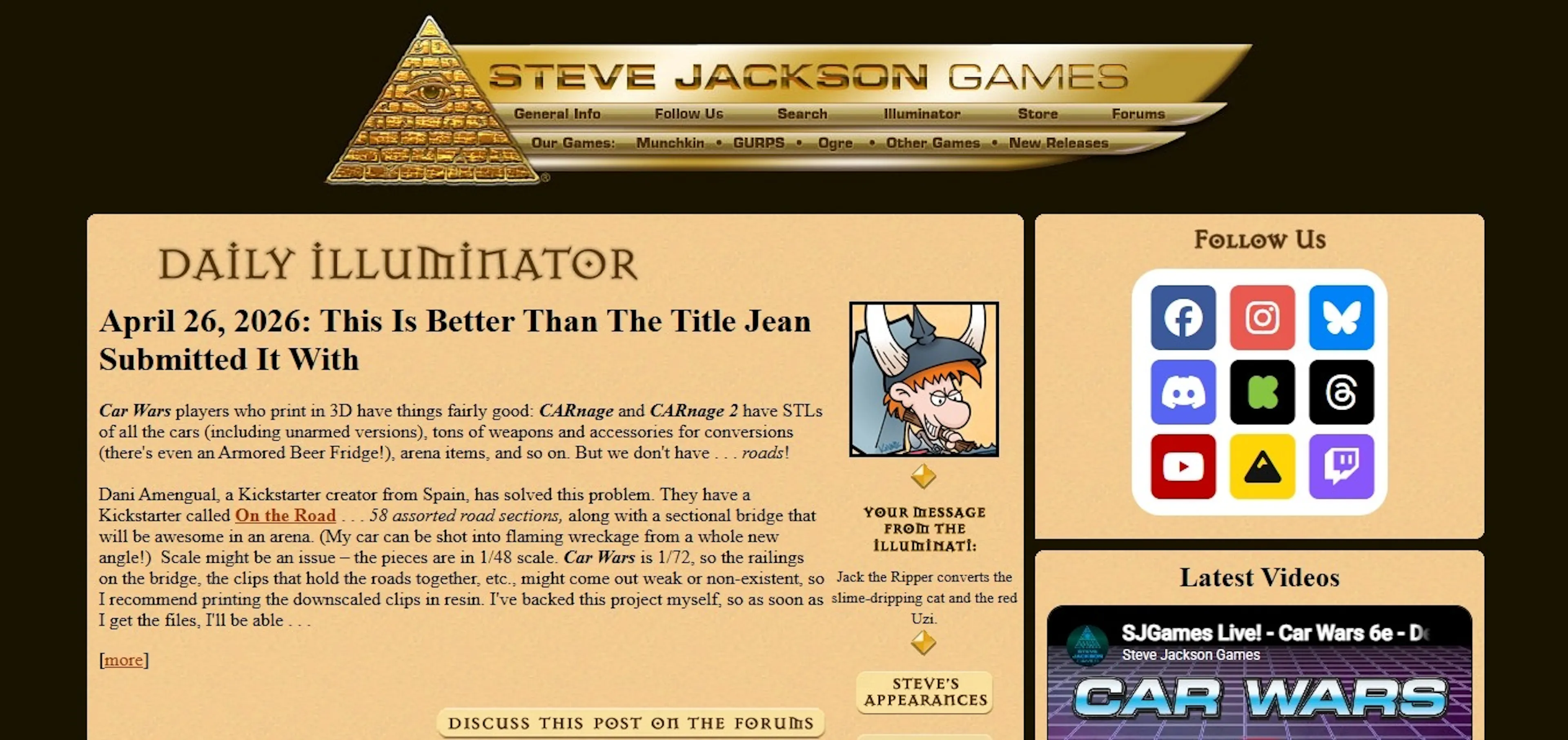 Current Steve Jackson Games Website (2026)
That specific event was important, so we’ll sum it up: agents from the United States Secret Service raided that company in March 1990. Not because the company itself was a real suspect, but because one of its employees at the time, Loyd Blankenship, may or may not have hacked some phone company files tied to BellSouth, a major regional telecom. Instead of a narrow search, agents seized computers, manuscripts, and a private email system used by the company’s online community, freezing day-to-day work.
It was a scandal. A flagrant violation of privacy rights. But Barlow’s writing on The WELL turned concern into momentum. His posts spread awareness across this early online community and caught the attention of Mitch Kapor, who had faced similar scrutiny. As bad cases piled up, both saw a need for organized defense. So, in mid-1990, they joined forces with
SJG sued the Secret Service and won in 1993 with the participation of the EFF as amicus curiae (adviser to the court).
A Declaration of the Independence of Cyberspace
Barlow not only founded the EFF and disappeared, but also stayed as an activist in the online world. In 1996, the United States tried to pass a law to ban “obscenities” and related content from the Internet, in what they called the “Decency Act.” This attempt, along with past state grievances, led Barlow to write his famous
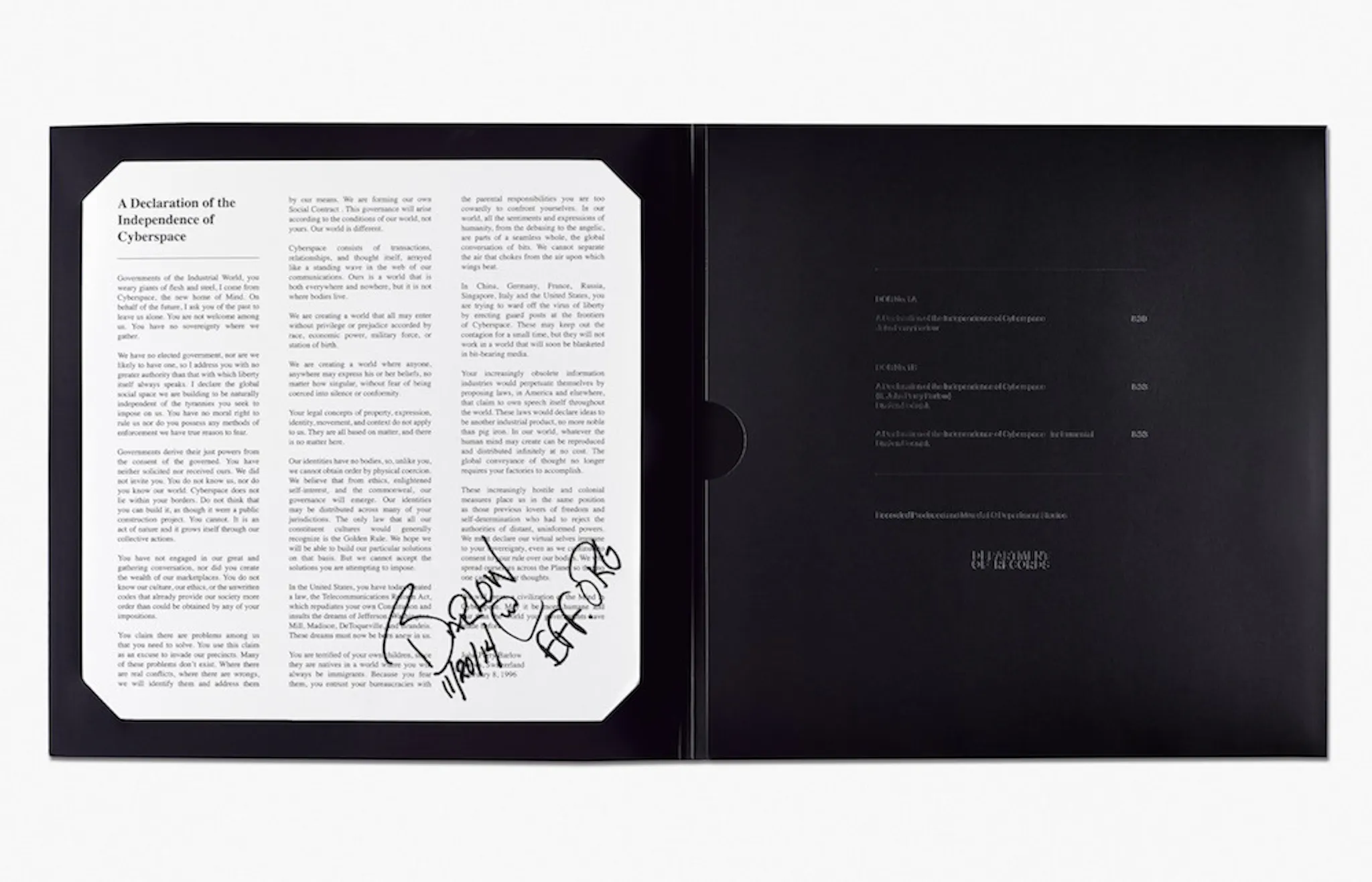 Declaration of the Independence of Cyberspace released on Vinyl by the Department of Records
Originally commissioned for the global event “24 Hours in Cyberspace,” and published in February 1996, it reads:
“Governments of the Industrial World, you weary giants of flesh and steel, I come from Cyberspace, the new home of Mind. On behalf of the future, I ask you of the past to leave us alone. You are not welcome among us. You have no sovereignty where we gather (…) We are creating a world where anyone, anywhere may express his or her beliefs, no matter how singular, without fear of being coerced into silence or conformity.”
Barlow argued that what people call “cyberspace” was a distinct realm, separate from physical borders and traditional jurisdiction, and it should follow its own norms. In his view, governments neither should nor could control it. This emerging space would guide itself through a simple ethic, the Golden Rule, where people treat others as they wish to be treated, rather than obeying the laws of an external authority. Well, that’s how the crypto community works, too.
Liberty and Enslavement
Barlow passed away in 2018 in his home, at the age of 70. Before that, though, he had time to give his opinion on distributed technologies and cryptocurrencies. It may sound a tad bleak, but in the end, as with most things in life, it’s up to us what to do with it. During an event for technologists at Stanford University in 2015,
“You are designing the architecture of liberty and enslavement, both, in these tools that are being derived around the blockchain and other things like it. What you do and the ways in which you do it will have long-lasting effects.”
Not all crypto networks allow the same degree of freedom and decentralization, that’s true. Central Bank Digital Currencies (

This is our first article in Cyber Libertarians, our new series about inspirational figures, following our
Featured Vector Image by TheDigitalArtist /
Photograph of John Perry Barlow by Jessica Louise Bernard /


Be the first to comment