



A single API integration with Tether’s omnichain USDT0 standard collapses bridge complexity across the corridors carrying $245 billion in annual stablecoin payment volume, and signals where the next phase of dollar settlement is actually being built.
What does a US dollar actually look like when it crosses three Asian borders, two blockchains, and one bridge contract before reaching a payout wallet in Manila? On May 20, 2026, Stables answered that question by removing two of those layers from the journey, and in doing so, quietly reorganized the economics of the largest stablecoin payment market in the world.
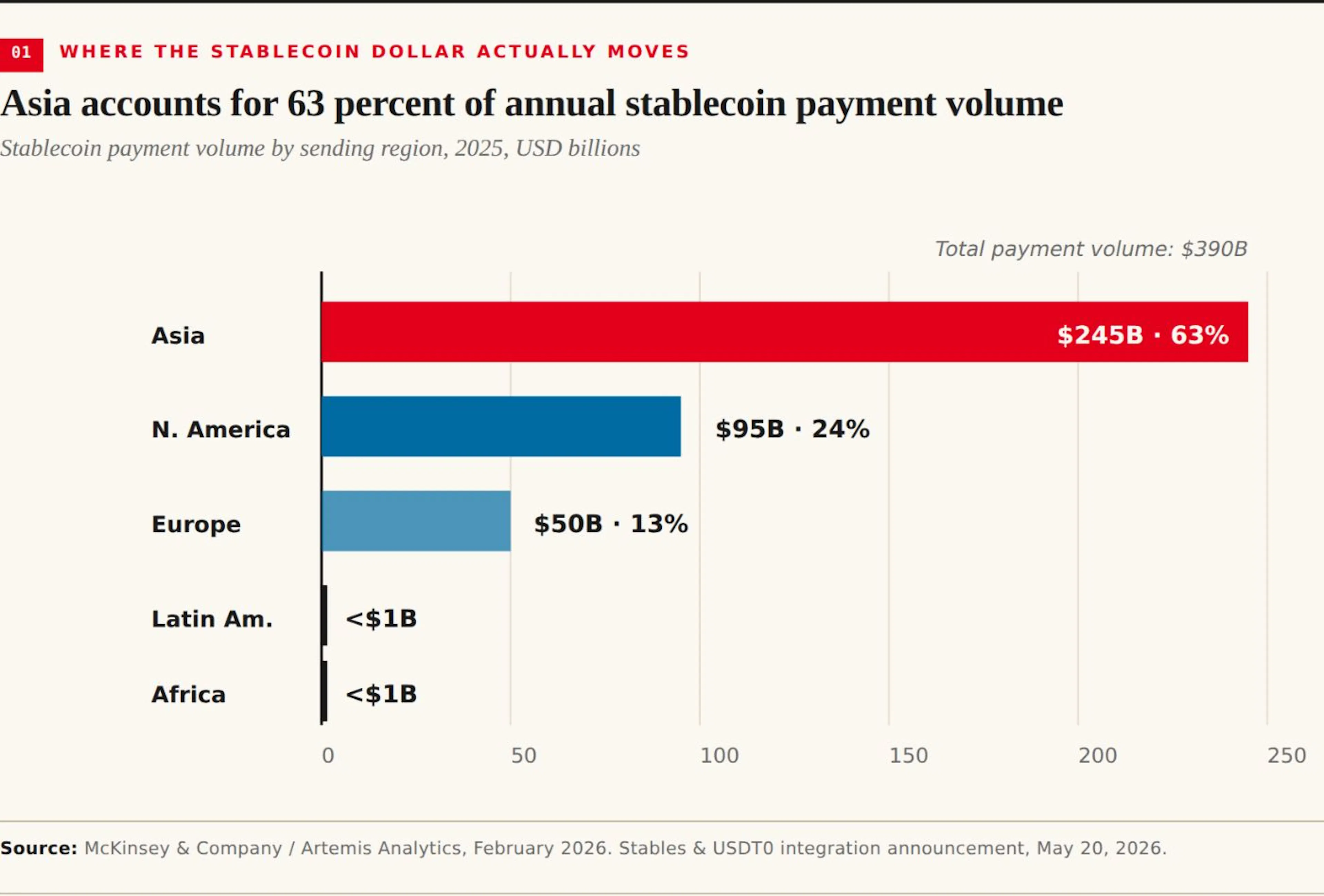 Asia accounts for 63 percent of annual stablecoin payment volume
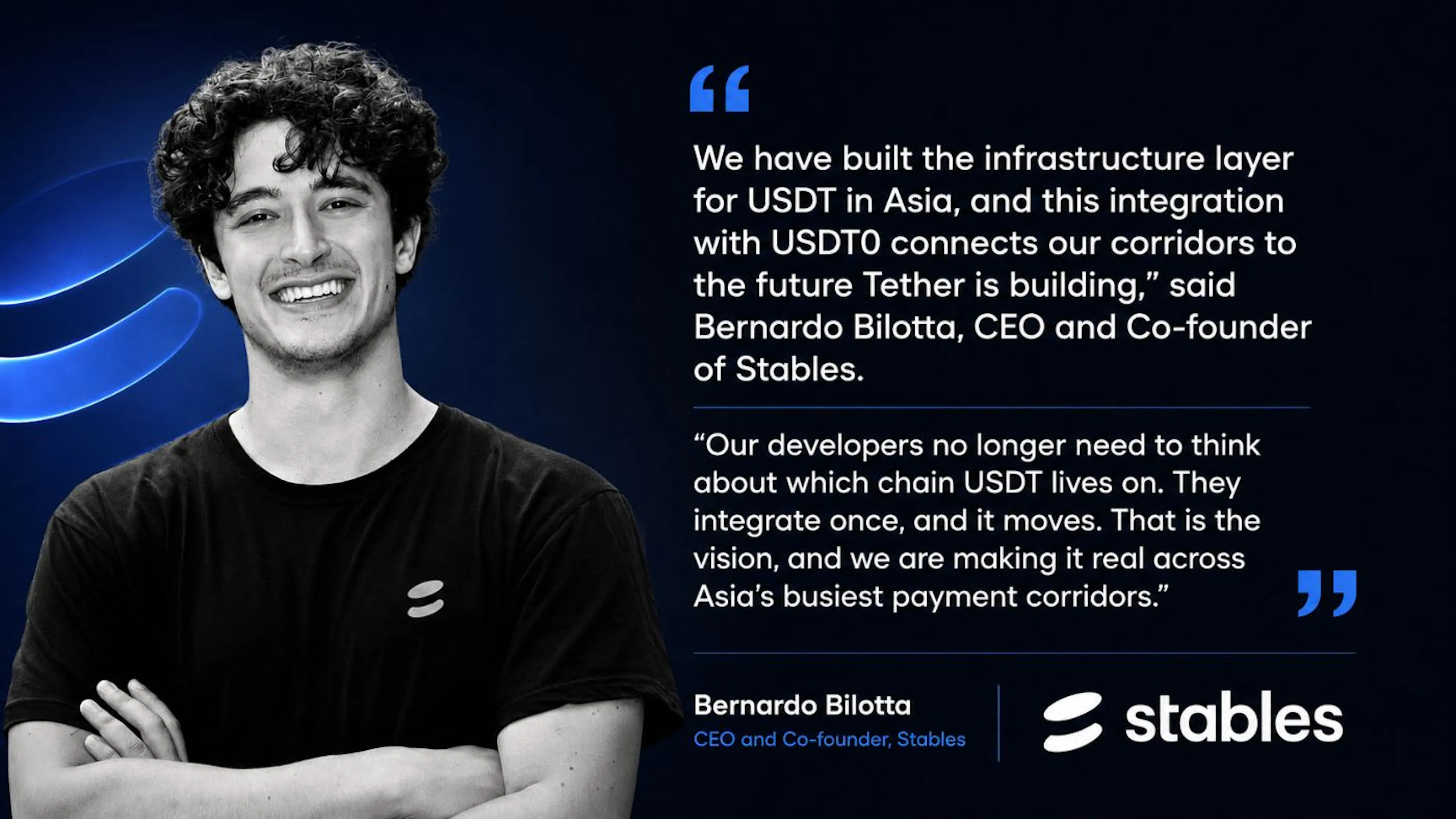
The Singapore-headquartered payments infrastructure firm announced that it has integrated USDT0, Tether’s omnichain extension built on LayerZero’s Omnichain Fungible Token standard, directly into its developer platform. The integration eliminates the chain-selection layer for developers building remittance, payroll, and merchant payout flows across Asia, which now carries roughly 60 percent of global stablecoin payment volume.
That 63 percent figure is worth pausing on, because the geographic concentration of stablecoin payment utility is among the most lopsided distributions in modern finance. A February 2026 analysis from McKinsey and Artemis Analytics found that of the $390 billion in stablecoin payments processed globally during 2025, $245 billion originated from Asian payment corridors, with Singapore, Hong Kong, and Japan accounting for the bulk of that activity. North America, by comparison, processed $95 billion. Europe processed $50 billion. Latin America and Africa each processed under $1 billion. The volume sits almost entirely on top of USDT rather than USDC, which means that any infrastructure that improves USDT mobility specifically across Asia is operating on the largest stablecoin surface area in the world.
The fragmentation problem that Stables and USDT0 are jointly attacking has been the structural ceiling on this market for the better part of three years. USDT exists natively as an ERC20 token on Ethereum, a TRC20 on Tron, an SPL token on Solana, a Jetton on TON, and a BEP20 on BNB Chain, with additional native deployments across more than a dozen other networks. Each version is a separate contract with its own liquidity pool, its own bridge dependencies when moved between chains, and its own gas economics. A developer building an on-ramp flow from Singapore to the Philippines historically had to make a chain selection that propagated downstream into bridge fees, wrapped token counterparty risk, and reconciliation overhead that compounded every time a user crossed networks.
“Crypto promised better, faster, cheaper money movement. Fragmented chains rebuilt many of the problems fintech spent a decade trying to solve.“
Lorenzo R., Co-Founder, USDT0
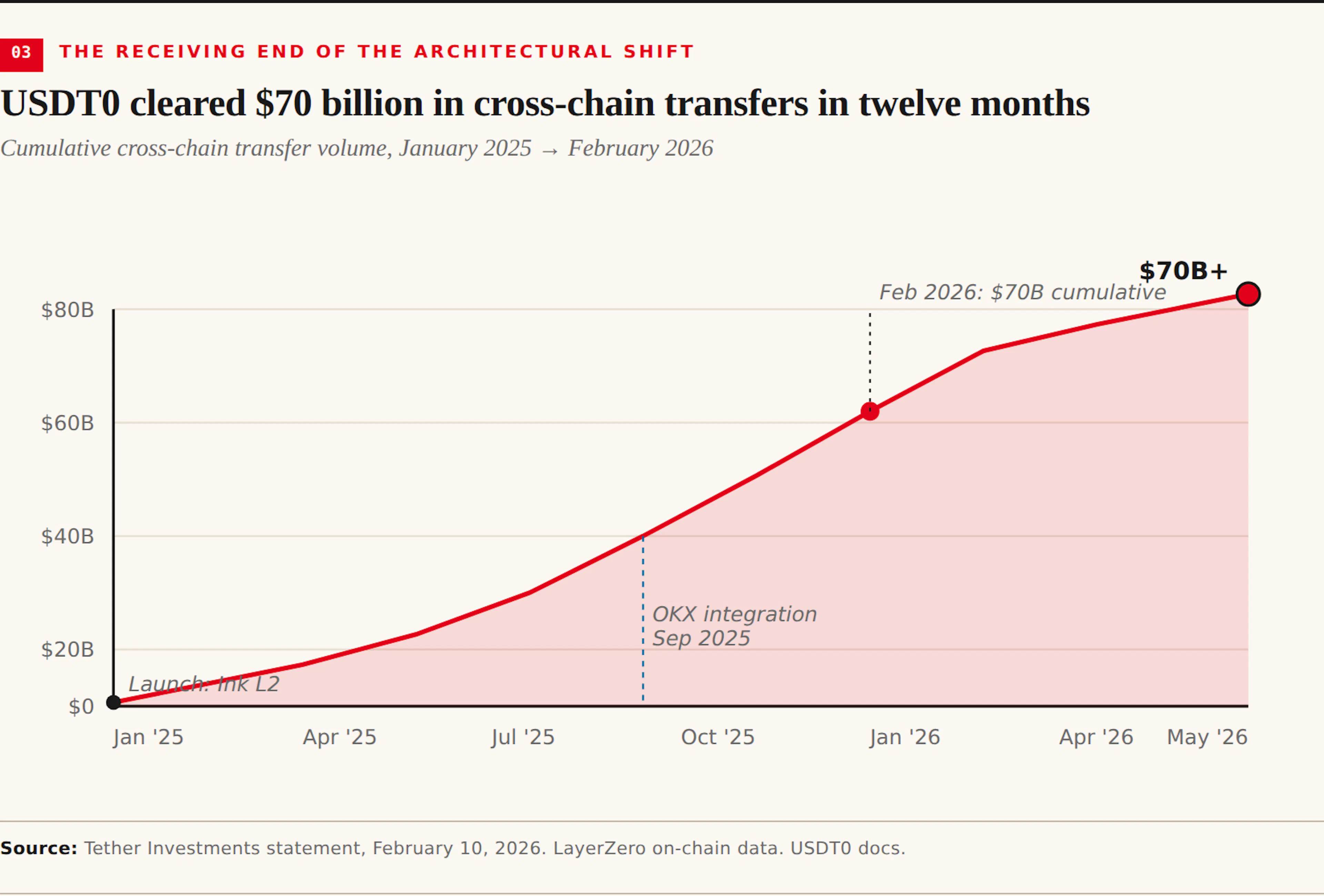 USDT0 cleared $70 billion in cross-chain transfers in twelve months
USDT0 collapses the fragmentation problem by treating Tether’s dollar as a single unified token across more than 23 networks, including Ethereum, Arbitrum, Optimism, Polygon, Base, BNB Chain, Avalanche, Solana, TON, Aptos, Berachain, Unichain, Hyperliquid, Kraken’s Ink, and most recently the payments-native chain Tempo. The mechanism is a lock-and-mint architecture in which canonical USDT remains locked in an Ethereum vault while LayerZero’s messaging layer mints and burns equivalent units of USDT0 on destination chains. Since its January 2025 launch, the protocol has settled over $70 billion in cross-chain transfers under live market conditions, and Tether Investments took a strategic equity stake in LayerZero Labs in February 2026 to deepen the underlying infrastructure.
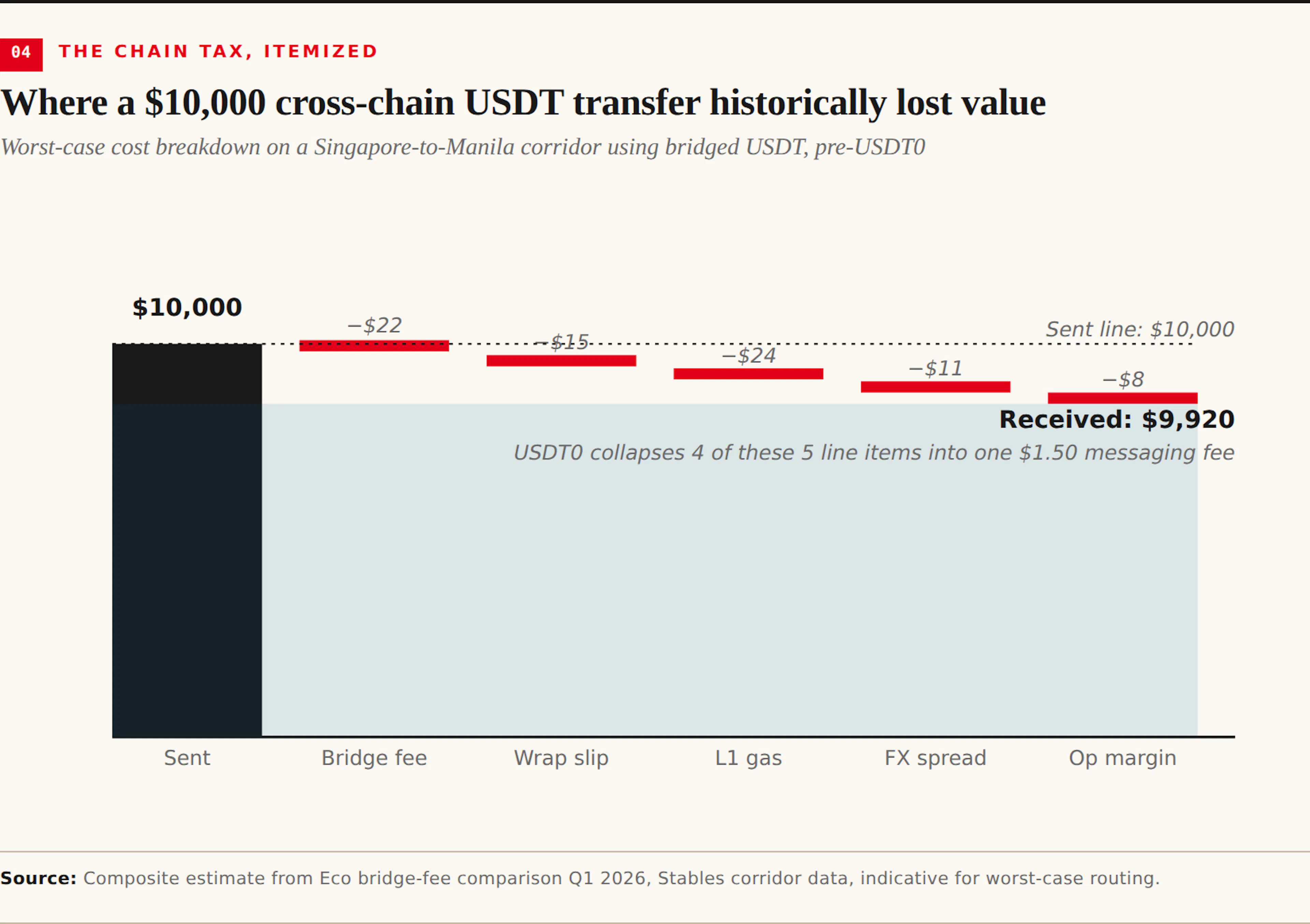 Where a $10,000 cross-chain USDT transfer historically lost value
The economic narrative justification for this integration sits in that waterfall. A typical worst-case cross-chain USDT transfer of $10,000 from a Singapore on-ramp to a Philippines payout wallet, routed through a non-canonical bridge with an Ethereum mainnet hop, has historically leaked roughly $80 in cumulative fees and slippage before the recipient saw a single peso. USDT0 collapses four of those five line items into a single LayerZero messaging fee, which on most $1,000-scale transfers currently runs between $0.50 and $3.00 depending on destination gas. At the scale of $245 billion in annual Asian stablecoin payment volume, even a 50-basis-point reduction in the chain tax represents over a billion dollars per year of recovered value, and that math is what makes the underlying integration commercially significant rather than merely technical.
The narrative justification for Stables specifically holding this integration runs through licensing depth and corridor coverage. The company holds a Digital Currency Exchange license in Australia, a Virtual Asset Service Provider authorization in Europe, and a Money Services Business registration in Canada, which positions it as one of the few API-first stablecoin orchestration providers that can legally service institutional flows touching multiple OECD jurisdictions simultaneously. Its co-founder and CEO Bernardo Bilotta has publicly estimated that USDT underpins roughly half of all Asian stablecoin flow, and the Stables platform layers compliance routing, liquidity orchestration, and multi-currency support on top of that base. The USDT0 integration removes the chain selection layer that previously sat above all of it.
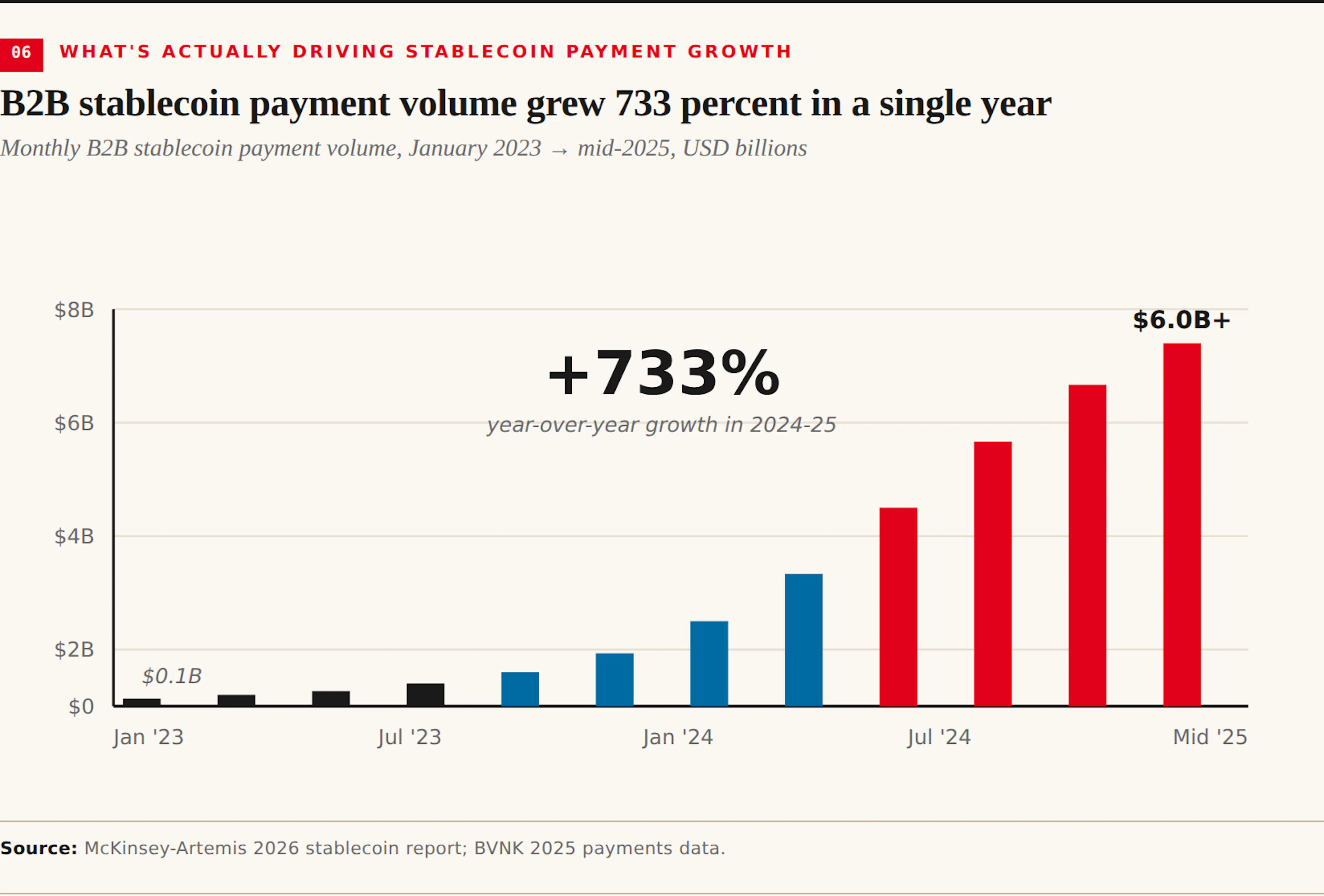 B2B stablecoin payment volume grew 733 percent in a single year
What changes for developers is the disappearance of an entire category of engineering work. A team building a Philippines payout flow no longer has to decide whether USDT lives on Tron because that is cheapest, on Solana because that is fastest, or on Ethereum because that is where treasury sits. A single API call moves the asset to wherever it needs to land, and the underlying protocol handles the chain abstraction silently. For enterprise clients running treasury operations across multiple chains, the integration also removes reconciliation complexity, because USDT0 maintains a single source of truth on the Ethereum lockbox rather than across fragmented per-chain balance sheets that have to be reconciled at end of day.
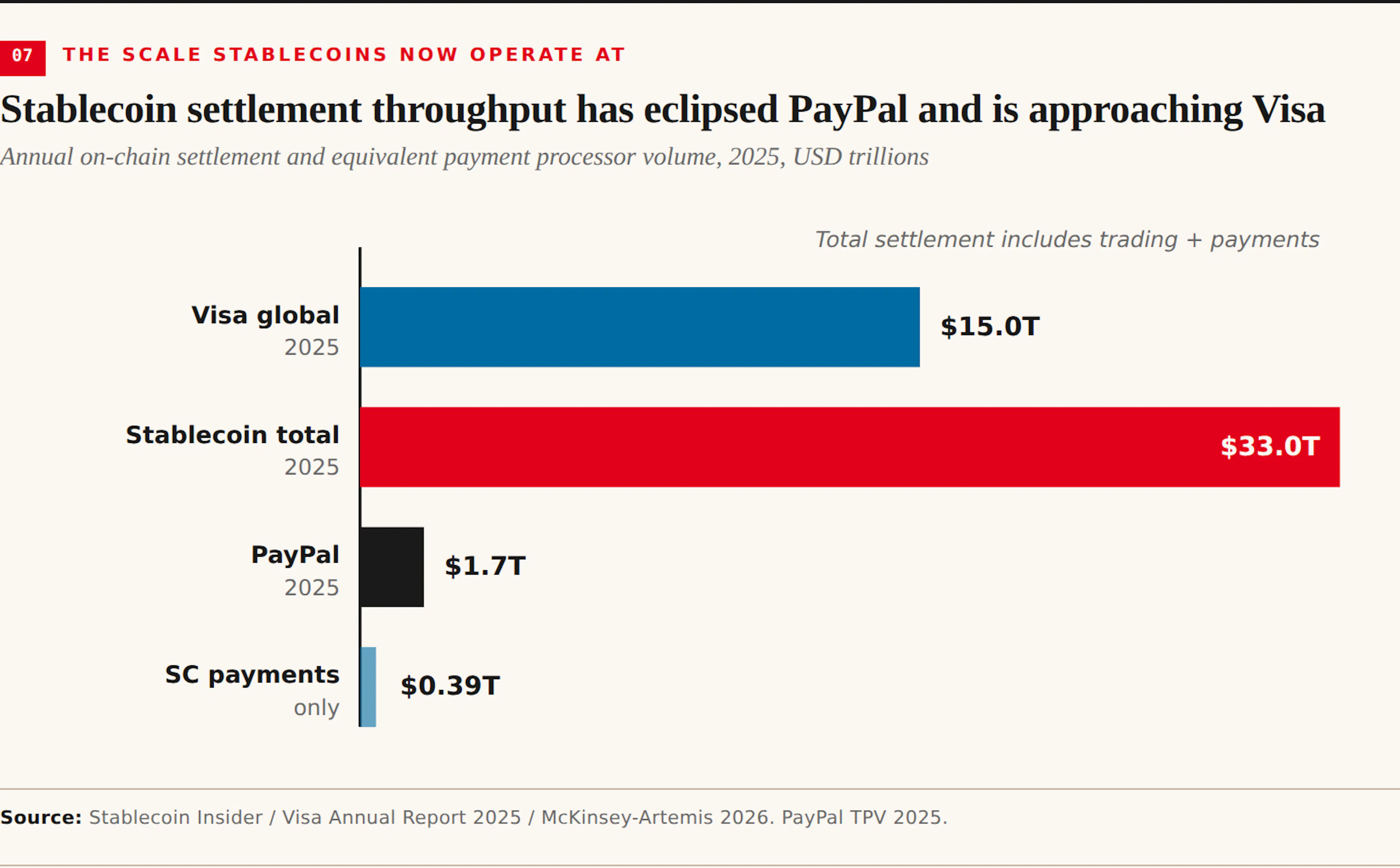 Stablecoin settlement throughput has eclipsed PayPal and is approaching Visa
The competitive context here matters more than the announcement itself. Stables has spent the past quarter assembling a complete orchestration stack across Asia, including T-0 Network for institutional liquidity routing, eStable for banking integration and local-currency stablecoin issuance, and Mansa for remittance distribution to recipient banks. USDT0 now sits underneath all of these as the settlement layer that makes the whole thing chain-agnostic. The architectural pattern that is emerging across the region is one in which dollar liquidity moves omnichain through USDT0, regulated local-currency stablecoins handle last-mile payout to recipient bank accounts, and orchestration platforms like Stables coordinate the flows under unified compliance frameworks that span multiple jurisdictions simultaneously.
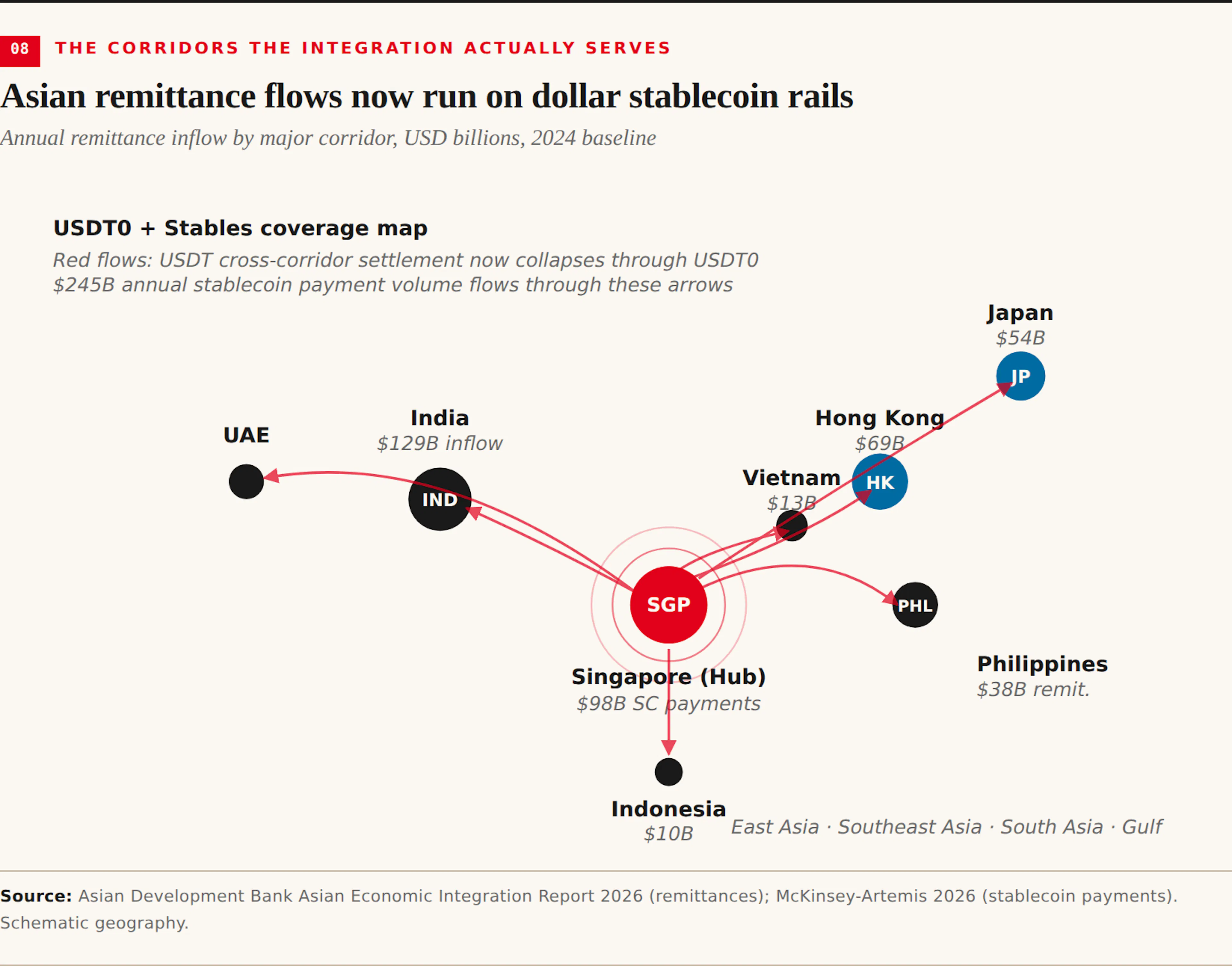 Asian remittance flows now run on dollar stablecoin rails
The longer-term implication of this integration extends well beyond the immediate developer experience or the corridor-by-corridor savings. Tether CEO Paolo Ardoino has publicly framed USDT0 as plumbing for an agentic finance economy, in which autonomous AI software handles transactions across networks without surfacing chain selection to the user at all. B2B stablecoin payments grew 733 percent year over year in 2025 to reach $226 billion in annual volume, a trajectory that suggests the bulk of stablecoin payment growth is now coming from corporate treasury operations rather than retail speculation, and that direction of travel only accelerates if chain abstraction becomes the default rather than the exception.
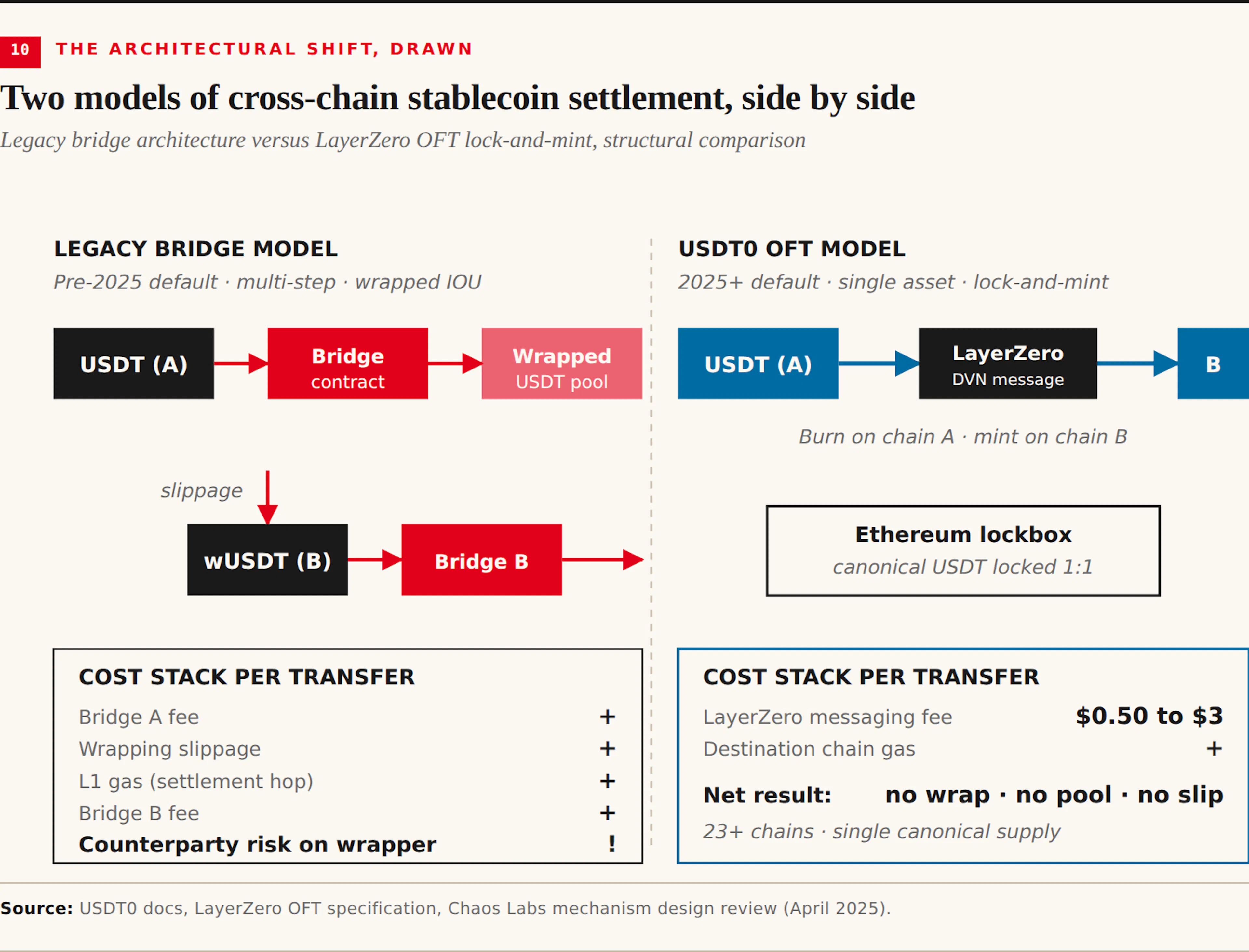 Two models of cross-chain stablecoin settlement, side by side
If the agentic finance thesis holds, the addressable surface for stablecoin payments shifts from a chain-by-chain integration problem to a single corridor coverage question. Asia, having built the deepest payment corridors first and having concentrated 63 percent of the world’s stablecoin payment volume inside them, becomes the place where the omnichain future arrives soonest and where the commercial returns to that abstraction accrue earliest. The integration that Stables and USDT0 announced on May 20 is the early structural confirmation that the chain itself is finally being abstracted out of the payment, and that the dollar is being treated as the only object the payment actually cares about.
Don’t forget to like and share the story!
HackerNoon has reviewed the report for quality, but the claims, opinions and analysis herein belong to the author.
All claims, opinions, and analytical conclusions are those of the author, who retains full control over the work.
#DYOR



Be the first to comment