




TLDR
- ENS price traded near $4.58 after gaining 3.67% in 24 hours.
- ENS DAO approved the onchain proposal activating its new Security Council.
- The new council will serve a two-year term until July 16, 2028.
- Five of eight council members must approve any emergency proposal cancellation.
- ENS must reclaim $4.70 to extend its rally toward $4.80.
The ENS price moved higher as the Ethereum Name Service DAO approved the onchain proposal activating its new Security Council for the next two years.
ENS Price Recovers as Volume Rises
Ethereum Name Service price traded near $4.58, gaining 3.67% over the past 24 hours. The token recovered after falling below $4.40 during intraday trading.
ENS later climbed above $4.70, but sellers returned near the session high. The pullback pushed the token back toward the $4.57 area as traders watched short-term resistance.
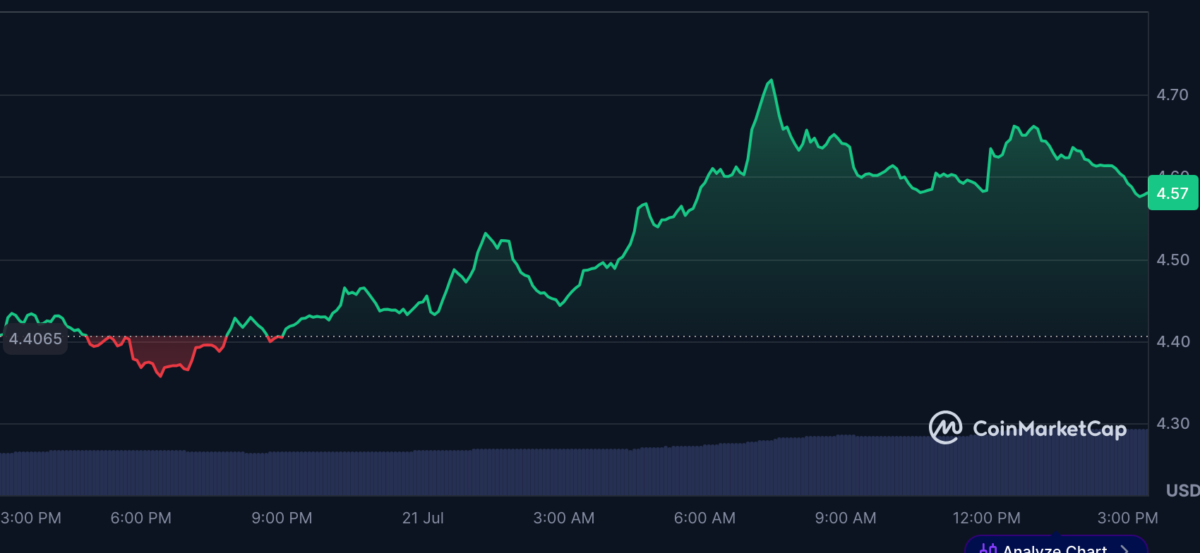 Source: CoinMarketCap
Trading volume increased 41.79% to $20.62 million, showing stronger market activity around the token. Market capitalization also rose 3.75% to $187.92 million.
ENS must reclaim $4.70 to support another move toward $4.80. Immediate support remains near $4.50, followed by a deeper support zone around $4.40.
ENS DAO Approves New Security Council
ENS DAO has approved the onchain proposal activating its new eight-member Security Council. The council has limited veto authority to cancel malicious governance proposals before execution.

The council was selected through EP 6.50, and its term will run until July 16, 2028. The outgoing council’s cancel authority is set to expire on July 24, 2026.
The brief overlap avoids a gap where no Security Council could cancel a harmful proposal during the governance waiting period. Successful ENS proposals enter a two-day timelock before transactions can be executed.
During that window, the Security Council can cancel a queued proposal if it meets emergency conditions. The new council uses a five-of-eight multisig, meaning five members must agree before any cancellation occurs.
The outgoing council used a four-of-eight threshold. The higher threshold raises the number of required approvals before the council can act.
Council Role Remains Limited
The Security Council cannot submit proposals, change approved proposals, move treasury funds, or carry out separate governance actions. Its contract only allows cancellation of pending timelock operations.
The council’s mandate focuses on malicious, coercive, or exploitative governance attacks. These may include proposals linked to fraud, stolen governance credentials, flash loans, vote buying, or hidden code behavior.
Regular governance disputes remain outside the council’s role. Budget debates, protocol direction, DAO policy, and organizational questions still belong to ENS delegates and tokenholders.
Members must follow a public charter, sign Appointment Agreements with the ENS Foundation, and complete KYC and background checks. ENS DAO also has a process to remove members who knowingly act outside their authority.
The group includes long-time ENS contributors, delegates, security operators, and Ethereum governance participants. Their authority expires after two years unless ENS DAO approves another extension.
The approval comes as DAOs continue reviewing governance security after past attacks across the sector. ENS DAO’s new council adds a final review layer after a proposal passes but before execution begins.




Be the first to comment