



In Bitcoin news today, BTC has climbed from roughly $64,000 to $80,000 in a single week, and the next major catalyst arrives today (August 28) at 10 a.m. ET, when Federal Reserve Chair Kevin Warsh delivers his first Jackson Hole keynote.
It is his first major set-piece speech since taking office in May, and the address is being closely watched as a key test for a rally that has already run hard.
🚨 TODAY IS A BIG DAY FOR CRYPTO.
Fed Chair Kevin Warsh speaks at Jackson Hole at 10 AM ET.
Markets see a 66.3% chance of a pause and 33.7% chance of a rate hike in September.
Two scenarios:
• If Warsh sounds dovish, we pump.
• If he sounds hawkish, we dump.Expect… pic.twitter.com/joUDtY2JtZ
— Ash Crypto (@AshCrypto) August 28, 2026
Here is the tension the market is pricing right now: will Warsh leave the door open to Federal Reserve support for the Treasury’s expanded bond-buyback program, or will he draw a hard line around Fed independence?
For traders still deciding how to size positions ahead of the event, this breakdown of bitcoin’s path to $80,000 lays out the scenarios leading up to the speech.

Bitcoin News Today: The Market Is Already Bracing for Volatility
$BTC Slowly chopping higher. Marginally higher highs into higher lows.
Obviously you don’t want this to break down, but generally speaking I feel like the crab walk up tends to end in a larger expansion at some point.
Anyways, $80K is the resistance to break first. Just need to… pic.twitter.com/8K592UZh3N
— Daan Crypto Trades (@DaanCrypto) August 28, 2026
Anticipation was high leading up to Friday’s podium moment, with a popular crypto account on X suggesting that Warsh’s debut speech would trigger significant volatility, reflecting the crypto community’s close monitoring of the situation.
This highlights the stakes: whether the Fed will support or distance itself from an active Treasury effort to lower long-term borrowing costs.
The rally began on August 19 when Treasury Secretary Scott Bessent announced plans to double buybacks of longer-dated Treasury notes, increasing operations from $2Bn to at least $4Bn starting September 9 through November 4.
This came as the 30-year Treasury yield was at its highest since 2007, signaling intent to cap long-term yields and potentially move toward yield-curve control.
It’s important to note that this buyback program is not quantitative easing and does not inject new liquidity into markets; its size is modest compared to the $40 trillion federal debt, making a sustained drop in yields unlikely without Fed intervention.
What Warsh Could Signal, And What He Probably Won’t
Two readings of Friday’s speech carry opposite implications. Language that frames the buybacks as routine liquidity management, stresses monetary-policy independence, or rules out Fed participation would likely push Treasury yields and the dollar higher while pressuring both Bitcoin and gold lower.
Conversely, wording that leaves room for coordination between the Treasury and the Fed would tend to validate expectations of a more extensive policy intervention, thereby extending the current momentum.
Fidelity’s Jurrien Timmer has warned that the market senses a slippery slope toward fiscal dominance and a possible erosion of Fed independence, with the buyback program potentially needing to grow large enough to draw the Fed in, according to CoinDesk.
Analysts at BNY, meanwhile, expect Warsh to speak broadly about his reform agenda across five internal task forces rather than offer concrete guidance, citing his reticence on forward guidance, per BNY’s published analysis. That makes an outright endorsement or rejection of the buyback program the less likely outcome, even as markets watch for signals.
Why Long-Term Yields Are the Real Transmission Channel
It’s telling that the Treasury’s actions last week to buy back more long-dated paper and issue more Bills took down the dollar and caused both gold and Bitcoin to soar. The market senses a slippery slope towards fiscal dominance and a possible loss in Fed independence. The… pic.twitter.com/QQhH3TG7lH
— Jurrien Timmer (@TimmerFidelity) August 27, 2026
Longer-dated Treasury yields function as the benchmark for borrowing costs across the broader economy, tying this speech directly to fiscal management and risk-asset valuations well beyond crypto.
Bitcoin and gold behave as hard assets that tend to benefit from financial repression and abundant fiat liquidity, which is precisely why both rallied together on the buyback headline.
The single variable that matters here is not where interest rates go next, but whether the Fed stands behind Treasury’s attempt to manage the long end of the curve or stands apart from it. Readers weighing broader positioning can find more context in this look at defensive options signals in bitcoin’s market.
Bitcoin News: Can the $80,000 Rally Hold?
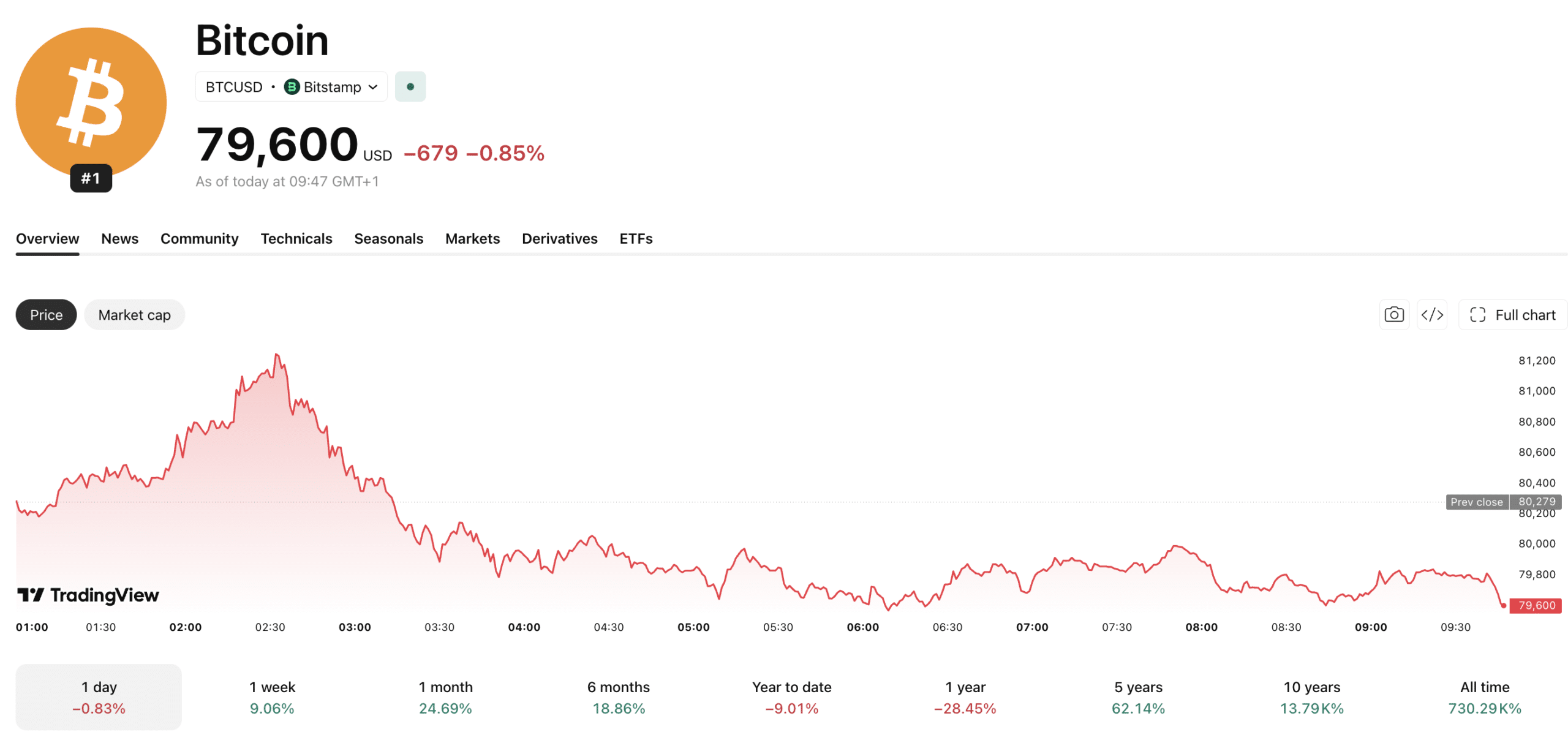
In other Bitcoin news, the confirmed move, BTC from roughly $64,000 to $80,000 in a week, is not in dispute. What happens next splits into three scenarios.
In the bull case, Warsh’s language leaves genuine room for Fed-Treasury coordination, and the rally in bitcoin and gold extends further.
In the base case, a general speech with little concrete guidance leaves the market to reprice expectations on its own, resulting in choppy, directionless trading.
In the bear case, a clear defense of Fed independence or explicit exclusion of Fed participation lifts yields and the dollar and pressures both bitcoin and gold.
None of these outcomes is confirmed yet. For a broader look at how these macro dynamics interact with 2026 price expectations, see this bitcoin price outlook.
EXPLORE: Best Crypto Presales With Asymmetric Upside in the Current Market

Why you can trust 99Bitcoins
Established in 2013, 99Bitcoin’s team members have been crypto experts since Bitcoin’s Early days.
90hr+
Weekly Research
100k+
Monthly readers
50+
Expert contributors
2000+
Crypto Projects Reviewed


Follow 99Bitcoins on your Google News Feed
Get the latest updates, trends, and insights delivered straight to your fingertips. Subscribe now!







Be the first to comment