




Bhutan has denied reports that it sold a major portion of its Bitcoin holdings, as analysts continue to monitor large wallet transfers linked to the country.
The Himalayan nation, which gained global attention for quietly building a large Bitcoin treasury through hydro-powered mining operations, is now facing renewed scrutiny after on-chain data appeared to show a dramatic decline in its holdings.

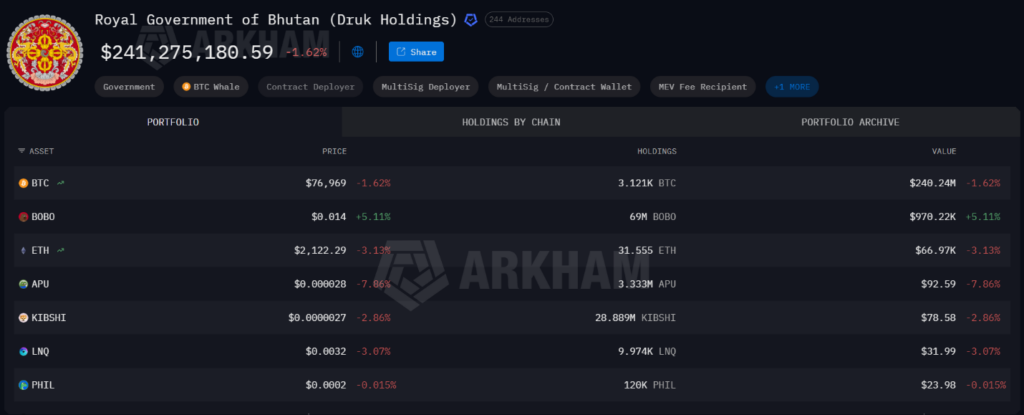
According to blockchain analytics platform Arkham Intelligence, wallets attributed to Bhutan’s sovereign wealth fund, Druk Holding and Investments (DHI), once held nearly 13,000 BTC at their peak in October 2024.
However, the same wallet cluster now reportedly contains just over 3,100 BTC, fueling speculation that the kingdom may have liquidated a large share of its reserves over the past year.
Despite the wallet activity, Bhutanese officials insist no recent Bitcoin sales have taken place.

 
Last week, a representative from DHI stated they could not recall the last time the organization sold Bitcoin.
“I don’t recall the last time we sold any BTC,” DHI CEO Ujjwal Deep Dahal told CoinDesk via email.
Notably, DHI did not dispute that the wallets identified by Arkham belonged to Bhutan, nor did it provide updated figures regarding the country’s remaining Bitcoin holdings. The lack of clarification has only intensified debate within the crypto community about whether the transfers represent outright sales, custody reshuffling, collateral arrangements, or other financial strategies.
Blockchain analysts noted that many outgoing transactions involved wallets associated with centralized exchanges and institutional trading platforms, including OKX and Galaxy Digital. Such movements are commonly interpreted as preparation for selling activity.
Bhutan has repeatedly promoted its Bitcoin mining initiative as a sustainable, environmentally friendly operation powered by excess hydroelectric energy. Unlike many governments that acquire Bitcoin through purchases, Bhutan accumulated its reserves primarily through mining.
The country reportedly operates multiple state-backed mining facilities, with officials emphasizing that operations remain active despite wider industry challenges.
DHI stated that favorable weather conditions this year helped maintain strong hydroelectric output, ensuring uninterrupted mining activity across the kingdom’s infrastructure. Officials also said Bhutan continues upgrading to newer-generation mining equipment to remain competitive in an increasingly difficult industry environment.
The comments came as broader concerns emerged about mining profitability worldwide.
A recent report from digital asset investment firm CoinShares suggested that many Bitcoin mining companies have entered a difficult financial period following the latest halving cycle.
The report indicated that average mining costs for public companies surged significantly in late 2025, while mining revenues weakened due to lower hash price metrics. Analysts described the period as one of the toughest environments miners have faced in recent years, with several firms reportedly operating near or below profitability thresholds.
Against that backdrop, some observers speculated Bhutan may have slowed mining activity or sold reserves to offset operational pressures. Those concerns intensified after analysts noticed a lack of fresh inflows into wallets linked to Bhutan’s mining operations over recent months.
The controversy surrounding Bhutan’s Bitcoin reserves has also raised broader questions about the country’s long-term crypto ambitions.
Late last year, Bhutan announced plans to allocate up to 10,000 BTC toward the development of Gelephu Mindfulness City, a major economic and innovation zone designed to attract international investment.
At the time, the pledge represented one of the largest state-backed Bitcoin commitments globally. However, if Arkham’s estimates regarding Bhutan’s remaining reserves are accurate, the kingdom may no longer hold enough BTC to fulfill that commitment outright.





Be the first to comment