

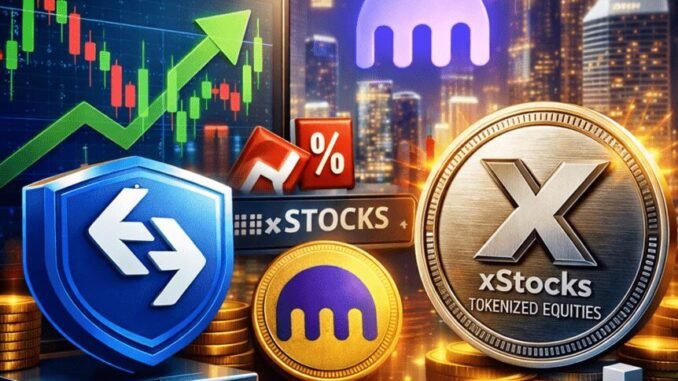

Bitget Wallet has integrated xStocks infrastructure, unlocking access to more than 130 tokenized stocks and ETFs for its 90 million users through its self-custodial wallet platform. The move broadens Bitget Wallet’s tokenized real-world assets portfolio to exceed 300 products, spanning equities, commodities, precious metals and index-linked assets, the company confirmed on Tuesday.
The expanded offering includes tokenized equities with a trading history that Bitget says surpassed $30 billion in transaction volume since launching in 2025. Access to these assets is restricted to jurisdictions where tokenized securities are permitted, with the United States, United Kingdom and other sanctioned regions remaining off-limits.
Bitget Wallet emphasizes zero trading fees and gasless execution, leveraging both request-for-quote (RFQ) and automated-market-maker (AAM) liquidity models. Users trade tokenized assets from the same interface used for cryptocurrency trading, swaps and custody while maintaining control of their private keys and funds.
Behind the scenes, Bitget Wallet is operated by Payward, the parent company of Kraken, which completed the acquisition of Backed Finance in late 2025 to bolster its tokenized equities capabilities.
Key takeaways
- Bitget Wallet expands tokenized assets to more than 300 products by integrating xStocks, opening access to 130+ tokenized stocks and ETFs for its vast user base.
- Tokenized equity products have processed over $30 billion in trading volume since the feature launched in 2025, with geographic restrictions limiting availability in the US, UK and other jurisdictions.
- Trading is offered through RFQ and AAM liquidity models, with zero trading fees and gasless settlement, streamlining participation in tokenized markets.
- Payward’s Kraken now operates Bitget Wallet, following the acquisition of Backed Finance, signaling ongoing consolidation in the tokenized-assets space.
- The broader market for tokenized equities is expanding rapidly, with major exchanges entering or expanding their offerings and data suggesting substantial growth potential in the coming years.
Bitget’s expansion underscores a shifting landscape for tokenized equities
The integration of xStocks into Bitget Wallet marks another milestone in a crowded race to bring real-world assets onto crypto rails. By connecting tokenized equity and other real-world assets directly into a wallet that already supports crypto trading and custody, Bitget aims to reduce the friction typically associated with accessing traditional financial instruments through digital-native interfaces. The stated model—zero fees and gasless execution—lowers the barrier to entry for new users and could accelerate activity in this niche, especially among traders seeking diversified exposure beyond crypto.
From a user experience standpoint, the arrangement promises a unified portal where traders can switch between crypto and tokenized assets without leaving the Bitget ecosystem. The ability to keep private keys in users’ hands while tapping into the liquidity of real-world instruments highlights a core attraction of tokenized assets: custody remains with the user, even as access is broadened via a centralized platform.
Industry observers are also watching how the governance and liquidity frameworks underlying tokenized stocks evolve. Bitget’s use of both RFQ and AAM liquidity models mirrors a broader industry push to balance price discovery with efficient execution, particularly for assets that may have less liquidity than their fiat-backed counterparts. In practice, RFQ can offer price transparency through dealer quotes, while automated market makers provide continuous liquidity at the potential cost of wider spreads during periods of volatility.
Competitive dynamics and the market trajectory for tokenized equities
Bitget’s announcement arrives amid a flurry of activity as major crypto platforms push further into tokenized stocks and stock-linked derivatives. In March, Coinbase launched stock perpetual futures for international users, delivering leveraged, 24/7 exposure to U.S. equities through its derivatives framework. Kraken has expanded its xStocks business with bundles that combine crypto and tokenized stock portfolios, alongside tokenized equity perpetual futures for non-U.S. users. Earlier this year, Binance signaled a renewed interest in tokenized equities after stepping back from its stock-token business in 2021 following regulatory scrutiny in Europe.
Market data from RWA.xyz paints a picture of a still-nascent but accelerating market. The tokenized equities sector has grown to roughly $1.5 billion in represented assets, with prominent tokens tied to companies such as Nvidia, Tesla, Alphabet, and others forming a core part of the landscape. Within this space, Ondo remains the largest tokenized stocks platform by asset value at about $883 million, followed by Bitget’s xStocks at roughly $391.5 million. The dominant assets tracked by RWA.xyz include tokenized versions of company shares and index-linked products such as those tied to the S&P 500, with Strategy and well-known names like Tesla and Nvidia among the frequently cited holdings.
These dynamics illustrate a broader shift as traditional financial infrastructure increasingly overlaps with crypto-native tooling. The presence of major players in tokenized equities signals growing investor appetite for regulated exposure to real-world assets via blockchain rails, while regulatory environments continue to shape where and how these products can be offered. For participants, the takeaway is clear: the bar for access to tokenized equities is gradually lowering, but regulatory clearance and platform risk remain the central considerations for what comes next.
Looking ahead, investors and builders should watch how custody approaches evolve as more platforms integrate tokenized equities into unified wallets, how liquidity models adapt to varying levels of on-chain activity, and how regulators respond to a market that blends traditional securities with decentralized technologies. The coming quarters will reveal whether the current expansion translates into sustained user adoption and meaningful liquidity across a broader spectrum of real-world assets.
As competition intensifies, the key questions for readers are what regulatory clarifications will emerge, how platforms will balance access with compliance, and which tokenized-asset offerings will reach scale first. The trajectory suggests tokenized equities will remain a developing frontier—one that could reshape how both institutions and individual traders approach traditional markets through a crypto-enabled lens.


Be the first to comment