

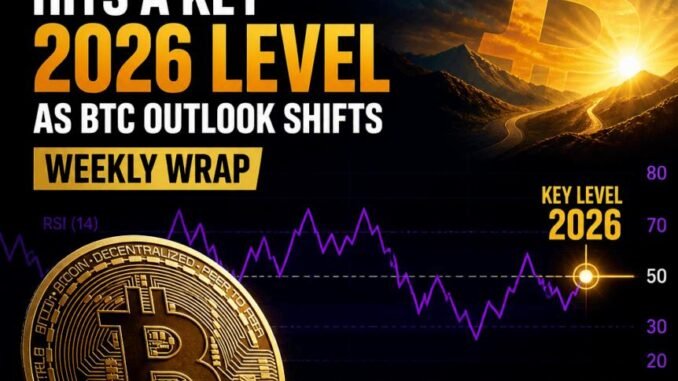

Bitcoin is heading toward the end of June with traders focused on a potential make-or-break area near $60,000—an important level that bulls have struggled to defend as bearish momentum has carried into the second quarter. At the same time, several widely watched momentum and onchain signals are flashing early “stabilization” clues that could complicate the bearish narrative.
Technical traders point to bullish divergences in RSI across multiple time frames, while onchain analytics from CryptoQuant highlights a “first bottoming flag” tied to how broadly Bitcoin’s unspent outputs remain in profit versus loss. Separately, macro traders are preparing for a tight window of economic releases—especially the U.S. manufacturing PMI—and the market’s sensitivity to U.S. labor data and geopolitical developments.
Key takeaways
- RSI divergences are appearing across several time frames in Bitcoin’s charts, an indication that selling pressure may be losing traction.
- June’s performance has been weak—CoinGlass data cited in the report shows nearly a 19% loss for BTC/USD in June, its worst since the 2022 bear market.
- Traders are comparing the current $60,000 test to prior bear-market behavior, arguing that support often breaks only after repeated attempts.
- CryptoQuant says a UTXO profitability indicator is at its lowest level since 2022, suggesting an early stage of internal “market clean-up.”
- Seasonality research cited by traders suggests July has historically been a better month than June in many years, though outcomes can vary.
RSI divergences revive recovery odds as June nears its close
As June approaches its end, analysts and traders are watching whether Bitcoin can hold a key structural level. According to TradingView data cited in earlier coverage, RSI signals across multiple time frames are showing bullish divergences—instances where price behavior and momentum diverge in a way that historically can precede reversals or at least a pause in decline.
Cointelegraph previously reported that RSI cues across time frames are aligning into bullish divergences with price as June ends. The article also referenced a comment from Bitcoin whale “Gerla” (CryptoGerla) on X, saying the four-hour chart is showing a bullish RSI divergence while a potential double bottom forms.

Other traders have emphasized that such divergence signals have not consistently appeared in prior dips during 2026. Pseudonymous commentator “Heisenberg” noted on X that recent oversold RSI divergences had not shown up in the same way during earlier drops—until the current setup—suggesting the present decline may be maturing rather than simply accelerating.
Still, the presence of divergences is not the same as confirmation. The same coverage points out that $60,000 has increasingly acted as resistance, with bulls unable to push through decisively—an issue that keeps traders wary of a breakdown scenario heading into month-end.
Why $60,000 matters: the “mid-2022” support test comparison
One reason traders treat the $60,000 level as more than just a psychological number is historical patterning. In the source reporting, commentators compared the current situation to 2022, when Bitcoin repeatedly interacted with the $30,000 area before it finally failed and later produced a bear-market low.
CoinGlass data cited in the article places Bitcoin’s June drawdown at nearly 19% for BTC/USD—described as the worst since the 2022 bear market and the sharpest performance so far this year. That framing matters because it puts current price weakness into context: the market is not just drifting lower, it is experiencing a month that resembles the intensity of prior major risk-off phases.
On X, commentator “Exitpump” argued that significant support and resistance levels rarely break on the first attempt, often requiring repeated tests before momentum flips decisively. The same post likened the current $60,000 dynamics to the way $30,000 behaved earlier in the 2022 cycle. Importantly, the argument here is conditional: even if June is fragile, it may not be a single-day event that determines the next trend leg.
Macro pressure points: PMI, labor data, and geopolitical risk
Even with technical setups improving, Bitcoin’s short-term direction often depends on what happens in U.S. economic data. The source highlights a “short but busy” four-day trading week ending Q2, with the manufacturing PMI as a potential swing factor.
According to the report, the Institute for Supply Management (ISM) is set to publish the manufacturing Purchasing Managers Index (PMI) on Wednesday. The source notes that the PMI has been breaking out from a multiyear downtrend and that estimates call for a score around the mid-50s, with a possible mild decrease versus the prior month. In prior coverage, Cointelegraph had described PMI strength as a potential tailwind for crypto markets.
Thursday’s June nonfarm payrolls report is another key focus. As trading resource The Kobeissi Letter summarized in a thread on X, the market is also set to react to geopolitical developments as the U.S. and Iran agree to discuss their fragile peace agreement. The same note tied the week’s schedule to the end of Q2, with earnings season on the horizon—factors that can amplify cross-asset volatility.
The report also stresses that Bitcoin’s correlation with equities has been inconsistent in recent months, and it includes an example of trader Daan Crypto Trades pointing to BTC versus the S&P 500 returning to a level seen during earlier risk-stress periods. That matters for investors because it implies the market may not be moving in a straight line with stock indices—meaning both crypto-specific and macro drivers can compete.
Seasonality and “first bottoming flag” signals: early stabilization vs. full reversal
Two separate narratives are being used to explain why July could look different from June. The first is historical seasonality. The source cites research shared by Rekt Capital on X, arguing that in previous years July has often offset June’s weakness—sometimes followed by August weakness that cancels July’s upside. CoinGlass data referenced in the article supports this pattern by showing only a few exceptions since 2013, while 2025 is noted as a case where both months finished green.
The second narrative is onchain. The report highlights a CryptoQuant QuickTake post by contributor I. Moreno, who described an “early clear sign” of deeper market clean-up. Moreno focuses on the UTXO Block P/L Count Ratio Model, an indicator that compares how blocks of unspent outputs are distributed between profit and loss across the network.
In Moreno’s explanation as quoted in the source, a high ratio can indicate many UTXO blocks still sit in profit—often associated with higher distribution risk. When the ratio falls toward lower ranges, profitability compresses, losses spread more widely, and the market enters a more advanced reset phase.
The report states that the ratio is currently 5.9, described as the lowest since 2022 and one of the lowest readings on record, which Moreno called Bitcoin’s “first bottoming flag” of the current bear market. However, the same source cautions that this may only indicate the start of internal reset rather than the completion of a full bottom—history suggests additional stress absorption may still be required.
What this combination of signals implies is not certainty, but a shift in balance: momentum indicators are improving at the same time an onchain metric suggests distribution pressure may be moving into an earlier phase of exhaustion. The unresolved question is whether $60,000 holds long enough for those signs to translate into a sustained reversal.
Going forward, traders and investors should watch month-end price acceptance around $60,000, the immediate reaction to U.S. PMI and labor data, and whether the RSI divergences persist as July starts—alongside onchain follow-through on the “bottoming flag” theme highlighted by CryptoQuant.



Be the first to comment