

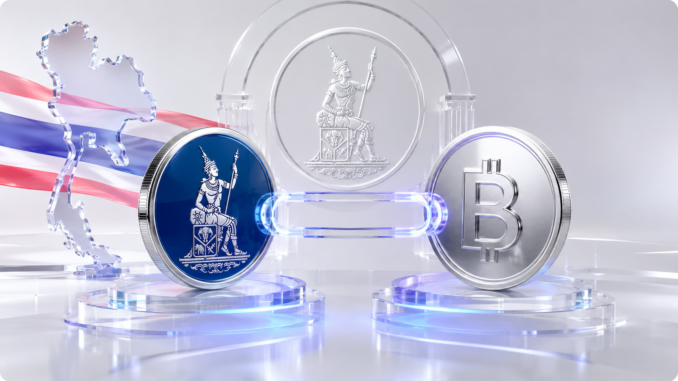
Thailand’s central bank is moving ahead with a 1:1 baht-backed stablecoin plan, with public hearings expected before the end of the year as the country studies a regulated route for digital settlement.
The Bank of Thailand is preparing guidelines for a Thai Baht Stablecoin backed by the national currency at a one-to-one ratio. Governor Vitai Ratanakorn said the central bank plans to open the issue for study and public feedback in the coming months, giving banks and financial institutions a possible path into regulated stablecoin use.
The plan marks a shift from Thailand’s earlier caution toward private baht-pegged tokens. In 2021, the central bank warned that baht-backed stablecoins intended for payments could resemble electronic money and require direct regulatory review before operation. The new work keeps that control inside the official financial system while creating room for a supervised tokenized-baht model.
The Bank of Thailand is not treating the project as an open foreign-currency payment lane. Vitai stressed that domestic payments in Thailand must be made in baht, a point that keeps the proposed stablecoin tied to national-currency settlement rather than dollarized crypto payments.
Banks Could Use The Token For Settlement
The planned token would be backed by Thai baht at a 1:1 ratio and made available for settlement use by banks. Specific retail payment use cases have not been finalized, and the central bank is still reviewing how the token could be used without weakening payment oversight, monetary stability or consumer protection.
That design places the baht stablecoin closer to regulated financial-market infrastructure than an offshore crypto trading token. The central bank’s goal is to keep pace with digital finance while allowing commercial banks and financial institutions to participate in tokenized settlement under official rules.
Thailand is also tightening crypto-transfer controls elsewhere. The country’s securities regulator recently opened comments on crypto Travel Rule requirements, moving wallet transfers, counterparty data and digital asset business operators toward stricter compliance rules.
Those two tracks show Thailand’s current approach to digital assets. Payment innovation can move forward through regulated channels, while open crypto transfers face heavier checks around money laundering, wallet risk and cross-border activity.
Local Stablecoin Push Follows Global Policy Shift
Thailand’s plan comes as central banks and regulators reassess stablecoins through currency sovereignty, payments infrastructure and settlement efficiency. Dollar stablecoins still dominate global crypto liquidity, but more jurisdictions are studying local-currency tokens to keep digital payments tied to domestic money.
That concern has already shaped Europe’s stablecoin debate. The Qivalis euro project gained 37-bank backing as European institutions looked for a regulated euro-denominated counterweight to dollar stablecoin dominance.
The U.S. side of the debate is different. Federal Reserve Governor Christopher Waller recently linked stablecoin growth to Treasury demand, showing how dollar-backed tokens can extend demand for U.S. safe assets when stablecoin reserves are held in cash and short-term government debt.
Thailand’s baht-backed plan moves in the opposite direction: a domestic-currency token designed to keep settlement inside the baht system. The Bank of Thailand is expected to hold public hearings before year-end, with guidelines still under development and bank settlement use under review.



Be the first to comment