

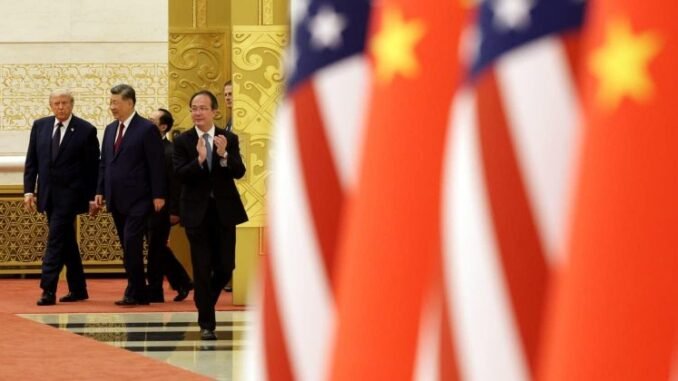

After a meeting between President Trump and President Xi Jinping in Busan, China is signaling tariff reductions and meaningful progress on agricultural market access.
Trump announced that US tariff rates on Chinese imports would drop from 57% to 47%. In return, Xi agreed to resume immediate purchases of US soybeans and boost imports of other agricultural products. The deal also reportedly includes commitments from Beijing to curtail the export of fentanyl precursors to the US.
The contours of a managed-trade deal
The framework both sides are pursuing targets tariff reductions on $30B to $50B worth of non-sensitive goods. That category primarily covers agricultural and energy products.
Here’s the thing about this deal structure: it’s built around numerical purchase targets rather than the structural economic reforms that US negotiators have historically demanded from Beijing.
Trump indicated he may sign the trade agreement soon but left the door open for future renegotiations.
Fentanyl-linked tariffs are expected to be halved or reduced as part of the broader arrangement. Beijing’s commitment to restrict fentanyl precursor exports gives Washington political cover to ease those specific duties.
Why farm market access is the real headline
Xi’s agreement to resume immediate soybean purchases is designed to be a quick, visible win. The promise to increase imports of other agricultural products beyond soybeans broadens the scope.
What this means for crypto and risk assets
The move from 57% to 47% tariffs, while still elevated, represents a directional shift. Technology restrictions, semiconductor export controls, and security concerns around Taiwan remain unresolved. The managed-trade framework deliberately sidesteps these harder issues by focusing on agricultural and energy goods.



Be the first to comment