



Circle and Tether are the leading stablecoin issuers across the globe, providing USDC and USDT, respectively. However, it is Circle that has been making moves toward regulatory clarity faster than Tether.
For instance, USDC became the EU‘s first significant stablecoin under MiCA regulation. In fact, Circle’s revenue for the first half of the year, at $1.40 billion, confirmed its growing adoption.
Circle’s USDC has been dominated by agentic payments, which has contributed to such revenue. Even with that, the protocol is aiming for a larger global reach.
Circle to expand USDC to 40 developing markets
While stablecoin adoption has continued to grow, it has not reached greater levels. As such, CEO Jeremy Allaire of Circle announced they were targeting expansion into 40 developing markets across Latin America, Southeast Asia, Africa, and the Middle East.

In this context, Visa is now moving USDC funding for cross-border payouts from pilot to commercial use across 180 countries.
However, the cost of turning USDC back into local money is unknown. A cheap transfer can still have an expensive last step.
This could widen the gap between USDC and USDT in transaction volume. According to Bernstein reports, it now handles over 60% of adjusted transaction volume in 2026, despite USDT having a bigger cap.
That is, USDC was capped at $72.5 billion, while USDT was at $183 billion, which is more than double. Still, Circle continues to provide stablecoin liquidity, minting $3.75 billion in USDC on Solana over the past 7 days.
Has Circle’s new blockchain helped in the quest?
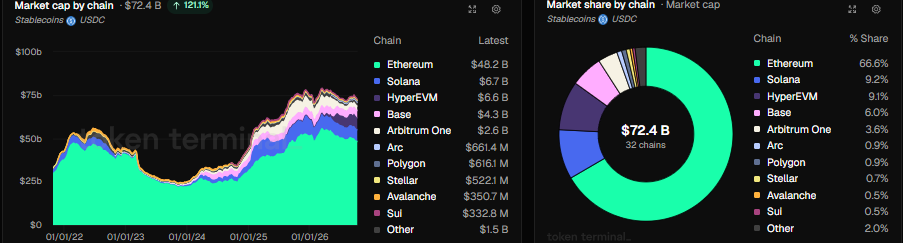
As Circle challenges Tether in stablecoin business dominance, it launched its chain in mid-September under the name Arc. However, the Arc blockchain is still underutilized, accounting for less than 1% of all USDC, equivalent to $661.4 million.
As per Token Terminal, 66.6% of the supply was on Ethereum [ETH], with Solana [SOL], HyperEVM, Base, and Arbitrum One [ARB] following, respectively. This indicates that Arc is yet to play a key role in challenging USDT’s dominance.
It is still worth noting that the DeFi TVL of USDC grew by 6% upon chain launch. Weekly asset senders also increased by 5.4%, reaching 5.5 million as of press time.
However, Circle’s stock CRCL continued to decline in valuation, from $84 to $82.
Final Summary
- Circle’s USDC accounts for 60% of stablecoin transactions, even though USDT has a market cap that is double.
- Despite launching Arc blockchain, most of the USDC circulating supply was sitting on Ethereum and Solana.



Be the first to comment